
Have you seen WTW in a text and felt lost? You are not alone. Many people see these three letters and wonder what they mean. They show up in chats, comments, and captions. Slang changes fast, so it is easy to miss new words.
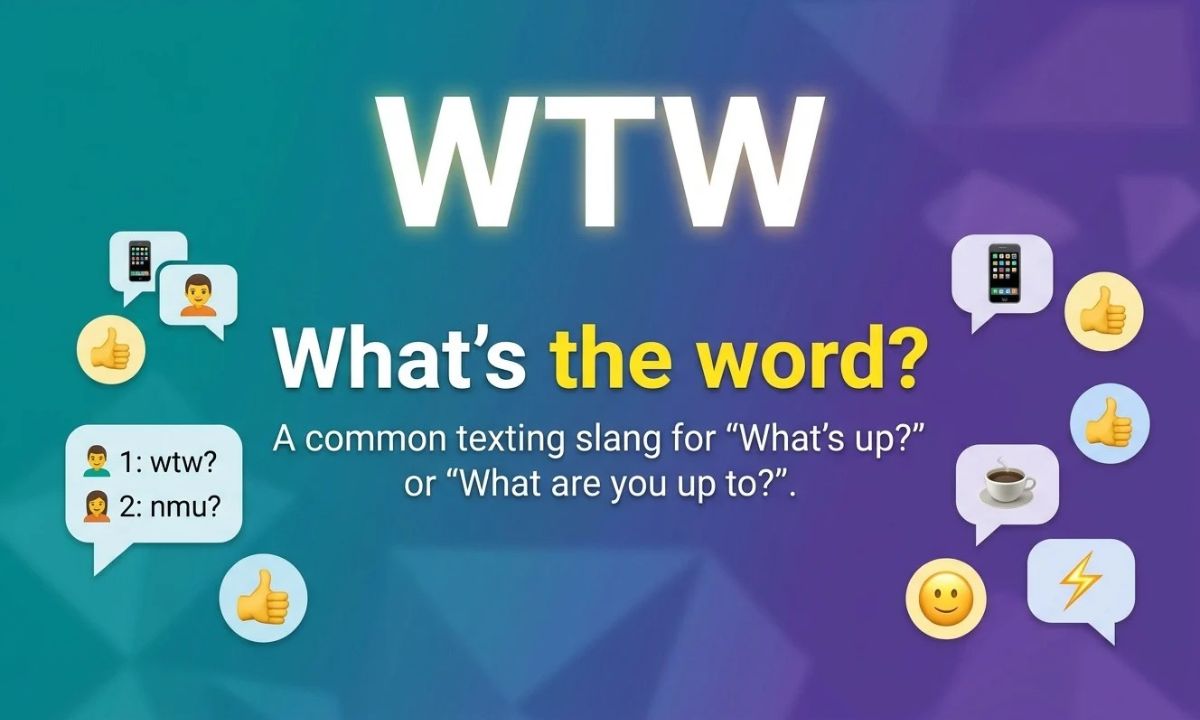
WTW stands for “What’s the word?” It is a casual way to say hello. It works like “What’s up?” or “How are you?” People use it to start a chat with friends. It also asks, “What is going on with you?” Some people write it in lowercase as wtw.
You will mostly see this slang on social media and in text messages. Snapchat, Instagram, and WhatsApp are common places. Young people use it with close friends. It sounds relaxed and friendly, so it does not fit formal emails. In this guide, you will learn the meaning, how to reply, and when to use it.
Pro Tip: Use WTW only with friends, never in work emails. If you are unsure, check the chat tone first. A simple reply like “Nothing much, you?” always works.
What Does WTW Mean in Text, Chat, and Slang?
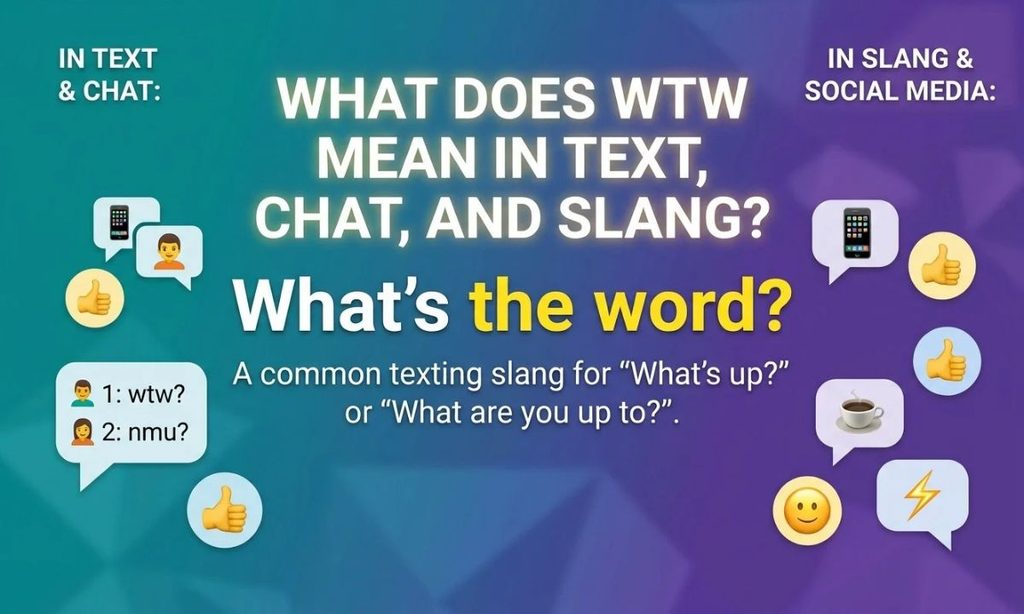
WTW most often means “What’s the word?” or “What’s the wave?” in texting and social media. Both are casual greetings, like saying “What’s up?” or “What’s going on?” Some people also use it to ask what the plan is for the night.
Meaning & Definition Of WTW
WTW is an acronym, which means each letter stands for a word. In online chat, WTW stands for “What’s the word?” The “W” at the end of “wave” gives the second reading, “What’s the wave?”
Both versions do the same job. You send them to a friend to start a talk or to ask what is happening.
Quick Definition Table
| Question | Short Answer |
| What does WTW stand for in text? | What’s the word? / What’s the wave? |
| What does it mean? | What’s up? What’s going on? |
| Is it a greeting? | Yes, mostly |
| Is it formal? | No, it is slang |
| Who uses it most? | Teens and young adults |
| Where is it used? | WhatsApp, Instagram, Snapchat, TikTok, texts |
In one line: WTW is a short, casual way to say “Hey, what’s up?”
Background & Origin Of WTW
Texting has always loved short forms. We had “LOL,” “BRB,” and “OMG” long before WTW. People shorten phrases because typing is slow and chat is fast.
“What’s the word?” is much older than the internet. Friends said it on street corners and on the phone to mean “What’s new?” Texting simply squeezed the phrase into three letters.
“What’s the wave?” came from youth and music culture. In slang, a “wave” is a mood, a vibe, or a plan. If you ask about the wave, you ask what the vibe is tonight. Music scenes, social media, and group chats spread this use very quickly.
Why Did WTW Become Popular?
- Short to type. Three letters beat four words.
- Sounds cool. It feels relaxed and friendly.
- Works for both a greeting and a plan: one phrase, two uses.
- Spread by short videos. Creators use it in captions and comments.
Pro tip: Slang changes fast. If you see WTW and the context seems odd, look at who sent it and what they said before and after.
What Does WTW Mean in Text?
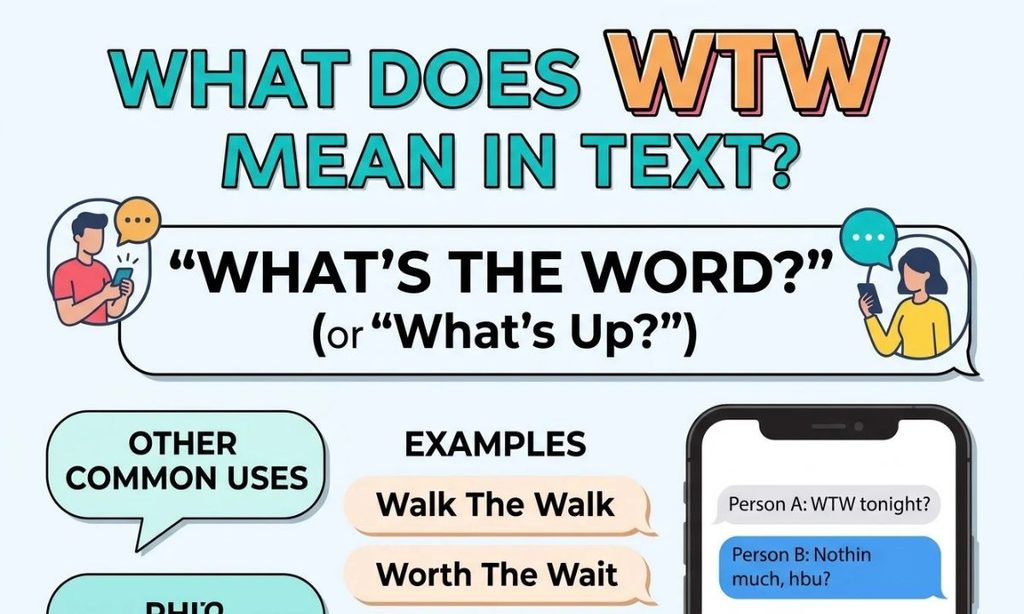
When someone texts you “WTW,” they usually want one of two things:
- A simple hello. They want to chat and see how you are.
- A plan check. They want to know what you are doing or where everyone is going.
Example 1
Friend: Wtw bro
You: Nothing much, just chilling. You?
Example 2
Friend: Wtw tonight?
You: Movie at Sam’s place. Come over.
In the first chat, WTW means “What’s up?” In the second, it means “What’s the plan?” The extra word “tonight” makes the second meaning clear.
Real-life experience: Many people reply to WTW with “nm” or “nm, u?” That short answer is totally normal. Nobody expects a long essay back.
Meaning Of WTW in Chat & Slang
In slang, WTW is a conversation starter. It carries a relaxed mood. Think of it as the text version of a head nod.
Slang Flavors of WTW
| Version | Feels Like | Example |
| What’s the word? | Friendly check-in | “Wtw fam?” |
| What’s the wave? | Asking about the vibe or plan | “Wtw this weekend?” |
| Wtw + name | Personal hello | “Wtw Zain” |
| Wtw? + time | Plan question | “Wtw tonight?” |
You will often see WTW with other slang like “bro,” “fam,” “twin,” or “g.” These words add a close, friendly tone.
Usage Of WTW in Different Contexts
WTW changes slightly with where and how you use it. The meaning stays close to “What’s up?” but the mood shifts.
1. Between Close Friends
This is the most common use. You can send “wtw” with no other words. It says, “I’m thinking of you. Let’s talk.”
2. In Group Chats
Someone drops “wtw everyone?” to wake up a quiet chat. It often leads to plans like a game night or a hangout.
3. In Comments
People write “wtw” under a friend’s photo or video. It works like a casual hello.
4. As a Plan Question
“Wtw Saturday?” means “What are we doing Saturday?” This is a very useful way to use it.
5. In Voice and Real Life
Some people now say it out loud as “W-T-W.” It is less common, but you may hear it.
Pro tip: Always check the extra words around WTW. A time, a place, or a day tells you it is a plan question. A name or “bro” tells you it is a greeting.
Meaning Of WTW in Chat, WhatsApp, Instagram, TikTok
Different apps have a slightly different feel. Here is how WTW looks on the big ones.
WTW on WhatsApp
On WhatsApp, WTW is a quick hello to friends and cousins. It is used in personal and group chats. Because WhatsApp is also used for work, avoid sending it to teachers or bosses.
WTW on Instagram
On Instagram, people reply to stories or send DMs with “wtw.” It often starts a chat after someone posts a photo or a story. In comments, it is a casual way to say hi.
WTW on TikTok
On TikTok, WTW shows up in comments and captions. Creators use it to ask their audience “What’s up?” or “What’s the vibe?” It can also be part of a trend caption.
WTW on Snapchat
Snapchat is very fast and casual. A Snap with the text “wtw” is a simple “Hey, are you free?”
Comparison by Platform
| Platform | Typical Use | Tone |
| Direct hello, plan check | Friendly | |
| DM and story reply | Casual | |
| TikTok | Comments, captions | Playful |
| Snapchat | Quick check-in | Very casual |
| Text/SMS | Hello or plan question | Relaxed |
Meaning Of WTW in Physics, Medical, and Aircraft Terminology
This is where many people get confused. WTW is not a standard, official abbreviation in physics, medicine, or aircraft work. Many websites guess at meanings here, so it is important to be honest.
WTW in Physics
There is no famous physics term with the exact short form WTW. In science class, you may see people write things like “wave-to-wave” to describe one wave moving into the next. That is a plain description, not an official abbreviation. If you see WTW in a physics book, the book will explain it right there.
WTW in Medical Terms
WTW has no widely accepted medical meaning. The closest well-known phrase is “wet-to-dry,” a type of wound dressing, but doctors write it as “wet-to-dry” or “WTD,” not WTW. If you see WTW on a medical form, ask the doctor or nurse what it means. Never guess about health.
WTW in Aircraft Terms
There is no official aviation code that matches WTW. Pilots do use the phrase “wingtip-to-wingtip” to describe planes flying very close together. People sometimes shorten it, but this is informal.
Other Real Uses of WTW
| Field | Meaning | Is It Official? |
| Energy and cars | Well-to-wheel (how much energy a fuel uses from the source to the car) | Yes, widely used |
| Racing | Wheel-to-wheel (cars racing very close) | Common phrase |
| Home and flooring | Wall-to-wall (carpet covering a whole room) | Common phrase |
| Business | Willis Towers Watson (a large advisory company) | Yes, a company name |
Real-life tip: If you see WTW in a work document, a school paper, or a form, do not use the texting meaning. Look at the subject. A car article probably means well-to-wheel. A house listing probably means wall-to-wall.
Common Misconceptions Of WTW
Many people get WTW wrong. Here are the biggest mix-ups.
Misconception 1: “WTW always means ‘What’s the word?’”
Not always. It also means “What’s the wave?” and sometimes other things depending on the topic.
Misconception 2: “WTW is rude”
It is not rude. It is casual and friendly. It only feels out of place in formal settings.
Misconception 3: “WTW is a flirty message”
Not by itself. It is neutral. The tone comes from who sends it and what follows.
Misconception 4: “WTW has a medical or science meaning”
As explained above, there is no standard meaning in those fields.
Misconception 5: “Everyone knows WTW”
Not true. Older people and non-slang users may not understand it. If you are unsure, just ask, “What does that mean?”
Similar Terms & Alternatives
You can say the same thing in many ways. Here are some close options.
Words That Mean the Same as WTW
- WYD – What are you doing?
- WYA – Where are you at?
- WSP / Wassup – What’s up?
- HRU – How are you?
- SUP – What’s up?
- HBU – How about you?
- WDYM – What do you mean? (different use)
Full-Sentence Alternatives
- “What’s up?”
- “What’s going on?”
- “What are you up to?”
- “How are things?”
- “Any plans today?”
Comparison Table
| Term | Meaning | Best Use |
| WTW | What’s the word/wave | Greeting or plan check |
| WYD | What are you doing | Asking about current activity |
| WYA | Where are you at | Asking location |
| HRU | How are you | Asking about feelings |
| WSP | What’s up | General greeting |
Meaning Of WTW in Urban Dictionary
Urban Dictionary is a site where regular people write slang meanings. For WTW, the most common entries say it stands for “What’s the word?” and sometimes “What’s the wave?” Many entries describe it as a friendly, laid-back greeting.
A few things to remember:
- Urban Dictionary entries are written by users, so they can be wrong or jokey.
- Some entries are silly or not safe for kids.
- The top meanings usually match what real people use in chat.
Pro tip: Use Urban Dictionary as a hint, not as a final answer. Always check the chat context.
How to Respond to WTW
Replying is easy. You do not need a perfect answer. Match the energy of the sender.
Simple Replies
- “Nm, you?” (nothing much)
- “Just chilling.”
- “Not much, wbu?”
- “Hey! What’s up with you?”
If It Is a Plan Question
- “We’re going to the park at 6. Come.”
- “No plans yet. Any ideas?”
- “Staying home tonight. You?”
If It Is a Friend You Like
- “Hey! Good to hear from you. How’s your day?”
If You Don’t Understand
- “Sorry, what do you mean?”
- “Haha, what does wtw mean?”
Reply Cheat Sheet
| Situation | Good Reply |
| Casual hello from a friend | “Nm, u?” |
| Plan question | Tell your plan or ask theirs |
| From a crush | Friendly and a bit longer reply |
| From a stranger | Short and careful |
| From a boss or teacher | Polite and clear, “Hello, how can I help?” |
Real-life experience: When I answer slang greetings, a quick, light reply works best. If you write too much, the chat can feel heavy. If you write too little, it can feel cold. Aim for the middle.
What Does WTW Mean From a Girl or Guy?
The meaning is the same no matter who sends it. WTW means “What’s up?” or “What’s the plan?” The difference is in the tone and the relationship.
From a Guy
Guys often use WTW with friends as a quick greeting. It may also be a way to see if you are free to hang out. If a guy you are dating sends it, he may just want to talk.
From a Girl
Girls use WTW in the same way. It is friendly and casual. If she sends it to you alone, she may want to chat or check in.
Is It Flirty?
By itself, no. But these signs can make it flirty:
- It comes late at night.
- It comes with emojis like 😏 or 😊.
- It is sent only to you, not the group.
- It leads into a longer, personal chat.
Pro tip: Do not read too much into three letters. Look at how they treat you in general. Actions and consistent attention tell you more than one text.
Differences from Similar Words
Many short chat words look alike. Here is how WTW is different.
WTW vs WYD
- WTW: Opens a chat or asks about the vibe or plan.
- WYD: Asks what you are doing right now.
WTW vs WSP
- WTW: Slightly more trendy and often asks about a plan.
- WSP: A plain “what’s up.”
WTW vs HRU
- WTW: Casual and quick.
- HRU: Asks how you feel. It is a little more caring.
WTW vs WYA
- WTW: About the word or plan.
- WYA: About your location.
Full Comparison
| Word | Focus | Feels Like |
| WTW | General check-in or plan | Cool, relaxed |
| WYD | Current activity | Direct |
| WYA | Location | Urgent or meet-up |
| HRU | Feelings | Caring |
| WSP | General hello | Simple |
Meaning Of WTW in Gen Z
Gen Z is the group of people born roughly between the late 1990s and early 2010s. They grew up with phones, so their language is short, fast, and playful.
For Gen Z, WTW is:
- A friendly greeting that feels cooler than “Hi.”
- A way to build vibe. The word “wave” fits their love of moods and aesthetics.
- A group-chat starter. It brings energy back into a quiet chat.
- A sign of belonging. Using the same slang makes people feel close.
Why Gen Z Likes Short Slang
- Speed. They type fast and move on.
- Identity. Slang shows they are part of a group.
- Fun. Language is a game.
- Social media. Trends spread in hours.
Real-life note: Slang can be gone in a year. If you are not Gen Z, you do not have to use WTW. Just understand it. Trying too hard can feel awkward.
Is WTW a Casual or Formal Expression?
WTW is casual. It is not for formal writing.
Where It Is Fine
- Texts with friends
- Group chats
- Social media comments
- Casual DMs
Where to Avoid It
- School essays
- Emails to teachers
- Job applications
- Business messages
- Official letters
Formal vs Casual Table
| Situation | Use WTW? | Better Choice |
| Friend chat | Yes | WTW is fine |
| Teacher email | No | “Hello, I hope you are well.” |
| Job message | No | “Good morning, how are you?” |
| Instagram comment | Yes | WTW is fine |
| Report or essay | No | Use full words |
Pro tip: A good rule is to match the person’s style. If they write casually, you can too. If they write formally, stay formal.
Relevance in Online Conversations & Dating Apps
WTW is very useful in online chat because it is quick, friendly, and low pressure.
In Online Conversations
- It breaks the ice with someone you know.
- It restarts a slow chat.
- It keeps things light without needing a big message.
On Dating Apps
On dating apps, people use many short openers. WTW may show up in chats that have already started, or in messages between people who already match.
Good points:
- It feels relaxed and easy.
- It does not need a long answer.
Weak points:
- It is low effort. It does not show much about the sender.
- It may feel boring or unclear as a first message.
- It can make a person seem not very interested.
Better Openers on Dating Apps
Instead of only “wtw,” try:
- “Hey! I saw you like hiking. Any favorite trails?”
- “Your photo from the beach looks fun. Where was it?”
- “Hi! What’s the best part of your week so far?”
These are warmer and start a real chat.
Safety Tips for Online Chats
- Do not share private details with someone you just met.
- Do not send money or personal photos.
- Be careful if a stranger pushes to move to a private app fast.
- Trust your feelings. If it feels wrong, stop chatting.
Quick Dating Chat Table
| Message | Effort Level | Likely Result |
| “wtw” | Low | May get a short reply |
| “Hey, how’s your day?” | Medium | Friendly reply |
| A question about their interests | High | Better chat |
Practical Tips for Using WTW the Right Way
Here is a short list you can use right now.
- Know your audience. Use WTW with friends, not with teachers or bosses.
- Add context. Write “wtw tonight?” so people understand the plan.
- Keep it light. WTW is for easy, relaxed talk.
- Match their reply. If they answer briefly, do the same.
- Check the topic. In a car or home article, WTW may mean something else.
- Ask when unsure. A simple “what does that mean?” is fine.
Quick Summary Table of WTW Meanings
| Meaning | Where You See It | Official? |
| What’s the word? | Text, chat, social media | Slang |
| What’s the wave? | Text, chat, social media | Slang |
| Well-to-wheel | Energy and cars | Yes |
| Wheel-to-wheel | Racing | Common phrase |
| Wall-to-wall | Flooring and homes | Common phrase |
| Willis Towers Watson | Business | Company name |
Final Words
Now you know the meaning of WTW in text. It stands for “What’s the word?” and works like a casual hello. People use it in chats, comments, and social media posts. It is short, fun, and easy to remember. Once you learn it, you will spot it everywhere.
Using slang the right way matters. WTW fits best with friends and people your age. Keep it away from work emails and formal messages. Always think about who you are talking to. A good match of words and tone makes your chat feel natural.
Replying is simple. You can say “Nothing much, you?” or “Just chilling.” You can also share what you are doing right now. If you do not know a slang word, ask a friend or check this guide. Language keeps changing, so stay curious. Keep learning new text slang, and you will never feel lost in a chat again.
FAQs
What does WTW mean in slang?
In slang, WTW means “What’s the word?” It is a casual way to say hello. It asks, “What is up with you?”
What to say to WTW in text?
Keep your reply short and casual. You can say “Nothing much, you?” or “Just chilling.” Then ask them back to keep the chat going.
What does WTW stand for?
WTW stands for “What’s the word?” Some people also use it to mean “What’s the vibe?” It is a friendly greeting between friends.
What does WTW mean in Gen Z?
Gen Z uses WTW as a quick hello or check-in. It means “What’s going on?” You will see it often in DMs, comments, and stories.
What is WTW in Snapchat?
On Snapchat, WTW is a short way to ask, “What’s the word?” People send it as a snap or chat message. It starts a conversation with a friend.
What does “WTW” stand for in chat?
In chat, WTW stands for “What’s the word?” It means “What are you up to?” Use it with close friends and keep it light.
What does WTW tonight mean?
WTW tonight means “What’s the word tonight?” It asks about your plans for the evening. It is like saying, “What are we doing tonight?”
What does WTC mean from a girl?
When a girl sends WTC, it usually means “Want to chill?” She is asking if you want to hang out. Check the chat tone first, because the meaning can change with context.

Hi, I’m Shahid, a passionate content writer and blogger dedicated to creating easy-to-understand, well-researched, and SEO-friendly content. I specialize in explaining the meanings of words, phrases, names, internet slang, symbols, and everyday expressions in a simple and engaging way.