
Have you ever seen “JFC” in a text and felt confused? You are not alone. This short term shows up a lot in chats, tweets, and comments. People use it when they feel shocked, annoyed, or surprised. Once you learn what it means, you will spot it everywhere.
JFC is an abbreviation. It stands for “Jesus F***ing Christ.” People use it as a strong exclamation. It shows big emotion, like shock or frustration. It is similar to saying “oh my god,” but much stronger and more casual.
This slang term did not start on social media. It grew from older spoken phrases. People have used similar expressions for many years. Texting and online chats just made it shorter and faster to type. Now it fits perfectly into quick, casual conversations.
You will see JFC used in many ways today. Some people use it to react to bad news. Others use it as a joke among friends. It also shows up in memes, tweets, and group chats. Knowing its meaning helps you understand tone in online talk.
What Does JFC Mean?
JFC is a short slang term. People type it fast, without thinking twice. It carries a lot of emotion in just three letters. Most people use it to react to something big, bad, or surprising.
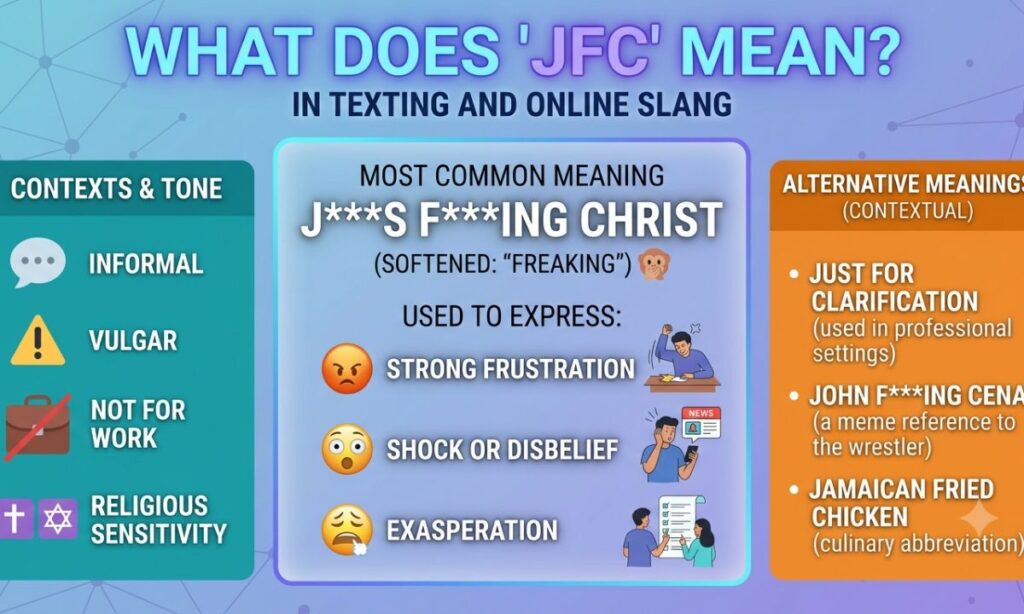
JFC stands for “Jesus F***ing Christ.” It is a strong exclamation. People say it when they feel shocked, angry, or annoyed. It works like a swear word mixed with a religious phrase. That mix makes it powerful, but also a bit risky to use.
Some websites soften the meaning and say JFC stands for “Jesus Freaking Christ.” This softer version is common too. People use it when they want the same punch, but without the harsh curse word. Both versions mean the same basic thing: a burst of strong feeling.
You will find JFC on Twitter, Instagram, TikTok, Snapchat, and in group chats. It shows up in memes. It shows up in comments under funny videos. It shows up when a friend tells you shocking news. This guide explains every part of JFC in simple words.
JFC did not appear overnight. It grew out of an older spoken phrase that people have used out loud for many decades. Long before texting existed, people shouted similar words when something went wrong or something shocked them.
Online forums picked up the phrase in the early days of the internet and shortened it into an easy-to-type acronym. From there, texting apps and social media helped it spread across the world.
Today, JFC is one of many short reaction terms that make digital chatting faster. It sits in the same family as words like LOL, OMG, and WTF. Each one packs a big feeling into a tiny amount of typing.
Example Uses:
Here are some easy examples. Each one shows JFC in a real chat setting.
- “JFC, I just saw the electric bill this month.”
- “JFC, did you see what happened on the news?”
- “JFC, that exam was so hard.”
- “JFC, my dog just ate my homework, literally.”
- “JFC, this traffic is not moving at all.”
Notice how JFC sits at the start of the sentence. This is the most common spot for it. It works like a shout before the real message begins. It grabs attention right away.
JFC can also stand alone as a full reaction. Someone can text just “JFC” with nothing else. The other person will understand right away that something shocking or annoying just happened.
JFC also works well at the end of a sentence, not just the start. A person might write, “They cancelled the trip, JFC.” This puts the emotional weight at the very end, almost like a sigh after the bad news lands. Both positions are common, and neither one is wrong.
Sometimes people repeat the letters or stretch them out for extra effect, like “JFCCCC” or “jfcccc.” This small change shows even bigger frustration or shock than a normal “JFC.”
It works the same way as writing “nooooo” instead of “no.” The extra letters carry extra emotion, even though the word itself does not change meaning.
Punctuation also changes the feeling of JFC. A single exclamation mark, like “JFC!”, feels sharp and sudden. Three exclamation marks, like “JFC!!!”, feel louder and more dramatic.
A period after JFC, like “JFC.”, can feel flat, tired, or defeated, almost like the person has given up on being surprised anymore.
What Does JFC Stand for in Chat and Texting?
In texting and chat apps, JFC almost always means the same thing. It stands for “Jesus F***ing Christ” or the softer “Jesus Freaking Christ.” People use it as a quick way to show a strong emotional reaction.
Texting moves fast. Nobody wants to type a full sentence when three letters can do the job. JFC saves time and still carries a big emotional punch. That is the whole point of chat slang.
In digital chats, JFC works as an interjection. An interjection is a word or phrase that shows sudden feeling. Words like “wow,” “ouch,” and “ugh” are also interjections. JFC just happens to be a stronger, more grown-up version.
Common Chat Situations:
Below is a simple table showing where JFC shows up most and what it usually means in that spot.
| Chat Situation | What JFC Usually Means |
| Friend shares bad news | Shock or sympathy |
| Someone shares a funny fail video | Disbelief mixed with humor |
| A long, annoying wait (traffic, lines) | Frustration |
| A shocking plot twist in a show | Surprise |
| A mistake or accident happens | Frustration or worry |
| Someone posts a wild fact | Amazement |
In each case, JFC does the same basic job. It tells the other person, “I feel something strong right now.” The exact feeling depends on the words around it and the tone of the chat.
People also use JFC in gaming chats. A player might type JFC after strangely losing a match. It shows frustration without needing a long complaint.
JFC also appears often in group chats when someone shares a screenshot of a strange text, a weird receipt, or an awkward email. The person sharing it does not need to explain the whole story.
They just add “JFC” above the screenshot, and everyone in the chat instantly understands the tone before they even read the details.
Another common spot for JFC is customer service complaints shared online. When someone posts about a bad experience at a store or with a delivery, the comment section often fills with short replies like “JFC, that is so unfair” or “JFC, companies really do not care anymore.”
This shows how the word helps strangers bond quickly over shared frustration, even without knowing each other.
Is JFC a Bad Word or Offensive Slang Meaning?
This is one of the biggest questions people ask about JFC. The short answer is: it can be offensive to some people, but not to everyone. It depends on the setting, the audience, and personal beliefs.
JFC contains two things that can bother people. First, it uses the name “Jesus,” which is a holy name in Christianity. Second, it often includes a curse word hidden inside the letters. Together, these two parts can feel disrespectful to religious readers.
At the same time, many people use JFC without thinking about religion at all. For them, it is just a slang reaction, like saying “wow” or “no way.” The word has become so common online that its original religious weight feels smaller to younger users.
When It May Be Considered Offensive:
- Around people with strong religious beliefs
- In formal writing, like school essays or work emails
- When talking to teachers, bosses, or elders
- In public posts meant for a wide, mixed audience
- When texting someone you do not know well
When It Is Usually Accepted:
- In private chats with close friends
- In casual social media comments
- In meme captions and reaction posts
- In gaming chats with teammates
- Among peers who already use similar slang
Here is a simple table to compare these two situations side by side.
| Setting | Is JFC Okay to Use? |
| Texting your best friend | Usually fine |
| Posting on a public work account | Not fine |
| Commenting on a meme page | Usually fine |
| Messaging a teacher | Not fine |
| Chatting in a private gaming group | Usually fine |
| Writing a school assignment | Not fine |
The safest rule is simple: think before you type. If you are not sure how someone will react, choose a milder word instead.
Age also plays a big part in how people react to JFC. Older generations often grew up hearing the full phrase used only in serious, angry moments. Because of that, many older readers still connect it to real anger or disrespect.
Younger generations, who see the acronym everywhere online, often view it as a lighter, almost harmless reaction word. This age gap explains why the same three letters can feel shocking to a parent and completely normal to a teenager.
Cultural background matters too. In countries and communities where religious language is treated with extra care, JFC can feel much more offensive than in places where casual swearing is common in everyday talk.
Before using JFC with someone from a different background, it helps to think about how they generally feel about religious references and strong language in general conversation.
JFC Meaning on TikTok and Snapchat
JFC did not start on TikTok or Snapchat. It has been around since the early days of internet forums. But these two apps have helped the term stay alive and spread even faster among younger users.
On TikTok:
On TikTok, JFC often appears in comments under shocking, funny, or unbelievable videos. Someone posts a wild clip, and the comment section fills up with short reactions like “JFC” or “JFC 💀.”
It also shows up in video captions. A creator might post a clip of something going wrong and caption it “JFC, not again.” This tells viewers the tone of the video before they even watch it.
TikTok users also pair JFC with emojis to add more feeling. A skull emoji, a crying-laughing emoji, or a shocked-face emoji often follows the letters. This combo makes the reaction feel even bigger.
On Snapchat:
On Snapchat, JFC shows up more in private chats than public posts. Since Snapchat is mostly used for close friends, people feel more comfortable using strong slang there.
Someone might send a Snap of a messy room, and the friend replies “JFC 😭.” It works as a quick, private reaction between two people who already know each other well.
Snapchat chats disappear quickly, which makes users feel freer to use casual, even edgy, language. This is one reason JFC feels right at home on the app.
Both apps also encourage very quick replies, since videos and Snaps move fast and disappear or scroll away. There is rarely time to type a long, thoughtful comment. A short word like JFC fits perfectly into this fast-paced style, letting users react in under two seconds without breaking the flow of scrolling or chatting.
On TikTok especially, sounds and trends often shape how JFC gets used. A viral audio clip built around shock or surprise can trigger a wave of “JFC” comments across hundreds of videos that use the same sound.
This shows how slang on TikTok spreads not just through words, but through trends, sounds, and shared jokes across the whole platform.
JFC Abbreviation Meaning in Gen Z Slang
Gen Z did not invent JFC, but they have helped keep it popular. For this generation, short reaction terms are a normal part of daily communication. JFC fits right into that pattern, next to terms like “lowkey,” “no cap,” and “bruh.”
Gen Z often uses JFC in a less serious way than older generations might expect. It is less about real anger and more about dramatic effect. A funny fail, a silly mistake, or an over-the-top story can all get a “JFC” response, even when nobody is truly upset.
This shift is common in slang history. A word starts strong and serious. Over time, as more people use it casually, its emotional weight softens a little. JFC has followed this same path online.
Gen Z also mixes JFC with other slang in the same sentence. You might see something like:
- “JFC, that’s actually wild.”
- “JFC bro, no cap.”
- “JFC, I’m dead 💀.”
This mixing shows how JFC has become just one tool in a much bigger slang toolbox. It sits next to dozens of other short reaction words that Gen Z uses every day.
Gen Z also tends to use JFC with a strong sense of humor, even in situations that sound negative. A missed bus, a spilled drink, or a silly typo can all earn a joking “JFC” response. This playful use is different from older, more serious uses of the same phrase, where it usually only came out during real anger or real shock.
Because Gen Z grew up fully online, they are used to seeing strong language softened by memes, emojis, and jokes. A curse-based term like JFC feels less heavy when it is surrounded by laughing emojis and silly captions.
This constant softening is part of why JFC feels so normal in casual Gen Z conversations, even though the full phrase behind it remains fairly strong.
JFC Meaning in WhatsApp Chat Conversations
WhatsApp is one of the most popular chat apps in the world. Many people use it daily to talk with family, friends, and coworkers. JFC shows up here too, but usage depends a lot on who is in the conversation.
In WhatsApp groups with close friends, JFC feels normal and light. In family groups, especially ones with parents or grandparents, it can feel out of place or even rude. Many users switch their language style depending on which WhatsApp group they are texting in.
WhatsApp Usage Examples:
- Friend group chat: “JFC, did you see the price of petrol today?”
- Work-related chat: Better to avoid JFC completely.
- Sibling chat: “JFC, mom is going to be so mad.”
- College group project chat: Depends on how close the group is.
- Family elders chat: Best to avoid JFC here too.
A simple way to decide is to look at how the group already talks. If curse words and slang already appear often, JFC will likely fit right in. If the group stays polite and formal, it is safer to skip it.
WhatsApp is also used heavily for voice notes, not just typed messages. Some people say the full phrase out loud in a voice note instead of typing “JFC.” This spoken version can feel even stronger than the typed acronym, since tone of voice adds extra emotion that text alone cannot show.
It is worth remembering that a joke in text can sound much more serious once it is spoken aloud.
Because WhatsApp connects so many different types of relationships, from close friends to distant relatives to coworkers, it is one of the trickiest apps for deciding whether JFC fits.
A good habit is to match your language to the most careful person in that specific group, rather than the most casual one. This keeps the whole conversation comfortable for everyone involved.
Difference Between JFC and OMG Slang Meaning
JFC and OMG often get used in similar situations. Both react to shocking news. But they are not the same, and knowing the difference helps you pick the right one.
JFC:
- Stands for a phrase containing a curse word
- Feels stronger and more intense
- Common among older teens and adults
- Better for close friends, not public or formal chats
- Can feel offensive to religious readers
OMG:
- Stands for “Oh My God” or “Oh My Gosh”
- Feels lighter and softer
- Used by almost every age group
- Safe for most casual settings, even mixed company
- Still mentions “God,” but is far more accepted overall
Here is a comparison table to make the difference crystal clear.
| Feature | JFC | OMG |
| Full Meaning | Jesus F***ing Christ | Oh My God / Gosh |
| Contains a curse word | Yes | No |
| Common age group | Older teens, adults | All ages |
| Safe for formal chats | No | Mostly yes |
| Emotional strength | Very strong | Moderate |
| Best used with | Close friends | Almost anyone |
Think of OMG as the everyday version and JFC as the extra-strong version. If you are unsure which one to use, OMG is almost always the safer pick.
There are other similar reaction words worth knowing too, such as “WTF,” “SMH,” and “FFS.” Each one carries its own level of strength. WTF often shows confusion mixed with shock. SMH shows disappointment without much shock at all.
FFS leans closer to JFC in strength, since it also hides a curse word inside its letters. Knowing these differences helps you pick the exact right tone for any message.
A simple way to remember the strength order is to picture a scale, from calm to intense. On the mild end sit words like “wow” and “no way.” In the middle sits OMG, which almost everyone accepts. Near the strong end sit WTF and FFS.
At the very top of the intensity scale sits JFC, ready for only the biggest reactions and the closest audiences.
Why Do People Say JFC in Online Arguments?
Online arguments move fast and get heated quickly. In the middle of a debate, people often reach for short, punchy words instead of long sentences. JFC fits perfectly into this kind of fast, emotional typing.
People use JFC in arguments for a few clear reasons:
- To show disbelief – They cannot believe what the other person just said.
- To express frustration – They feel tired of repeating themselves.
- To add drama – A short, strong word comments stand out.
- To end a point sharply – JFC often works as a mic-drop word before walking away from a chat.
For example, in a comment thread, someone might write: “JFC, read the whole post before replying.” This shows annoyance without writing a long angry paragraph.
JFC also spreads fast in arguments because other readers copy the tone. Once one person uses strong slang, others in the same thread often follow. This is a normal pattern in fast-moving online discussions.
It is worth noting that using JFC in an argument can also raise the temperature of a conversation. Because it contains a curse word, it can make a disagreement feel more heated than it needs to be. Choosing calmer words often leads to better, more respectful conversations.
JFC Meaning in Memes and Internet Culture
Memes love short, punchy reactions, and JFC fits that style perfectly. A single meme image paired with the caption “JFC” can say more than a full paragraph of text.
Meme Contexts:
- Reaction memes: A shocked face paired with “JFC” as the caption.
- Fail compilations: Videos of accidents or mistakes often get “JFC” comments.
- Relatable memes: Posts about daily struggles, like bills or Mondays, often use JFC to add humor.
- Political or news memes: JFC sometimes appears as a reaction to big headlines, though this can feel more serious than funny.
- Gaming memes: Screenshots of unfair game moments often carry a “JFC” caption.
Meme culture tends to strip some of the seriousness out of JFC. When it appears next to a funny cat picture or a silly fail video, it feels playful rather than harsh. This is part of why the term feels so normal to many internet users today.
Meme pages also help spread new spellings and versions of JFC, like “jfc” in lowercase, or stretched versions like “jffcccc” for extra comedic effect. Internet culture constantly reshapes slang in small, creative ways like this.
JFC Meaning – Urban Dictionary Explanation
Urban Dictionary is a website where users submit their own definitions for slang words. JFC has many entries there, written by different people over the years.
Most Urban Dictionary entries agree on the core meaning: JFC stands for “Jesus F***ing Christ,” used as an exclamation of shock, anger, or disbelief. This matches what most other slang dictionaries and everyday chat also show.
Some entries also mention playful, alternate meanings that people invented as jokes. These are not the main meaning, but they show how flexible internet slang can be.
A few joking examples people have shared online include using JFC for silly phrases unrelated to the original meaning, just for fun in specific friend groups.
It helps to remember that Urban Dictionary is written by everyday internet users, not language experts. This means definitions can vary in tone, and some entries may be more extreme or joking than others.
The core, most common meaning remains the same across nearly all of them: a strong exclamation of shock or frustration.
Alternative Meaning of JFC (Business Context)
Not every JFC online has anything to do with slang. In business and formal writing, JFC can stand for completely different things. Context always decides the real meaning.
Here are a few real, non-slang meanings of JFC used in professional or organizational settings:
| Alternative Meaning | Field/Context |
| Joint Forces Command | Military organizations |
| Japan Football Club | Sports naming conventions |
| Jones Financial Corporation (example naming pattern) | Business and finance company names |
| Junior Football Club | Youth sports leagues |
| Joint Fact-finding Committee | Government or legal groups |
If you see “JFC” in a news article, business report, or official document, it rarely means the slang version. Formal writers avoid slang in serious documents, so the letters likely stand for an organization or committee name instead.
This is why context matters so much with abbreviations. The same three letters can mean a casual text reaction in one place and a formal military term in another.
When Should You Avoid Using JFC?
Even though JFC is common online, it is not the right choice for every situation. Knowing when to hold back is just as important as knowing what the term means.
Avoid using JFC in these situations:
- School assignments and essays – Formal writing should stay professional and free of slang or curse words.
- Work emails and messages – Even casual workplaces usually expect polite, clear language in writing.
- Conversations with religious family members – Some people find the term deeply disrespectful.
- Public social media posts meant for a wide audience – You cannot control who reads a public post, so it is safer to stay neutral.
- Talking with young children – JFC carries a hidden curse word that is not appropriate for kids.
- First-time conversations with new people – You do not yet know how they will react to strong language.
A simple habit can help here: pause before sending. Ask yourself who will read the message and how they might feel about it. If there is any doubt, choose a softer word like “wow,” “no way,” or “OMG” instead.
Being mindful about slang does not mean you cannot use it at all. It simply means using it in the right place, with the right people, at the right time.
FINAL WORDS
JFC is a simple text term with a strong meaning. It stands for “Jesus F***ing Christ.” People use it to show shock, anger, or surprise. It fits well in casual chats and social media posts. Now you know exactly what it means when you see it.
This term is common, but it is not always polite. It works well with friends who use casual language. It may not be a good choice for work chats or formal messages. Always think about who you are talking to before you use it.
Slang like JFC keeps changing with time. New phrases pop up every year in texting culture. Staying updated helps you understand online conversations better. Now you can read and use JFC with full confidence. Keep learning new terms to stay sharp in digital chats.
Frequently Asked Questions
What does JFC mean in text?
JFC stands for “Jesus F***ing Christ” (or the softer “Jesus Freaking Christ”). People use it to show shock, frustration, or disbelief in a chat. It works like a stronger version of “oh my god.”
Is JFC offensive?
JFC can offend people because it mixes a religious name with a curse word. It is usually fine among close friends but risky with strangers, elders, or religious readers. Always think about your audience before using it.
What is the difference between JFC and OMG?
JFC contains a curse word and feels much stronger than OMG. OMG stands for “Oh My God” and is accepted by almost every age group. JFC is best kept for casual chats with close friends.
When did JFC become popular?
JFC has roots in online forums from the early 1990s and grew fast with the rise of texting and social media in the 2010s. It became especially common as short reaction slang spread across Twitter and other apps. Today it is a normal part of casual online chat.
Can JFC mean something else?
Yes, outside of slang, JFC can stand for things like Joint Forces Command or Junior Football Club. In business or formal writing, it almost never means the slang version. Context always decides the real meaning.
Is JFC used on TikTok?
Yes, JFC shows up often in TikTok comments under shocking or funny videos. It is usually paired with emojis to add extra emotion. It also appears in captions to set the tone before a viewer watches the clip.
Should I use JFC at work?
No, JFC is not appropriate for work emails or professional messages. It can look unprofessional and disrespectful in a formal setting. Save it for casual chats outside of work.
What does “Jesus Freaking Christ” mean versus JFC?
“Jesus Freaking Christ” is a softer version of the same phrase, swapping out the curse word for “freaking.” JFC can stand for either version depending on who is using it. Both carry the same basic feeling of shock or frustration.
Is JFC a Gen Z term?
JFC did not start with Gen Z, but this generation uses it often and casually. They tend to use it more for humor than real anger. It sits alongside other slang like “no cap” and “lowkey” in everyday Gen Z texting.
What platforms use JFC the most?
JFC is common on Twitter, Instagram, TikTok, Snapchat, and WhatsApp chats with friends. It shows up most in comments, captions, and private group chats. It is far less common on formal platforms like LinkedIn or work email.

Hi, I’m Shahid, a passionate content writer and blogger dedicated to creating easy-to-understand, well-researched, and SEO-friendly content. I specialize in explaining the meanings of words, phrases, names, internet slang, symbols, and everyday expressions in a simple and engaging way.