
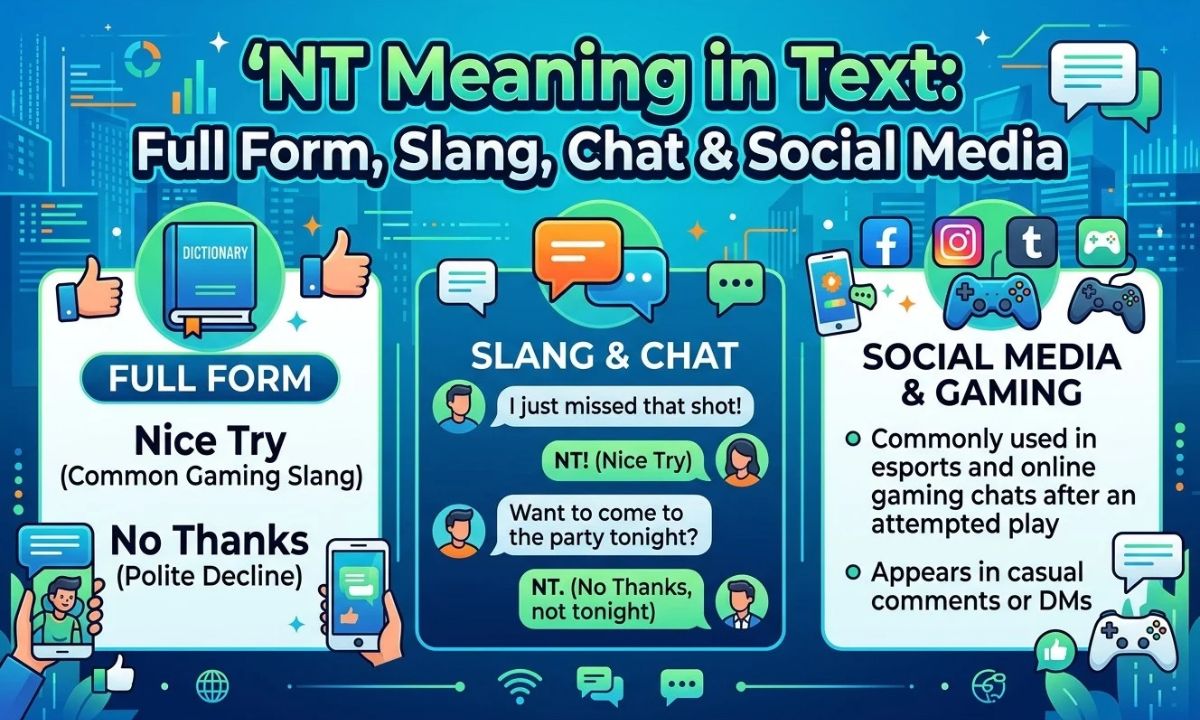
Have you ever seen NT in a text and wondered what it means? You are not alone. Many people see it in chats, games, and comments every day. It looks small, but it can change the whole tone of a message. Let’s clear it up in simple words.
In most cases, NT means “Nice Try.” People use it when someone tries something and does not win. It can be a kind cheer, like “good effort, buddy.” It can also be a playful tease between friends. The meaning depends on the tone and the person sending it.
NT can also stand for “No Thanks” in quick chats. In some groups, it may even mean “No Text.” That is why context matters so much. Look at the topic, the app, and the mood of the chat. This guide will show you the full form, slang use, and how to reply on social media.
Pro Tip: Always check the context before you reply to NT. If it follows a game or a joke, it almost always means “nice try.” If you are unsure, just ask, “Do you mean nice try?”
What Does NT Mean in Text?
NT most often means “nice try” in text messages, gaming chats, and social media comments. People use it when someone attempts something and does not quite succeed. It can also mean “no thanks” when someone turns down an offer.
So the short answer is this: NT = nice try (most common) or no thanks (second most common).
The tricky part is that two letters can carry very different feelings. Sometimes NT is warm and kind. Sometimes it is playful teasing. Sometimes it is a polite refusal. The meaning depends on the situation, and this guide will show you how to read it correctly every time.
Here is a quick summary before we go deeper:
| Abbreviation | Meaning | Where You See It | Feeling |
| NT | Nice try | Games, group chats, comments | Friendly, playful, or teasing |
| NT | No thanks | Replies to offers or invitations | Polite, short, firm |
| NT | Nice trade | Trading games and card games | Positive |
| NT | Not tonight | Dating or plan-making chats | Casual refusal |
Pro tip: If you are stuck, look at what was said just before the NT. That one message usually answers the question.
NT Meaning in Text Slang & Chat
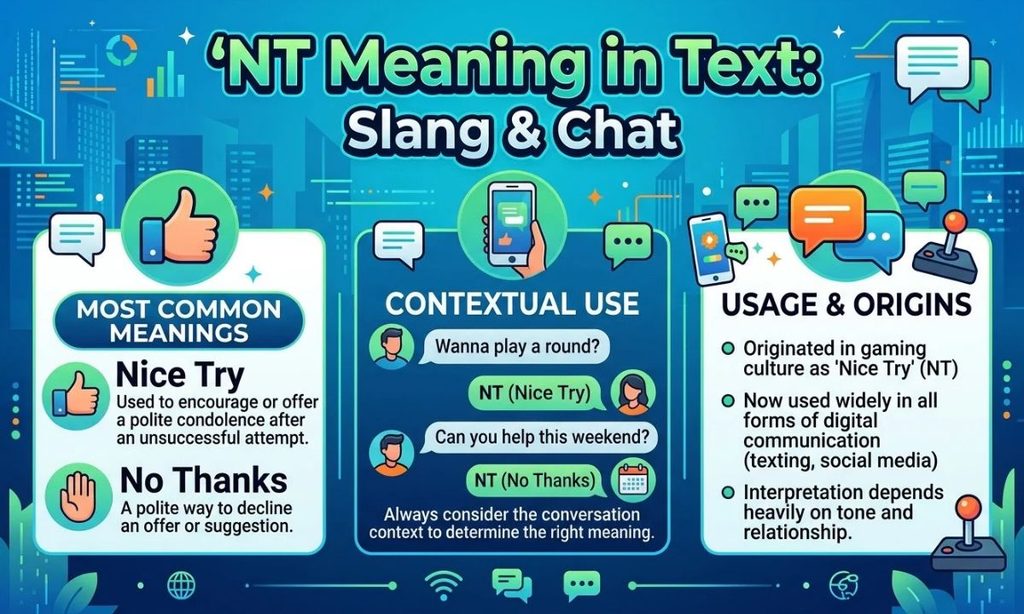
In everyday text slang, NT is a short reaction. People type it fast, with no punctuation and no extra words. It works like a small comment that says, “I saw what you did.”
Texting slang grew because typing takes time. Over the years, people shortened common phrases into letters: LOL, BRB, IDK, TBH. NT joined that family, mostly through online games where every second counts.
In a normal chat, NT usually shows up in three ways:
- As a reply to a failed attempt. Someone tries to guess a word, win an argument, or tell a joke, and it does not land.
- As a reply to an offer. Someone asks, “Want some cake?” and the answer is “nt.”
- As a sign of encouragement. A friend misses a shot, and you say “nt” to cheer them up.
Real-life experience: In many family and friend group chats, people use “nt” after someone loses a quiz game or guesses a movie name wrong. It is usually light and funny, not mean. The same two letters can feel very different if the friendship is new or the chat is tense.
NT Meaning in Gaming and Online Communities
Gaming is where NT became famous. Online players needed a quick way to react during a match without stopping their play. Typing “nice try” takes too long, so “nt” became the shortcut.
You will find NT in:
- Team shooters
- Battle royale games
- Sports games
- Card and board games
- Mobile games with chat
- Voice and text chat on gaming platforms
Players type “nt” when a teammate or an opponent attempts a big move and fails. Maybe a player jumps for a hard shot and misses. Maybe a team pushes forward and loses the fight. The reaction is “nt.”
Why Gamers Use NT
Gamers use NT for several simple reasons:
- Speed. Two letters take less than a second to type.
- Good sportsmanship. It shows respect, even after a loss.
- Team morale. A short kind word keeps players from getting upset.
- Habit. After thousands of matches, it just becomes automatic.
Pro tip: In many games, the very first thing people judge you on is your chat behavior. Saying “nt” after a teammate fails is one of the easiest ways to look like a good teammate.
NT Can Sound Supportive
Many people think NT is sarcastic, but in most gaming chats it is supportive. When your teammate drops the ball, “nt” tells them, “Good effort, keep going.”
Compare these two reactions:
| What You Type | What the Player Feels |
| “nt” | Encouraged, not blamed |
| “you messed up” | Embarrassed, maybe angry |
| “nt, we got this” | Motivated and part of the team |
Short and kind wins. That is why NT became so common in friendly lobbies.
That said, tone can flip. If an opponent types “nt” right after beating you, it may sound like teasing. Gamers call this “salty” or “toxic” behavior. The same letters feel different when the winner types them.
NT Meaning on Social Media
On social media, NT shows up in comments, replies, and direct messages. The platform changes the feeling a little.
- On short video platforms: Someone tries a trend, fails, and viewers comment “nt.”
- On image and story apps: A friend posts a funny failed attempt, and people reply “nt 😂.”
- On chat-based communities: Members react to jokes, guesses, and challenges with “nt.”
Social media NT is usually light, quick, and funny. It often comes with an emoji, which helps you read the mood.
Real-life experience: Comment sections often fill with “nt” under videos where someone tries a hard stunt or trick shot. Most viewers mean it kindly, but a few use it to tease. The emoji beside it is your best clue.
Common Meanings of NT
Let us look at the two big meanings first, then the smaller ones.
Nice Try
“Nice try” is the number one meaning of NT. It means someone made an effort, but the result was not successful.
It can be:
- Kind: “nt, you were so close!”
- Playful: “nt, but I saw that coming.”
- Sarcastic: “nt” after someone tries a weak trick on you.
Example: Your friend tries to sneak a cookie from your plate. You say, “nt.” You are teasing, not angry.
No Thanks
“No thanks” is the second most common meaning. It is a polite refusal of an offer, invitation, or suggestion.
Example:
- Friend: “Want to try my spicy noodles?”
- You: “nt, too hot for me.”
This meaning appears less often than “nice try,” and it usually comes with extra words that explain the refusal.
Other Meanings of NT
| Meaning | Example Situation |
| Nice trade | A fair swap in a card or trading game |
| Not tonight | Declining plans for the evening |
| Nice throw | Sports or party games like darts |
| Nice timing | A perfectly timed action |
| Nice talk | Ending a pleasant chat |
| No text | A rule, such as “no text, call me” |
These are rare, but you may spot them in niche communities. Always check the setting before you decide.
Why Context Matters
Two letters cannot hold much meaning alone. That is why context decides everything.
Think about the word “bat.” It can mean a flying animal or a baseball tool. You only know which one when you see the rest of the sentence. NT works the same way.
If you guess wrong, small problems can happen:
- You may think a friend is teasing when they are offering support.
- You may think someone refused your offer when they were cheering you on.
- You may reply in a way that feels rude by mistake.
The next section teaches you a simple method to avoid these mistakes.
How to Understand NT From Context
Use these four quick checks. They take only a few seconds.
Look at the Message Around NT
Read the sentence before and after the NT.
- If the earlier message is about a failed attempt, NT is likely “nice try.”
- If the earlier message is an offer or question like “Want some?”, NT is likely “no thanks.”
Consider the Platform
Where did you see it?
| Platform | Most Likely Meaning |
| Online game chat | Nice try |
| Group chat with friends | Nice try or no thanks |
| Social media comments | Nice try |
| Messages about plans | No thanks or not tonight |
| Trading communities | Nice trade |
Think About the Conversation Topic
Is the talk about a game, a joke, food, or plans?
- Game or challenge: probably “nice try.”
- Food, plans, or invitations: probably “no thanks” or “not tonight.”
Check the Tone
Tone is the mood of the message. Look for clues:
- Emojis: 😂 or 😅 usually mean playful. 🙂 can mean kind. 😐 can mean flat or cold.
- Capital letters: “NT!” can sound excited or sarcastic.
- Punctuation: “nt.” with a period can feel more serious.
- Extra words: “nt, you’ll get it next time” is clearly supportive.
Pro tip: If the person has been friendly all day, assume the friendly meaning first.
NT Meaning in Urban Dictionary
Urban Dictionary-style entries list NT as “nice try,” and many also list “no thanks.” These community-written entries mostly agree with what we see in real chats.
You should remember one thing: slang dictionaries show many possible meanings, but they cannot tell you which one fits your chat. Some entries are jokes. Some are rare. Use them as ideas, not as final answers.
The best “dictionary” is the conversation itself.
NT Meaning in Text From a Girl & Boy
People often search for “NT meaning in text from a girl” or “from a boy.” Here is the honest answer: NT does not change meaning because of gender. The same rules apply to everyone.
What changes the meaning is the relationship and the situation.
| Situation | Likely Meaning |
| She replies “nt” after you try a joke that flops | Nice try (teasing) |
| He replies “nt” after you offer to meet up | No thanks or not tonight |
| Either one says “nt 😂” after you try to prank them | Nice try (playful) |
| Either one says “nt” with no emoji, no extra words | Unclear, so ask or read the earlier message |
Real-life experience: Many people overthink a short reply from someone they like. Short replies are often just quick typing, not hidden feelings. Do not build a big story from two letters.
Ask When the Meaning Isn’t Clear
Sometimes the clues do not help. In that case, just ask. It is simple, and it shows you care about understanding.
Friendly ways to ask:
- “Wait, nt as in nice try or no thanks? 😄”
- “Haha, was that a nice try or a no thanks?”
- “Sorry, what does nt mean here?”
Asking is not embarrassing. Most people are happy to explain. It also stops small mix-ups before they grow.
NT in a Text Message: Examples
Let us walk through five examples so you can see NT in action.
Example: A Failed Attempt
- You: “I bet I can guess your birthday month. Is it June?”
- Friend: “nt, it’s August”
Meaning: Nice try. Your guess was wrong, but it was a fun attempt.
Example: Gaming
- Teammate: misses a long shot
- You: “nt, next one is yours”
Meaning: Nice try, plus encouragement. This keeps the team happy.
Example: An Offer
- Cousin: “Do you want to come to the mall tonight?”
- You: “nt, I have homework”
Meaning: No thanks. You politely refuse and give a reason.
Example: Social Media
- Post: A video of someone trying a hard dance move and falling.
- Comment: “nt 😂 you’ll nail it next time”
Meaning: Nice try, said in a kind and funny way.
Example: Ambiguous Use
- Friend: “Want to play again?”
- You: “nt”
Meaning: Unclear. It could mean “no thanks” or “nice try” from the last round. This is when adding a few words helps: “nt, I’m tired” or “nt, good game, rematch?”
NT Examples in Different Situations
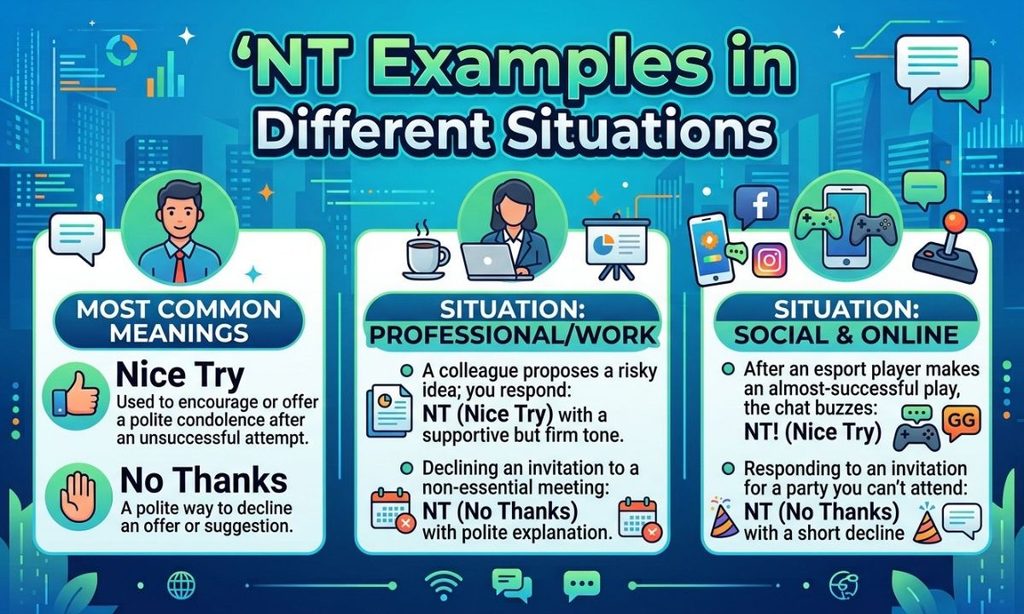
NT Between Friends
Friends use NT for jokes, small fails, and playful teasing.
- “nt, you almost caught the ball.”
- “nt, but I already know your trick.”
The tone is relaxed and friendly. Close friends can tease each other without anyone feeling hurt.
NT in Gaming
In games, NT is almost a habit of good manners.
- After a teammate fails: “nt”
- After a close loss: “nt, gg” (good game)
- After a missed shot: “nt, reset and go again”
Pro tip: Pair “nt” with “gg” and you will sound like a mature, friendly player.
NT in Social Media Comments
Comment sections move fast, so people use short reactions.
- “nt bro 😂”
- “nt, try again!”
- “nt but the effort was great”
Here, the emoji tells you how friendly the comment is.
NT in Group Chats
Group chats are full of jokes, plans, and quick replies. NT can mean either “nice try” or “no thanks,” so look at the last few messages.
- Someone shares a bad pun: “nt”
- Someone asks for volunteers for a task: “nt, I’m busy”
NT in Online Communities
Forums, fan groups, and hobby servers use NT for guesses, challenges, and trades.
- Quiz threads: “nt, close answer”
- Trading threads: “nt, good swap”
Online communities often have their own habits. Watch how others use NT before you use it yourself.
Is NT Formal or Informal?
NT is informal. It belongs in casual chats with friends, teammates, and online communities.
It is not a formal abbreviation like “FYI” or “ASAP,” which sometimes appear in work emails. NT is slang, and slang can look careless in serious writing.
| Setting | Is NT Okay? |
| Text with friends | Yes |
| Game chat | Yes |
| Social media comments | Yes |
| School email to a teacher | No |
| Job application | No |
| Business email | No |
Can NT Have More Than One Meaning?
Yes, NT can have more than one meaning. This is normal for slang. A tiny abbreviation can be reused in many ways, and people decide the meaning from the situation.
Here is a quick ranking from most common to least common:
- Nice try
- No thanks
- Nice trade
- Not tonight
- Other rare uses
If you only remember one thing, remember the first two.
Three Things That Help You Identify the Meaning
Keep this short checklist in your head:
- The message before it. What was NT answering?
- The place. Game, group chat, comment section, or private text?
- The tone. Is it friendly, teasing, or flat?
When all three point the same way, you can feel sure.
NT vs. Similar Texting Abbreviations
NT looks a bit like other short forms. Here is how to tell them apart.
| Abbreviation | Meaning | How It Differs From NT |
| NT | Nice try / no thanks | Short reaction to an attempt or offer |
| NP | No problem | Reply after someone thanks you |
| NVM | Never mind | Cancels a question or statement |
| NM | Not much | Answer to “What’s up?” |
| GG | Good game | Said at the end of a match |
| WP | Well played | Praises a good move |
| NS | Nice shot | Praises a good hit |
| NJ | Nice job | Praises success |
| NTY | No thank you | A clearer way to refuse |
Quick memory trick: NT is about trying or declining. NJ and WP are about succeeding. If someone did well, you say “nj” or “wp.” If someone failed, you say “nt.”
How to Reply When Someone Says NT
Your reply depends on which meaning you think the person intended.
If They Mean “Nice Try”
- Laugh it off: “haha thanks, I’ll get it next time”
- Be playful: “I was close though!”
- Be thankful: “Thanks, that helps”
If They Mean “No Thanks”
- Accept it kindly: “no worries!”
- Offer another option: “Maybe next time then”
- Move on: “okay, what do you want to do instead?”
If You Are Not Sure
- Ask: “nt as in nice try? 😄”
Pro tip: Do not reply angrily to a short message. Take a breath, check the context, and then answer.
When Should You Use NT?
Use NT when it fits the mood and the person.
- After a friend’s funny failed attempt
- After a teammate misses in a game
- When you want to encourage someone quickly
- When you politely refuse something in a casual chat
- In comment sections that already use short slang
Helpful rule: If the situation is light and friendly, NT is usually safe.
When Should You Avoid Using NT?
Skip NT when it could hurt, confuse, or look careless.
- When someone is truly upset about a failure
- When you do not know the person well
- When the chat is serious
- When the other person may not know the slang
- In school or work messages
Imagine a friend studied for a big test and still did badly. Saying “nt” would feel cold. A full sentence like “I’m sorry, I know you worked hard” is much kinder.
NT in Professional Communication
Avoid NT at work and in school. Professional writing should be clear, polite, and complete.
If you want to say “nice try” at work, use a better phrase:
| Casual | Professional |
| nt | Good effort, thank you for trying. |
| nt (no thanks) | No, thank you. |
| nt | I appreciate the attempt. |
Colleagues from different countries or age groups may not know gaming slang. Clear words prevent confusion and protect your image.
NT vs. NT in Different Contexts
The same two letters can act like different words. Here is a side-by-side view.
| Context | Likely Meaning | Typical Tone | Example |
| Game chat | Nice try | Supportive | “nt, we still have time” |
| Friend chat after a joke | Nice try | Teasing | “nt 😂” |
| Reply to an invitation | No thanks / not tonight | Polite | “nt, maybe next week” |
| Trading community | Nice trade | Positive | “nt, enjoy the card” |
| Comment section | Nice try | Playful | “nt bro” |
| Work email | Avoid | Unclear | Use full words |
This table is a great shortcut when you feel stuck.
Common Mistakes People Make With NT
Assuming NT Always Means “Nice Try”
Many people only know the first meaning. They see “nt” after an invitation and think it is a joke. Always test both meanings before deciding.
Ignoring the Previous Message
This is the biggest mistake. The earlier message holds the answer. Scroll up before you reply.
Using NT With Everyone
Not everyone knows or likes slang. An older relative or a new coworker may feel confused. Match your style to the person.
Reading Too Much Into It
Two letters are not a secret code. A person may type “nt” simply because they are busy or in a hurry. Do not assume anger or coldness without proof.
Forgetting That Humor Changes Meaning
A joking tone can turn “no thanks” into a playful refusal, or “nice try” into a friendly tease. Humor shifts how strong the message feels. Watch for laughing emojis and silly words.
How to Tell What NT Means in a Conversation
Follow this simple five-step method:
- Read the line before NT.
- Notice if there was an offer, a question, or an attempt.
- Look at the platform and the people.
- Check emojis and punctuation.
- Ask if you are still unsure.
Here is a small decision guide:
| If the earlier message was… | NT probably means… |
| A guess or attempt | Nice try |
| A game move that failed | Nice try |
| An invitation or offer | No thanks |
| A card or item swap | Nice trade |
| A plan for tonight | Not tonight |
Real-life experience: Most confusion disappears after reading one extra message above. Many people answer too fast and miss that small clue.
NT Meaning in Text: Realistic Conversation Examples
Conversation 1: Friends Playing a Guessing Game
- Ali: “Is it a cat?”
- Sara: “nt, it’s a rabbit”
- Ali: “Ahh, so close!”
NT = nice try.
Conversation 2: An Invitation
- Hamza: “Pizza after school?”
- Zain: “nt, I have to go home early”
- Hamza: “No problem, next time!”
NT = no thanks.
Conversation 3: Gaming Lobby
- Player 1: loses a round
- Player 2: “NT, we’ll win the next one”
- Player 1: “Thanks, let’s go”
NT = nice try, with support.
Conversation 4: Social Media Comment
- Video: A boy tries to flip a bottle and fails.
- Comment: “nt 😂 practice more”
NT = nice try, playful.
Conversation 5: Mixed Meaning
- Maya: “Want to join my team?”
- Noor: “nt”
- Maya: “Wait, nice try or no thanks?”
- Noor: “No thanks, haha”
This shows why asking works so well.
Why Context Is So Important With Internet Slang
Internet slang changes fast. A short word can mean one thing in a game, another in a chat, and something else in a forum. There is no single rulebook.
Context gives you the missing pieces: who is talking, what happened before, where the chat is, and how the person feels. When you read all of those, even a tiny abbreviation becomes clear.
Here is the golden rule for all slang:
- Read the whole conversation, not just the abbreviation.
- Think about the person and the place.
- Ask when you are unsure.
This habit helps with NT, and with hundreds of other short forms you will meet online.
Final Words
Now you know what NT means in text. Most of the time, it stands for “nice try.” It can be kind or playful, based on who sends it. Sometimes it means “no thanks” or “no text,” so the topic and mood of the chat always matter.
Use NT with care. With close friends, it is a fun way to tease or cheer them up. With new people or in a work chat, it may sound rude. If you are not sure, add a smile emoji or a short kind note to keep the tone light.
Next time you see NT, stay calm and think about the context. Reply in a friendly way, and ask if you need help. Small words like this are easy to learn. Keep practicing, and you will read chat slang like a pro.
“FAQs”
What does “nt” mean in chat?
In chat, NT most often means “nice try.” People send it after a failed move, a joke, or a plan that did not work. It can be kind or playful.
What is NT slang for?
NT is slang for “nice try.” It cheers someone on or teases them in a light way. Sometimes it can also mean “no thanks.”
What does “nt” mean in a text message?
In a text message, NT usually means “nice try.” It can also mean “no thanks” or “no text.” Check the topic of the chat to know which one fits.
What does “nt” mean on TikTok?
On TikTok, NT in comments means “nice try.” Fans use it when a creator fails a challenge or a trick. It can be friendly or a little cheeky.
What does “NT” stand for?
NT most commonly stands for “nice try.” In casual chats, it can also stand for “no thanks” or “no text.” The meaning depends on the context.
What is NT in LOL?
In LOL (League of Legends), NT means “nice try.” Players type it when a teammate makes a good attempt that does not work. It keeps the team positive.
What does NT refer to?
NT refers to the phrase “nice try” in most online chats. It points to an effort that did not succeed. In other cases, it may refer to “no thanks.”
What is NT in Mobile Legends?
In Mobile Legends, NT means “nice try.” Players use it after a failed fight or a close play. It is a quick way to show support.
What is NT in Twitch?
On Twitch, NT is a chat short form for “nice try.” Viewers type it when a streamer almost wins or just misses a move. It is often spammed during live games.
What does “nt” mean in Urban Dictionary?
On Urban Dictionary, NT is listed mainly as “nice try.” The entries describe it as a short way to praise effort or tease a failed attempt.

Hi, I’m Shahid, a passionate content writer and blogger dedicated to creating easy-to-understand, well-researched, and SEO-friendly content. I specialize in explaining the meanings of words, phrases, names, internet slang, symbols, and everyday expressions in a simple and engaging way.