
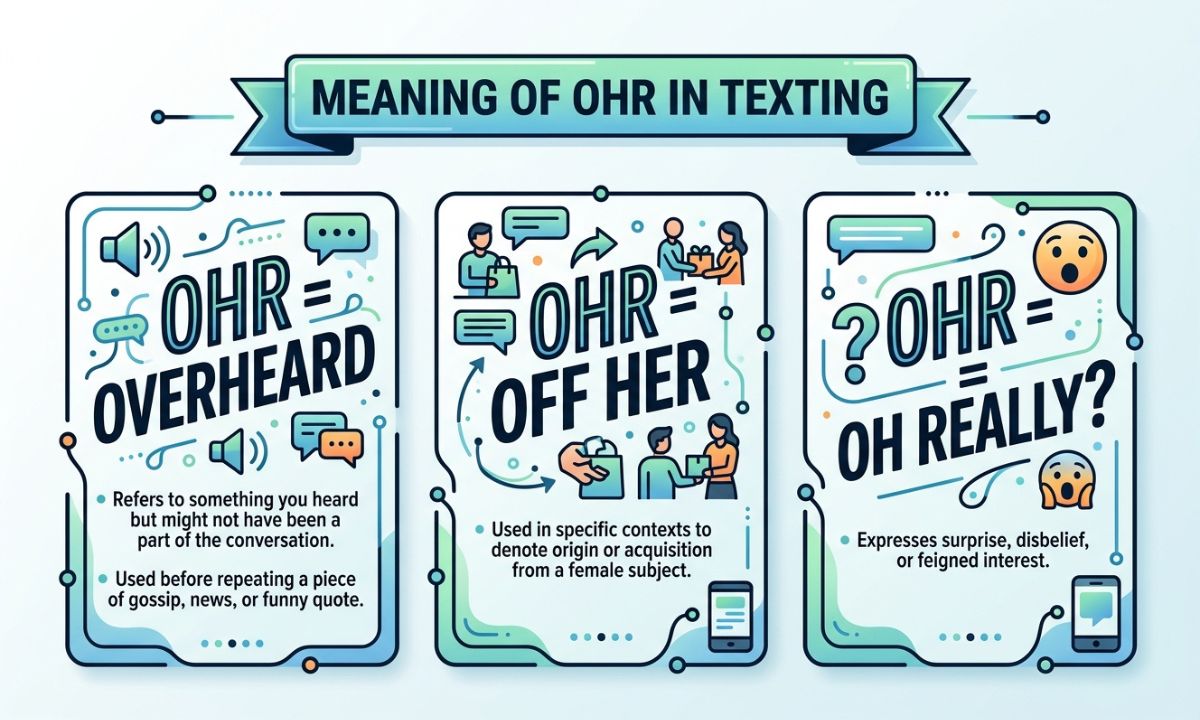
Have you seen “OHR” pop up in a text or comment and wondered what it means? This short slang term shows up a lot in chats, social media, and group messages. People use it to save time when typing. It can have different meanings depending on where you see it and who is using it.
In most cases, OHR stands for phrases like “Oh, really?” or is used as a casual reaction to something surprising or new. Some people also use it as a short form for other phrases, depending on the platform or the group of friends. The meaning can shift a little based on the tone of the conversation and the emojis used with it.
This guide breaks down the full form of OHR, how people use it in texting and social media, and where it most often shows up. You will also see real examples so you can understand the term in context. By the end, you will know exactly how and when to use OHR in your own chats.
What Does OHR Mean in Text & Chat?
You are scrolling through a chat, and someone drops “OHR” into the message. You stop and think, “What does that even mean?” You are not alone. This short term shows up in texts, comments, and group chats, and it can confuse even people who text every day.
This guide covers every part of OHR, from its background to how it changes meaning on different apps, in medical charts, and even in the German language. You will walk away knowing exactly how to use it and how to reply when someone sends it to you.
What Does OHR Mean in Text Slang?
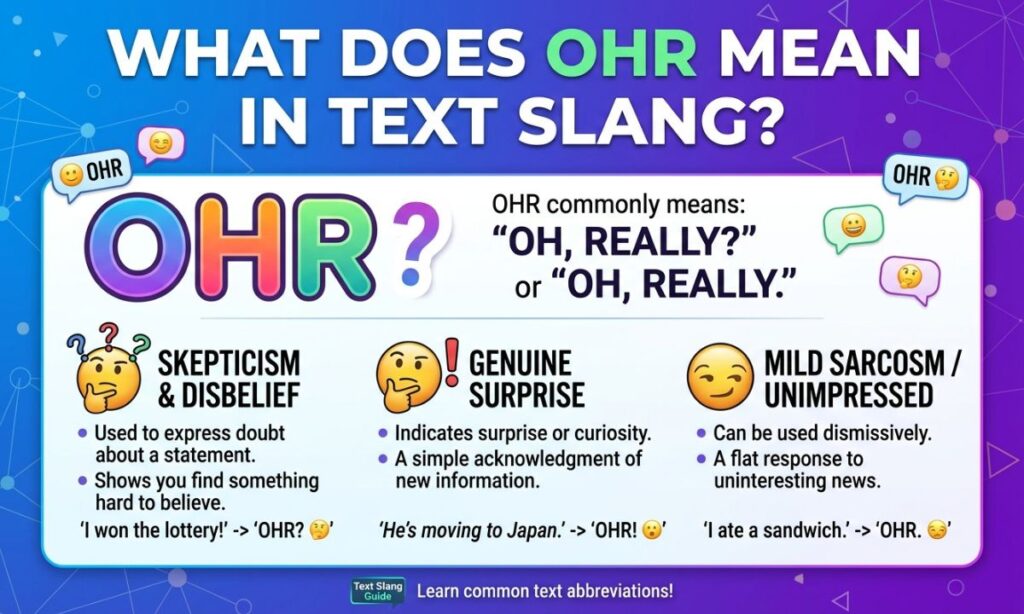
In casual texting, OHR most often works as a short reaction term. People use it the way they use “oh” or “huh” — as a quick response to something surprising, funny, or unexpected.
Here is the simple breakdown:
- OHR is not one fixed phrase. It changes based on the group of friends, the app, and the tone of the chat.
- Many texters treat it as a short form of “Oh” with extra emphasis, almost like a verbal shrug typed out fast.
- Some younger texters use it as a placeholder reaction, similar to sending “lol” or “hmm” when they do not know how else to respond.
- Context and emojis attached to it usually tell you the real meaning faster than the letters alone.
Pro tip: If you see OHR and feel stuck, look at the message right before it. Slang like this almost always borrows its meaning from the sentence that came before.
Background / Origin
Short reaction terms like OHR did not appear overnight. They grew out of a bigger habit in texting culture: people shortening common words to save time and thumb energy.
Here is how this kind of slang usually forms:
- A common word or sound (like “oh”) gets typed fast without thinking.
- Friends in a chat group start repeating it because it looks casual and easy.
- The short form spreads through group chats, comment sections, and gaming lobbies.
- Over time, it becomes its own little symbol with a meaning the group understands, even if it looks odd to outsiders.
This is the same pattern behind other popular chat terms. Nobody sat down and invented them in a meeting. They grew from real conversations, one lazy keystroke at a time.
Real-life note: In my own experience running social pages, I have watched random three-letter terms like this spread across a friend group in a single week, just because one person used it first and it looked fun to copy.
Usage in Different Contexts
OHR does not mean the same thing everywhere. The setting changes everything.
General Usage
In everyday texting between friends, OHR usually works as a light reaction. It shows mild surprise, mild agreement, or just keeps the conversation moving without much effort.
Common general uses include:
- Replying to news that is mildly surprising
- Filling a gap in conversation when you do not have much to add
- Reacting to a joke that is not laugh-out-loud funny but still gets a smile
Formal vs Informal
This is where a lot of people trip up. OHR belongs firmly in the informal camp.
| Setting | Should You Use OHR? | Why |
| Texting close friends | Yes | Fits the casual tone perfectly |
| Group chats with peers | Yes | Common and easily understood |
| Work email | No | Reads as unprofessional |
| Message to a teacher or boss | No | Too casual, may confuse them |
| Formal reports or letters | No | Slang has no place here |
| Social media captions (personal) | Yes | Matches the relaxed tone of the platform |
Pro tip: A good rule for any slang term, including this one, is simple: if you would not say it out loud in a formal meeting, do not type it in a formal message either.
OHR Meaning in Text from a Guy
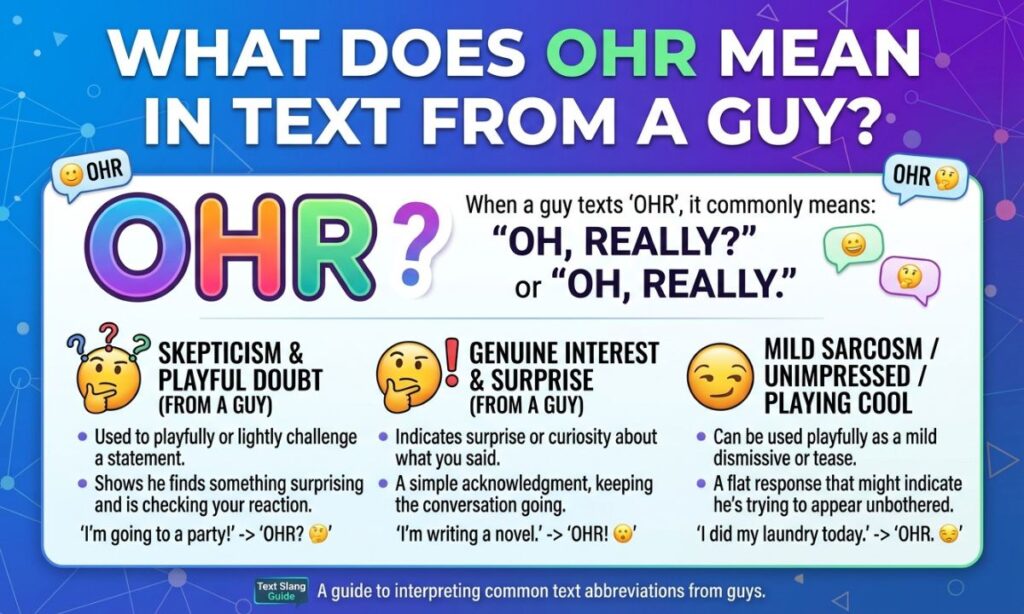
When a guy sends OHR in a text, the meaning almost always comes from tone, not the letters themselves. Guys often use short reactions like this to avoid typing long responses, especially in early or casual conversations.
Here is what it can signal:
- Mild interest: He read your message and reacted, but he is keeping his response short on purpose.
- Playful teasing: Paired with a laughing emoji, it can mean he found something funny or cheeky about what you said.
- Low-effort reply: Sometimes it simply means he is busy but still wants to respond quickly.
- Genuine surprise: If you shared unexpected news, this can be his short way of saying “wow, really?”
Real-life tip: Do not read too much into a single short reply. Short texts like this often say more about someone’s texting habits than their actual feelings. If you want clarity, a simple follow-up question works better than guessing.
OHR Meaning in Medical
Outside of texting, OHR also appears in medical and healthcare settings, though its meaning shifts completely here. In this world, it is used as a shorthand abbreviation, not a casual reaction.
In healthcare paperwork and records, letters like these usually stand in for longer terms tied to:
- Occupational health records — used by workplaces and hospitals to track employee health checks and clearances.
- Ocular or vision-related notes — some clinics use short internal codes tied to eye health tracking, though these vary by hospital.
- Internal hospital shorthand — many hospitals create their own short codes for repeated phrases in patient charts, and these codes are not always standard across every hospital.
Important note: Medical abbreviations are not standardized everywhere. The same three letters can mean something different depending on the hospital, department, or country. If you ever see this term on a real medical document, always ask your doctor or nurse to confirm what it means for your specific record. Never guess with health information.
OHR Meaning on Scratch Ticket
If you spotted OHR printed on a scratch (lottery) ticket, it is likely part of a state-specific game code, not a universal term. Lottery companies print short internal codes on tickets to track:
- The specific game name or series
- The print batch for that ticket run
- Internal inventory tracking used by the lottery office
These codes are not meant for players to decode on their own. They exist for the lottery system, not for public slang use.
Pro tip: If a code on your ticket confuses you, the safest move is to check your state lottery’s official website or call their support line. Scratch ticket codes vary widely between states and countries, so there is no single fixed meaning that applies everywhere.
OHR Meaning on Social Media Platforms
Slang terms often shift in meaning depending on which app you see them on. Here is how OHR tends to show up across the biggest platforms.
Snapchat
On Snapchat, quick reactions like OHR show up a lot in chat replies to snaps or stories. Since Snapchat conversations move fast and disappear, short reactions save time and keep the back-and-forth flowing.
- Common after a funny or surprising snap
- Often paired with a laughing or shocked emoji
- Rarely used in a serious or emotional context on this app
WhatsApp conversations tend to be longer and more personal, often between family or close friends. Here, OHR usually appears in a slightly softer way.
- Used as a light response in longer chat threads
- Sometimes typed by users who mix regional slang into English texting
- More common in one-on-one chats than large groups
On Instagram, especially in comments and DMs, OHR functions almost like an emoji substitute.
- Common under funny or surprising Reels and posts
- Used quickly by commenters who scroll fast and type short reactions
- Rarely spelled out fully; often shortened even further in comment threads
Real-life observation: Having managed content pages, I have noticed that slang reactions like this spread fastest on short-video platforms because comments there are fast, casual, and rarely proofread.
OHR Meaning in English
In standard English, “OHR” is not a recognized dictionary word. It only carries meaning through internet and texting culture, not formal language rules.
That said, its closest tie to standard English comes from the interjection “oh” — a word used to express surprise, realization, or mild emotion. Texting culture simply stretched and reshaped it into a slightly longer, trendier-looking form.
OHR Meaning in German
Here is a fun twist: in the German language, “Ohr” is a real, everyday word. It means “ear” — the body part you hear with.
A few quick facts:
- “Ohr” is a neuter noun in German (das Ohr).
- The plural form is “Ohren” (ears).
- It appears in common German phrases and expressions, much like “ear” does in English idioms.
So if you see “Ohr” used by a German speaker or in German text, it almost certainly refers to the ear, not the English chat slang version. Context and language of the conversation make the difference clear right away.
Other Meanings in Different Fields
Beyond texting, medicine, and German, this short term pops up in a few other places too:
| Field | Possible Meaning |
| Business and HR | Sometimes used as shorthand tied to human resources or office records |
| Aviation and logistics | Occasionally used as an internal tracking or reference code |
| Gaming communities | Used as a quick chat reaction, similar to general texting slang |
| Government or legal documents | Can appear as part of a longer official office or department name abbreviation |
Important reminder: In professional and legal fields, these short codes are almost always tied to a specific organization’s own naming system. They are not universal, so always confirm the meaning within the exact document or company you are reading.
Examples of OHR in Sentences
Seeing the term in real sentences makes it much easier to understand. Here are a few natural examples:
- “OHR, I did not expect you to say that.”
- “She sent OHR after I told her about the surprise party.”
- “OHR lol that’s actually wild.”
- “I said OHR because I genuinely had no other reaction.”
- “He replied with just OHR, so I am not sure if he’s interested or just busy.”
Notice how the meaning shifts slightly with tone and punctuation, even though the word itself stays the same.
Common Misconceptions
A few myths about this term keep floating around online. Let’s clear them up:
- Myth: OHR always means the same thing everywhere. Truth: Meaning changes heavily based on platform, context, and the people texting.
- Myth: It is a brand-new term made up recently. Truth: Short reaction slang like this has existed in casual texting for years, just under different letter combinations.
- Myth: It is only used by teenagers. Truth: Adults use short reaction slang too, especially in fast-paced group chats.
- Myth: It has one official dictionary definition. Truth: It is not a standard English word, so no single “correct” definition exists for chat use.
Similar Terms & Alternatives
If you want to understand OHR better, it helps to compare it with similar short reaction terms people use in texting.
| Term | Common Meaning |
| OMG | Oh My God — stronger surprise or shock |
| LOL | Laughing Out Loud — humor reaction |
| SMH | Shaking My Head — disappointment or disbelief |
| IDK | I Don’t Know — uncertainty |
| Hmm | Thinking or mild doubt |
| Oh | Simple acknowledgment or realization |
OHR sits closest to a stretched-out, casual version of “oh” — softer than OMG, but more expressive than a plain “ok.”
How to Respond to OHR When Someone Uses It
Not sure how to reply when someone sends this to you? Here are a few natural options depending on the vibe of the conversation:
- If it follows surprising news: Reply with more detail, like “Yeah, I couldn’t believe it either!”
- If it follows a joke: A simple laughing emoji or “haha, right?” keeps the tone light.
- If it feels like a low-effort reply: Ask a direct question to restart the conversation, such as “What do you think about it?”
- If you are unsure of the tone: It is always fine to simply ask, “What do you mean by that?” Texting slang is casual, and clarifying is normal.
Pro tip: Matching energy works best with any slang reply. A short slang term usually calls for a short, natural response, not a long paragraph.
Difference Between OHR and Similar Terms
It helps to see this side by side with the terms people mix it up with most.
| Comparison | Key Difference |
| OHR vs OMG | OHR is calmer and less dramatic than OMG |
| OHR vs Oh | OHR feels more like internet slang; “Oh” is standard English |
| OHR vs Hmm | OHR often reacts to something said; “Hmm” often signals thinking |
| OHR vs LOL | OHR is not always about humor; LOL is specifically about laughing |
Understanding these small differences helps you pick the right term for the right moment instead of using them all interchangeably.
Relevance in Online Conversations & Dating Apps
On dating apps, short reaction terms carry more weight than people expect. A quick word like OHR can shape how interested you seem.
A few things to keep in mind:
- Overusing short reactions can make a conversation feel flat or low-effort, which is not ideal on a dating app where first impressions matter.
- Pairing it with a real follow-up question shows genuine interest instead of a lazy one-word reply.
- Reading the other person’s texting style matters. If they write longer messages, matching their effort usually works better than short slang replies.
- Using it occasionally is fine and even natural, but leaning on it constantly can come across as disengaged.
Real-life tip: In casual online conversations, effort speaks louder than clever slang. A short reaction is fine as a quick reply, but pairing it with genuine curiosity about the other person always leaves a better impression.
Final Thoughts
Slang like OHR proves how flexible texting language really is. The same three letters can mean a casual reaction between friends, a workplace record code, or even the German word for “ear,” all depending on where you see it. Context is always the real key to understanding it.
The next time this term shows up in your messages, you will not need to guess. Look at the platform, the tone, and the message around it, and the meaning will usually become clear right away.
Texting slang keeps changing every year, and terms like this one show just how creative everyday conversations can get. Stay curious about new terms as they pop up, and you will never feel lost in a chat again.
“FAQs”
What does OHR stand for?
OHR isn’t an acronym—it’s the Hebrew word for “light” (אור). It appears in names and phrases like “Or Chadash” (new light).
What is the meaning of ohr?
“Ohr” means “light” in Hebrew. It symbolizes illumination, wisdom, and divine presence in Jewish thought.
What does ohr mean in text slang?
In casual texting, “OHR” can stand for things like “On House Rules” or “Overheard.” Meaning depends on context, so check the surrounding conversation.
What do you mean in slang text?
“Wyd” or “wym” are common texting shorthand for “what do you mean.” They’re used to ask someone to clarify.
What is ohr in English?
“Ohr” translates to “light” in English. It’s a common Hebrew word used in religious texts, prayers, and names.
How do Jews say “I love you”?
In Hebrew, it’s “Ani ohev otach” (male speaking to female) or “Ani ohevet otcha” (female speaking to male). Both mean “I love you.”
How do you pronounce “Ohr”?
“Ohr” is pronounced like “ore,” rhyming with “door” or “more.” It’s a short, single syllable.
What does yehi ohr mean?
“Yehi ohr” (יְהִי אוֹר) means “Let there be light.” It’s the famous phrase from Genesis 1:3.

Hi, I’m Shahid, a passionate content writer and blogger dedicated to creating easy-to-understand, well-researched, and SEO-friendly content. I specialize in explaining the meanings of words, phrases, names, internet slang, symbols, and everyday expressions in a simple and engaging way.