
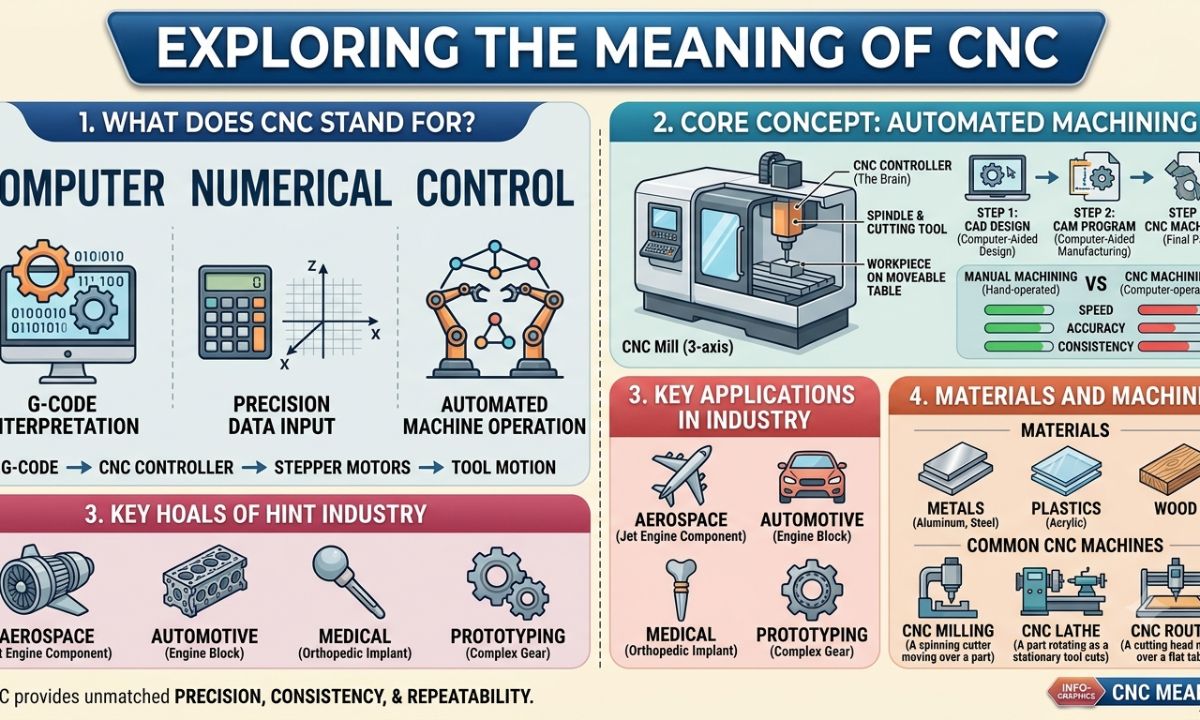
CNC is a short word with two very different meanings. Most people know it from factories and machines. But online, especially on social media, it also has a slang meaning. This guide will explain both sides so you fully understand the term.
In the world of machines, CNC stands for Computer Numerical Control. It means a computer controls the movement of a tool or machine. Factories use CNC machines to cut, drill, and shape materials with high accuracy. This method is common in metalworking, woodworking, and manufacturing.
Online, CNC has a different meaning. It is used as slang for “consensual non-consent.” This term comes from adult role-play communities. It describes a type of role-play where both people agree beforehand to act out a scene without real consent involved. It is always based on mutual agreement between adults.
CNC Full Form Explained
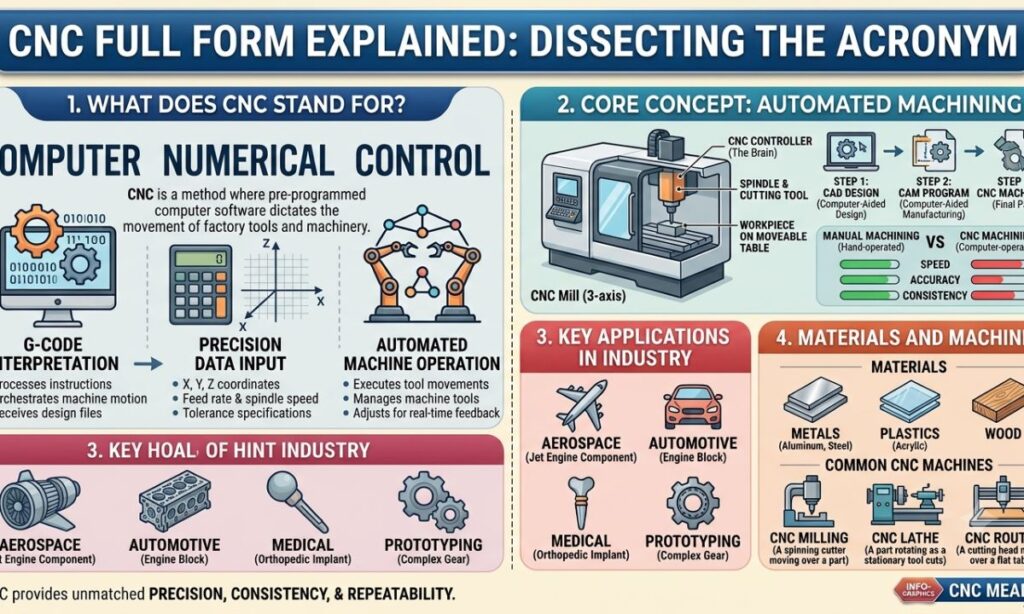
The full form of CNC is Computer Numerical Control. This means a computer controls the movement of a tool or a machine. Instead of a person moving the machine by hand, a computer program tells it exactly where to go, how fast to move, and when to stop.
Think of it like a robot arm that follows a recipe. The recipe is written in code. The machine reads this code and follows it step by step, every single time, without getting tired or making mistakes.
Pro Tip: If you ever see “CNC” written before a machine name, like “CNC lathe” or “CNC router,” it simply means that machine is run by a computer program, not by a person’s hands.
CNC technology did not appear overnight. Early versions of numerical control started with punched paper tape, long before modern computers existed. Machines read holes punched into the tape to know where to move.
Over time, computers replaced paper tape, and the “C” for “Computer” was added to the name. This is how the term CNC was born.
Today, CNC controllers are small computers built directly into the machine. They have screens, buttons, and sometimes touch panels, so operators can load programs, check tool positions, and fix small errors without needing a separate computer nearby.
CNC Meaning in Manufacturing
In manufacturing, CNC is one of the most important technologies used today. It changed how factories make parts for cars, phones, planes, and thousands of other products.
Before CNC, workers had to guide machines by hand. This took a lot of skill and time. Mistakes were common, and no two parts were ever the same. CNC solved this problem by letting a computer control the machine instead.
Now, a factory can make thousands of identical parts without a single difference between them. This is called repeatability, and it is one of the biggest reasons factories trust CNC machines.
From my experience watching small workshops switch to CNC tools, the biggest change owners notice first is not speed. It is consistency. Every part looks and fits the same, order after order.
CNC is used across almost every major manufacturing industry today. Some common examples include:
- Automotive industry: Engine blocks, gears, and brake parts are cut using CNC machines for exact fit and safety.
- Aerospace industry: Aircraft parts need extremely tight tolerances, since even a tiny error can cause serious problems at high altitude.
- Electronics industry: Small parts like connectors and casings are shaped using CNC for phones, laptops, and other devices.
- Medical industry: Surgical tools and implants are machined with CNC to match the human body precisely.
- Furniture and home goods: CNC routers cut wood panels, shelves, and decorative pieces at high speed.
Pro Tip: If you are choosing a manufacturing partner for your product, ask if they use CNC machining. It usually means your parts will match your design drawings closely, batch after batch.
Common CNC Machines
There are many types of CNC machines. Each one is built for a different job. Here is a simple table to help you understand the most common ones.
| CNC Machine | What It Does |
| CNC Mill | Cuts and shapes material using a rotating tool |
| CNC Lathe | Spins the material while a tool cuts it into shape |
| CNC Router | Cuts wood, plastic, or soft metal, often for signs and furniture |
| CNC Plasma Cutter | Uses hot plasma gas to cut metal sheets |
| CNC Laser Cutter | Uses a laser beam to cut or engrave material |
| CNC 3D Printer | Builds parts layer by layer instead of cutting them |
| CNC Grinder | Smooths and polishes surfaces with high precision |
Pro Tip: If you are just starting to learn CNC, mills and lathes are the best machines to study first. Most other CNC machines work on the same basic idea, just with different tools.
Each of these machines has its own strengths. A CNC mill is great for flat surfaces, holes, and pockets. A CNC lathe is best for round, cylindrical parts like shafts and bolts. A CNC router shines with softer materials and large flat sheets, which is why sign shops and furniture makers rely on it so heavily.
Plasma and laser cutters are usually chosen for sheet metal work, since they cut fast through flat material without needing a rotating tool. 3D printers, while technically computer-controlled too, work differently because they build up material instead of cutting it away, so they are sometimes grouped separately from traditional CNC machines.
Choosing the right machine depends mostly on the material and the shape needed. A business cutting flat metal signs would look at a plasma or laser cutter, while a business making 3D-shaped parts, like brackets or gears, would look at a mill instead.
Beginners often ask which machine to buy first, and the honest answer is: it depends entirely on what you plan to make, not which machine sounds the most advanced.
CNC Machining Meaning
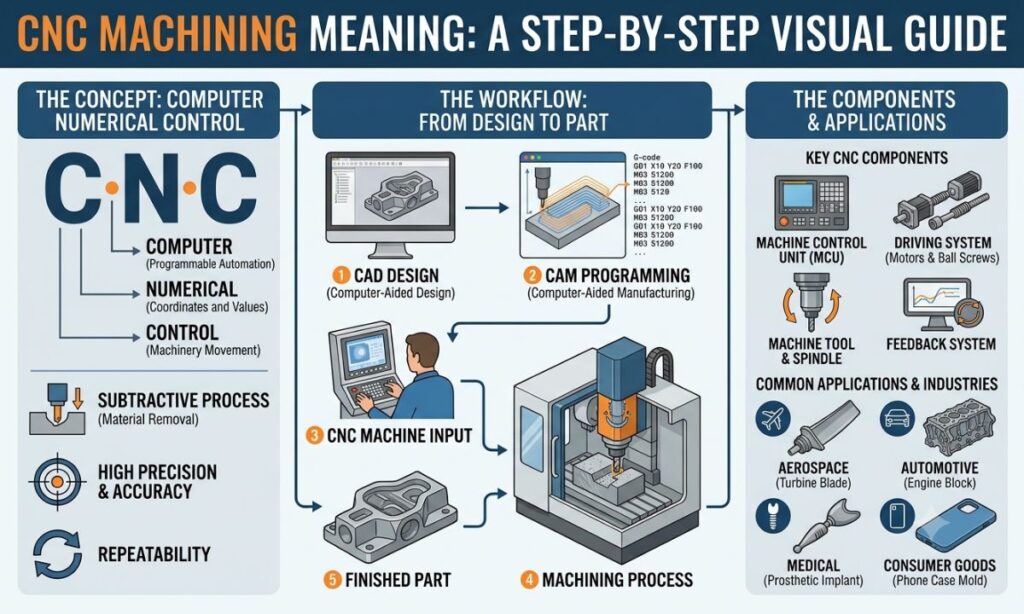
CNC machining is the actual process of making a part using a CNC machine. It is called a subtractive process. This means you start with a solid block of material and cut away the parts you don’t need, until only the final shape is left.
This is different from 3D printing, which builds a part by adding material layer by layer. CNC machining removes material instead of adding it.
CNC machining is used to make parts from metal, plastic, wood, and even foam. It is popular because it gives very high accuracy, often within a fraction of a millimeter.
There are two main types of CNC machining processes, and knowing the difference helps when you are planning a project:
- Milling: A rotating cutting tool moves around a fixed or slowly moving material to remove pieces and create flat surfaces, slots, or pockets.
- Turning: The material itself spins on a lathe while a fixed cutting tool shapes it, mostly used for round parts.
Some CNC machines combine both milling and turning into one machine, called a mill-turn center, which saves time by finishing a part without moving it between two separate machines.
Pro Tip: Before starting any CNC machining project, always ask what tolerance is needed. A children’s toy part and an aircraft bracket both use CNC machining, but the accuracy required for each is very different, and this affects both time and cost.
Key Benefits of CNC Machining
CNC machining offers many advantages over older, manual methods. Here are the biggest ones:
- High accuracy: Parts come out the same size every time, with very small margins of error.
- Faster production: Machines can run for long hours without breaks.
- Less human error: Since a computer controls the movement, mistakes caused by tired hands are reduced.
- Complex shapes made easy: CNC machines can cut shapes that would be very hard to make by hand.
- Less material waste: Precise cutting means less material is thrown away.
- Lower long-term cost: Even though machines are expensive to buy, they save money over time by reducing mistakes and rework.
- Safer for workers: Operators do not need to hold the material close to sharp, fast-moving tools.
Pro Tip: Many small business owners think CNC machines are only for big factories. In reality, small desktop CNC routers and mills are now affordable enough for home workshops and small businesses too.
It also helps to understand where CNC machining is not the best choice. For a single custom part, or a very simple shape needed just once, manual machining or even 3D printing might be faster and cheaper than setting up a full CNC program.
CNC truly shines when a part needs to be made many times with the same result, or when the shape is too complex for hands and hand tools alone.
Cost is another factor worth understanding early. CNC machines themselves can be expensive to buy, and skilled programmers or operators are needed to run them well.
However, once a program is written and tested, making the second, tenth, or thousandth part becomes very fast and cheap compared to doing the same work by hand each time.
CNC Machine Working Principle
Understanding how a CNC machine works helps you see why it is so powerful. The process generally follows these steps:
- Design the part: A designer creates a digital drawing of the part using CAD (Computer-Aided Design) software.
- Convert the design into code: CAM (Computer-Aided Manufacturing) software turns this drawing into a set of instructions called G-code.
- Load the program: The G-code is sent to the CNC machine’s control system.
- Set up the machine: An operator places the raw material on the machine table and loads the correct cutting tool.
- Run the program: The machine reads the code and moves the tool exactly as instructed, cutting the material into shape.
- Check the final part: The finished part is checked for accuracy against the original design.
This whole process turns a simple drawing into a real, physical object with very little manual effort.
Pro Tip: Most beginner mistakes in CNC work happen at the setup stage, not during cutting. Double-checking the material position and tool before starting the program can save hours of wasted work.
CNC machines move along directions called axes. A simple CNC machine might have three axes, usually named X, Y, and Z, similar to left-right, forward-back, and up-down directions. More advanced machines can have four or five axes, allowing the tool or the material to rotate as well, which makes it possible to cut very complex shapes from many angles without removing the part from the machine.
The number of axes a machine has directly affects what shapes it can create. A simple three-axis mill can cut flat surfaces and basic pockets easily, but a five-axis machine can carve curved, angled surfaces in a single setup, which is common in aerospace and medical part production.
CNC Meaning in Engineering
In engineering, CNC represents a shift from manual skill to programmed precision. Engineers use CNC systems to design and produce parts that need to be exact, such as engine components, medical tools, and aircraft parts.
CNC allows engineers to test and produce prototypes quickly. Instead of waiting weeks for a part to be shaped by hand, a CNC machine can often finish the same part in hours.
This speed is one reason CNC is now a core part of engineering education. Students learn CNC alongside CAD and CAM software, since these tools work together in real factories.
Mechanical, industrial, and manufacturing engineers all touch CNC at some point in their careers. Design engineers must think about what a CNC machine can actually cut, since some shapes are very hard or even impossible for a machine to reach with a rotating tool. This is called designing for manufacturability, and it is a skill engineers build through experience.
Pro Tip: Young engineers often design parts that look great on screen but are hard to machine in real life. Talking to a CNC machinist early in the design stage, not after the design is finished, saves a lot of time and cost later.
CNC Meaning in Metal Cutting
When people talk about CNC in metal cutting, they mean using a CNC machine to shape metal parts through cutting, drilling, or grinding.
Metal cutting with CNC is common in industries like automobile manufacturing, aerospace, and machinery production. The computer control allows the tool to cut metal at the exact speed and depth needed for that specific metal type.
Different metals need different cutting speeds. Steel, aluminum, and titanium all behave differently under a cutting tool, and CNC programs can be adjusted for each one to avoid damage to the tool or the part.
Cutting tools also matter a lot. Harder metals, like stainless steel or titanium, need stronger, heat-resistant tool tips, often coated to survive the high heat created during cutting. Softer metals, like aluminum, can be cut faster but need careful chip removal, since the cut material can build up on the tool if not cleared away.
Coolant is another important part of metal cutting. It keeps the tool and the material cool during fast cutting, extends tool life, and helps wash away small metal chips from the cutting area.
Pro Tip: Running a CNC program too fast on hard metal is one of the most common ways beginners damage cutting tools. Starting with slightly slower speeds and gradually increasing them, while watching the tool closely, is a safer approach.
Metal cutting also depends heavily on the shape of the cutting tool itself. A sharp, well-shaped tool cuts cleanly and lasts longer, while a worn or dull tool creates rough surfaces and can even bend or snap under pressure.
Regular tool inspection is a simple habit that saves both time and money in any metal cutting workshop.
CNC Programming Meaning
CNC programming is the process of writing the instructions that tell a CNC machine what to do. These instructions are usually written in a language called G-code, along with a supporting code called M-code for machine functions like turning coolant on or off.
A CNC program tells the machine things like:
- Where to move the cutting tool
- How fast to move it
- When to start and stop cutting
- Which tool to use for each step
Programmers need to understand both the machine and the material being cut. A good program reduces cutting time, saves tool life, and produces a smoother finish.
Pro Tip: Learning basic G-code, even just the common commands, helps machine operators troubleshoot problems faster instead of waiting for a programmer every time something looks wrong.
Here are a few common G-code commands beginners often see:
| Code | Meaning |
| G00 | Move the tool quickly, without cutting |
| G01 | Move the tool in a straight line while cutting |
| G02 | Move the tool in a clockwise circle while cutting |
| G03 | Move the tool in a counter-clockwise circle while cutting |
| M03 | Turn the spindle (cutting tool) on, clockwise |
| M05 | Turn the spindle off |
These codes look simple once you understand the pattern. Each line of G-code is basically one small instruction, and a full program is just hundreds or thousands of these small instructions placed in order.
Pro Tip: Many CNC programmers today rely on CAM software to write G-code automatically from a 3D design. Even so, understanding the basic codes helps you spot mistakes in the program before they turn into a damaged part.
CNC Meaning in Woodworking
CNC is not just for metal. In woodworking, CNC routers are extremely popular. They are used to cut, carve, and engrave wood into detailed shapes.
Furniture makers, sign makers, and hobbyists use CNC routers to create designs that would take much longer to carve by hand. A CNC router can repeat the same detailed carving on hundreds of pieces without any change in quality.
This has made CNC routers popular even among small home-based woodworking businesses, not just large furniture factories.
CNC woodworking machines are commonly used for:
- Cabinet doors and kitchen panels
- Decorative wall art and signage
- Musical instrument parts, like guitar bodies
- Wooden toys and puzzle pieces
- Engraved name plates and awards
Wood cutting speeds are usually faster than metal cutting, since wood is a much softer material. However, dust control becomes very important, since wood dust builds up quickly and needs proper collection systems around the machine.
Pro Tip: New CNC woodworking hobbyists often skip a proper dust collection setup at first. This is a mistake, since fine wood dust is both a health risk and a fire hazard when it builds up over time.
CNC vs Manual Machining (Key Difference)
Many beginners ask how CNC machining is different from manual machining. Here is a simple comparison table.
| Feature | CNC Machining | Manual Machining |
| Control | Computer-controlled | Human-controlled |
| Accuracy | Very high and consistent | Depends on operator skill |
| Speed | Faster for repeated parts | Slower for repeated parts |
| Skill needed | Programming and setup skill | Hands-on machining skill |
| Best for | Large or complex production runs | Small, one-off, or custom jobs |
| Human error | Low | Higher |
| Cost to start | Higher (machine cost) | Lower (basic tools) |
Pro Tip: Many workshops actually use both. CNC machines handle repeated, precise work, while manual machines are kept for quick custom jobs and small fixes.
Manual machining still has real value, especially for very small workshops, repair jobs, or one-off custom parts where setting up a full CNC program would take longer than just doing the job by hand.
A skilled manual machinist can often make quick judgment calls and small adjustments on the spot, something a CNC program cannot do on its own without being rewritten.
On the other hand, CNC becomes the clear winner as soon as a part needs to be made more than a handful of times, or when the shape is too detailed for steady hands alone.
Many training programs today still teach manual machining first, since it builds a stronger understanding of cutting, material behavior, and tool angles before moving on to programmed machines.
CNC Meaning in Industrial Automation
In industrial automation, CNC plays a major role in reducing human involvement in repetitive tasks. Factories connect CNC machines with robotic arms, sensors, and conveyor systems to create fully automated production lines.
This means raw material can enter a system, get cut and shaped by CNC machines, and come out as a finished part, with very little human touch in between.
This kind of automation increases speed and reduces labor costs, which is why CNC is often called one of the building blocks of modern smart factories.
Modern factories often connect CNC machines to central software systems. This allows managers to check machine status, production speed, and error alerts from a computer or phone, without walking to the machine floor. Some advanced factories even use sensors to predict when a machine part will wear out, so it can be replaced before it breaks and stops production.
Pro Tip: For small manufacturers thinking about automation, connecting even one or two CNC machines to a simple monitoring system is often a better first step than trying to automate the entire factory floor at once.
CNC Meaning in Text, Chat, and Slang
So far, every meaning of CNC has been about machines. But CNC also has a completely different meaning when used in text messages, online chats, and social media. This meaning has nothing to do with factories or machining.
CNC Meaning in Text or Chat
When you see “CNC” in a text message or chat, especially outside of a work or engineering context, it is usually not about machines. Online, CNC most often stands for “Consensual Non-Consent.”
This term is used in adult conversations, mainly related to role-play between consenting adults. It describes a type of role-play where two people agree beforehand to act out a scene that looks like it lacks consent, even though everything is fully agreed upon in advance.
The word “consensual” is the most important part of this term. It means both people talked about it and agreed to it before anything happens. It is a planned activity between adults, not a real lack of consent.
CNC Meaning in Relationship, Dating, and Slang
In relationship and dating conversations, CNC is used the same way, as slang for consensual non-consent role-play. Some couples discuss this as part of exploring role-play in their relationship.
Because this term comes up mostly in adult and mature conversations, it is not something used in normal daily texting between friends or family. If you see it used casually online, it is usually inside adult-content spaces or discussions about relationships and role-play.
Is CNC a Bad Word?
CNC by itself is not a bad word. It is simply an abbreviation. Whether it feels appropriate or not depends entirely on the context it is used in.
- In an engineering or manufacturing chat, CNC is a completely normal, professional term.
- In an adult or relationship context, CNC refers to a private topic between consenting adults and is not appropriate for public, casual, or workplace conversations.
Pro Tip: If you are unsure which meaning someone intends, look at the conversation around it. A message about machines, tools, or factories means the manufacturing meaning. A message in an adult or dating context means the other meaning.
Meaning of CNC Machinist
A CNC machinist is a trained worker who sets up, operates, and monitors CNC machines. This is a real, respected job title used across the manufacturing industry, and it is completely separate from the slang meaning of CNC.
A CNC machinist usually:
- Reads engineering drawings and blueprints
- Loads programs into the CNC machine
- Selects the correct cutting tools
- Watches the machine during operation to catch problems early
- Measures finished parts to check accuracy
This job requires training in both machining and basic computer skills, since machinists often need to make small adjustments to a program if something isn’t cutting correctly.
Becoming a CNC machinist usually starts with a technical training course or apprenticeship. Many machinists begin by learning manual machines first, since this builds a strong understanding of how cutting actually works before moving on to programmed machines.
Experienced CNC machinists are in high demand across many countries, since factories always need skilled people who can catch problems a computer program might miss, such as unusual sounds, vibration, or tool wear.
Pro Tip: If you are considering this career, strong attention to detail matters more than raw strength. Reading a measurement wrong by even a small amount can ruin an expensive part, so patience and precision are the most valuable skills in this job.
CNC Meaning in Sexual Context
In a sexual or adult context, CNC stands for “Consensual Non-Consent.” It refers to role-play scenarios that adults agree to beforehand, where the scene may look like it lacks consent, but full consent was given by both people in advance.
This is a topic discussed mainly in adult communities and relationship education spaces. Clear communication and agreement before any activity is the central idea behind this term. It is not used to describe non-consensual acts, since consent is the defining part of the phrase itself.
CNC Meaning Gay
Within LGBTQ+ online spaces and dating apps, CNC is used with the same meaning as in general adult slang, “Consensual Non-Consent.” It is not a term specific to any one group of people.
It simply describes a type of role-play some adults choose to explore, discussed openly in various dating and relationship communities, including LGBTQ+ ones.
The core meaning stays the same everywhere it is used: two adults agreeing in advance to a role-play scenario.
CNC Meaning Medical
In a medical or clinical setting, CNC does not have one single, widely recognized abbreviation the way it does in manufacturing. It is not a standard term you would find in general medical textbooks in the same way as terms like MRI or ECG.
Occasionally, CNC may appear inside specific hospital systems, research papers, or internal documents as a local abbreviation for something specific to that document. In these cases, the meaning changes depending on the source.
So it is always best to check the exact document or context where it appeared rather than assuming a fixed medical meaning.
Why CNC Is Important Today
CNC technology plays a huge role in the modern world, even if most people never think about it. Almost every object with a precise, machined part, from car engines to phone parts to furniture, likely passed through a CNC machine at some point.
Here is why CNC continues to matter:
- It powers mass production without losing accuracy.
- It reduces the cost of making complex parts, since less manual labor is needed.
- It supports industries like aerospace, medical devices, and automotive, where tiny errors can cause big problems.
- It allows small businesses to compete, since affordable CNC machines let smaller workshops produce parts that once needed a big factory.
- It connects with automation and robotics, forming the base of many smart factories today.
As factories continue moving toward automation, CNC remains one of the core technologies driving that change forward.
Looking ahead, CNC technology continues to grow alongside other tools like robotics, artificial intelligence, and cloud-based monitoring.
Some newer machines can now adjust cutting speed automatically based on sensor feedback, catching problems that older machines would have missed entirely.
For students and career-changers, this growth means CNC skills are likely to stay valuable for a long time.
Learning to read a technical drawing, understand basic programming, and operate a CNC machine safely opens doors across many different industries, not just one single job type.
Pro Tip: If you want to start learning CNC on your own, many free G-code simulators exist online. Practicing with a simulator before touching a real machine is a safe, low-cost way to build confidence.
Final Thoughts
CNC is a word that carries very different meanings depending on where you see it. In factories and workshops, it means Computer Numerical Control, a technology that lets computers guide machines to cut, shape, and build parts with amazing accuracy.
This meaning powers much of the modern manufacturing world, from car parts to furniture to aerospace components. Online, in texts and adult conversations, CNC means something completely different:
Consensual Non-Consent, a term used in role-play discussions between adults who agree to it in advance. The two meanings share nothing in common except the letters themselves.
FAQs
What does CNC stand for?
CNC stands for Computer Numerical Control. It means a computer controls the movement of a machine or tool.
What is a CNC machine used for?
A CNC machine is used to cut, shape, drill, or carve materials like metal, wood, and plastic into precise parts.
What does CNC mean in texting?
In texting, CNC usually stands for “Consensual Non-Consent,” a term used in adult role-play conversations.
Is CNC machining expensive?
CNC machines cost more to buy upfront, but they save money over time by reducing errors and speeding up repeated production.
What is G-code in CNC?
G-code is the programming language that tells a CNC machine where to move, how fast to move, and when to cut.
What industries use CNC machines?
Automotive, aerospace, electronics, medical, and furniture industries all rely heavily on CNC machines.
What is the difference between CNC and 3D printing?
CNC removes material to shape a part, while 3D printing adds material layer by layer to build a part.
What does a CNC machinist do?
A CNC machinist sets up, programs, and monitors CNC machines to produce accurate finished parts.

Hi, I’m Shahid, a passionate content writer and blogger dedicated to creating easy-to-understand, well-researched, and SEO-friendly content. I specialize in explaining the meanings of words, phrases, names, internet slang, symbols, and everyday expressions in a simple and engaging way.