
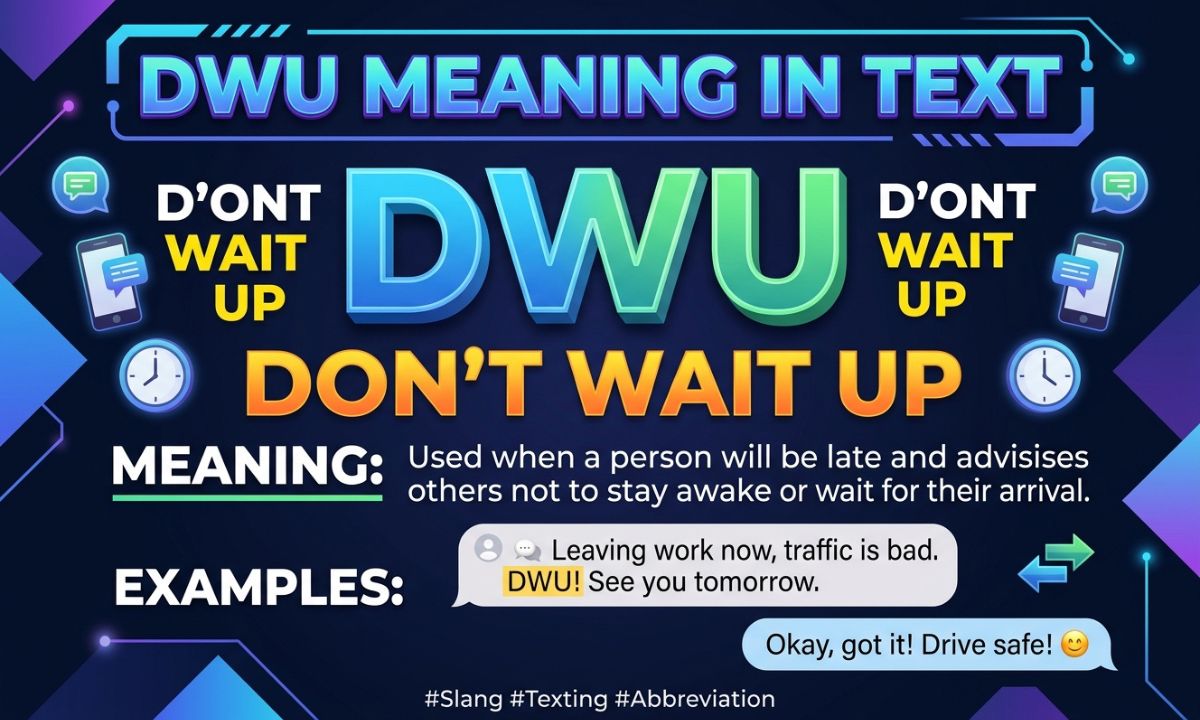
Have you seen the letters DWU in a text message and felt confused? You are not alone. Many people see this short slang term online and wonder what it means. It shows up in texting, social media, and even in group chats with friends. Understanding it can help you keep up with modern online conversations.
DWU stands for “Don’t Wait Up.” People use this phrase to tell someone not to stay awake waiting for them. It is common when someone is going out late or coming home after a long time. This short form saves time and makes texting faster and easier.
In this article, we will explain the full meaning of DWU in simple words. We will also share how and when to use this slang term correctly. By the end, you will know exactly how to use DWU in your own texts and chats with confidence.
What Does DWU Mean in Text & Chat?
People text this when they’ll be out late, busy, or unavailable for a while. It’s a quick, friendly way of saying: “Go ahead and relax, sleep, or carry on with your night — you don’t need to stay up waiting for me.”
It’s common between friends, family, and partners on WhatsApp, Instagram, Snapchat, and TikTok, and it usually shows up at the end of a message like a casual sign-off (e.g., “Heading out with the team, DWU!”).
DWU Meaning Slang
DWU is a short slang word people type in texts and chats. It saves time when you are busy or in a hurry. Most people use it when they are talking to close friends, family, or a partner.
The word looks simple, but it can carry a warm and caring feeling. It tells the other person, “Relax, you don’t need to worry about me.” That is why so many people like using it every day.
Here is a quick snapshot of DWU before we go deeper into every detail.
| Quick Facts | Details |
| Full Form | Don’t Wait Up |
| Type of Word | Text and chat abbreviation |
| Tone | Casual, friendly, caring |
| Common Users | Friends, family, couples, teens, young adults |
| First Seen | Early internet slang lists around 2007 |
| Popular On | WhatsApp, Instagram, Snapchat, TikTok, Twitter/X |
Full Form, Stands For & Short Meaning of DWU
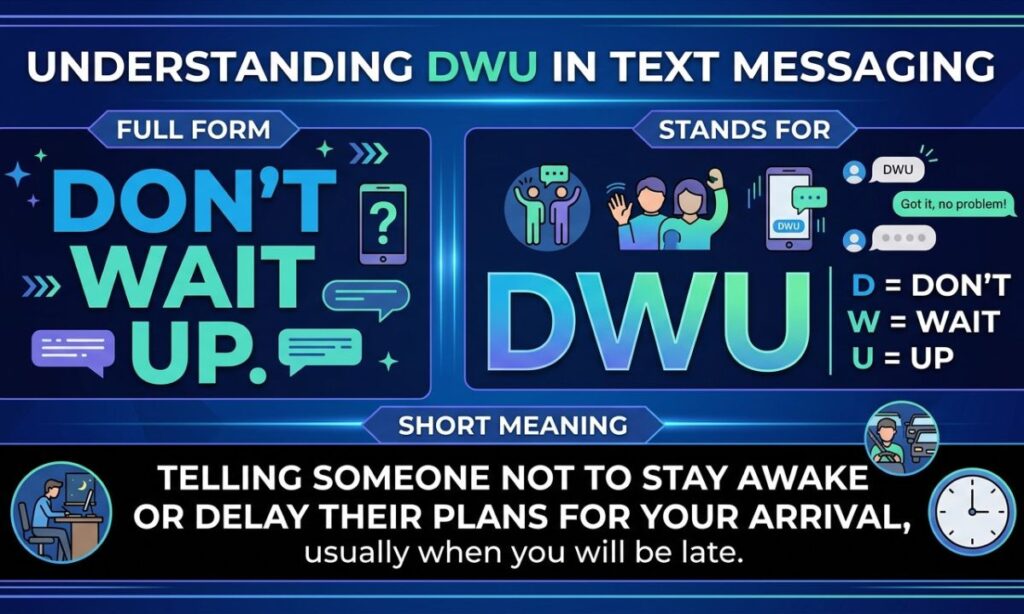
DWU stands for “Don’t Wait Up.” This is the most common and accepted meaning across the internet. It means the sender wants you to go ahead and sleep, relax, or continue your night without waiting for them.
In simple words, DWU means: “You don’t have to stay awake for me. I will be late or busy.” It is a small phrase, but it carries a big and thoughtful message.
Let’s break down the short meaning in three simple points:
- D = Don’t
- W = Wait
- U = Up
Put them together, and you get “Don’t Wait Up.” It is one of those texting shortcuts that makes total sense once you see the letters spelled out.
Other Rare Meanings of DWU
DWU is not always about waiting up at night. In a few rare cases, people use the same three letters for other things. This does not happen often, but it is good to know so you don’t get confused.
| Rare Meaning | Where It’s Used |
| Do What’s Up | Playful slang on some social apps |
| Dreaming With You | Romantic or sentimental texts |
| Don’t Worry, Understand | Niche online groups |
Even with these rare uses, “Don’t Wait Up” remains the correct and most common meaning by far. If you see DWU in a normal chat, it almost always means the sender will be out late or busy.
Origin, History & First Known Use of DWU
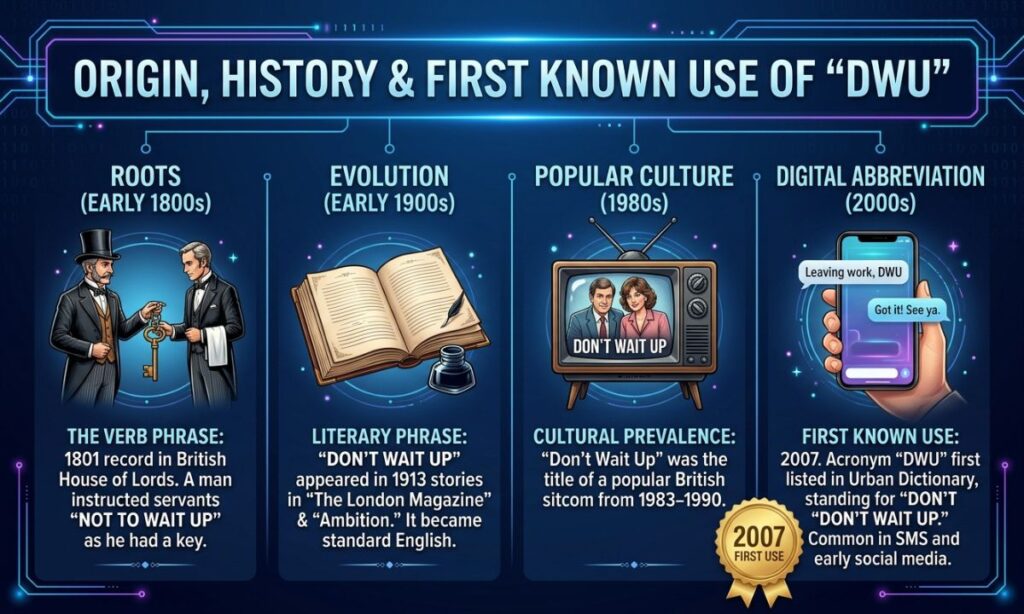
The phrase “don’t wait up” is much older than texting itself. People used to say this out loud long before phones existed. A person heading out for the night would tell their family, “Don’t wait up for me,” meaning they should go to sleep instead of staying awake.
This full phrase has been found in old writings from the early 1900s. Even earlier, in the 1800s, similar wording appeared in records about people telling their household not to stay awake for them. So the idea behind DWU is over a hundred years old.
The short form DWU itself came much later. As texting became popular in the early 2000s, people began shortening common phrases to save time and characters. DWU started showing up in online slang lists around 2007, and it slowly became a common part of digital conversations.
Here is a simple timeline to show how DWU grew over time:
- Early 1800s–1900s: The full phrase “don’t wait up” appears in spoken English and old writings.
- 1983–1990: A British TV show even used “Don’t Wait Up” as its title, showing the phrase was already common.
- Early 2000s: Text messaging becomes popular, and short abbreviations start replacing full sentences.
- 2007: DWU is listed as slang in early internet slang dictionaries.
- 2010s–Today: DWU becomes common across texting apps and social media platforms worldwide.
How People Use DWU in Daily Conversations
DWU fits naturally into everyday chats. People often use it near the end of a message, almost like a friendly goodbye. It works well in casual, relaxed conversations rather than formal or work-related ones.
Here are the most common situations where people type DWU:
- Telling a parent or partner they will be home late.
- Letting a friend know they are heading to a party or event.
- Saying they will be busy with work or study for a long time.
- Signing off a chat before going out for the night.
- Reassuring someone that they don’t need to check in constantly.
Real-Life Example
Think about a normal evening chat. A person going out with friends might text their mom: “I’m meeting the group for dinner, might be late. DWU.” This one small word tells the mom everything she needs to know without a long explanation.
Pro tip: DWU works best when the relationship is already close and comfortable. Sending it to a new coworker or someone you barely know can feel confusing, since they may not understand texting slang the same way.
DWU and Sentence Placement
DWU can appear at the start, middle, or end of a message, and each placement feels slightly different. Placing it at the end, like a sign-off, is the most common style. Placing it at the start makes the message feel more direct and urgent.
- At the end: “Heading out with the team, DWU!”
- At the start: “DWU, I’ll probably be back around midnight.”
- In the middle: “I might be late tonight, DWU, but I’ll message when I’m home.”
All three versions carry the same meaning. The choice usually comes down to personal texting style rather than any strict rule.
Emojis Often Paired With DWU
People often add emojis next to DWU to make the tone even clearer. This is especially common on visual apps like Snapchat and Instagram.
- 🌙 – Shows it is nighttime or late
- 😴 – Playfully tells someone to go to sleep
- ❤️ – Adds a warm or romantic touch
- 👍 – Confirms plans in a simple, casual way
Adding an emoji is optional, but it can soften the message and make it feel friendlier, especially in text-only conversations where tone can be hard to read.
DWU Meaning Across WhatsApp, Instagram, TikTok & Snapchat
DWU means the same thing no matter which app you see it on. But the way people use it can change slightly depending on the platform’s style and audience.
| Platform | How DWU Is Commonly Used |
| Used in personal chats with family and friends, often before going out | |
| Seen in direct messages and sometimes in story captions | |
| Snapchat | Used in quick chats between close friends, often paired with emojis |
| TikTok | Appears in video captions or comments to sound casual and relatable |
| Twitter/X | Used in short posts to show unavailability for a while |
On visual apps like Snapchat and Instagram, DWU is often paired with fun stickers or emojis, such as a moon or a sleepy face. On WhatsApp, it tends to be more plain and direct since people mostly use it there for practical updates.
From personal experience, I have noticed that younger users tend to pair DWU with extra flair, like using it in a bio or a caption to sound relaxed and easygoing. Older users usually stick to the simple, direct texting use, mainly to update family members about their plans.
DWU Meaning Slang Urban Dictionary
Slang dictionaries, including popular ones built by everyday internet users, list “Don’t Wait Up” as the top meaning for DWU. This confirms what most texting guides already agree on.
Slang dictionaries also mention a few playful alternate meanings, though these are far less common. One example is “dat’s what’s up,” a totally different slang phrase that happens to share the same three letters. This can confuse readers, so context always matters.
Here is how to tell the two apart quickly:
- If the message is about plans, timing, or going out, it almost always means Don’t Wait Up.
- If the message is a reaction to news or a statement, it might rarely mean something closer to agreement or excitement, though this use is uncommon today.
Key takeaway: Trust the context of the conversation. The topic being discussed will almost always tell you which meaning fits.
DWU Meaning in Text from a Guy & Girl
Many people wonder if DWU means something different depending on who sends it. The short answer is no — the core meaning stays the same for everyone. However, the emotional tone can shift slightly based on the relationship.
When a Guy Texts DWU
When a guy sends DWU, it usually means he will be busy, out with friends, or unavailable for a while. It is often practical and to the point. In a romantic chat, it can also feel warm, showing he does not want to stress the other person out by making them wait.
When a Girl Texts DWU
When a girl sends DWU, the meaning is the same — she is letting someone know not to wait around for her. The tone is often polite and considerate, especially if she is going out or handling something that will take time.
| Sender | Typical Tone | Common Situation |
| A Guy | Practical, sometimes affectionate | Going out, gaming, busy with work |
| A Girl | Considerate, friendly | Going out, spending time with friends, busy schedule |
Pro tip: Do not read too much into who sends DWU. The words themselves matter more than the sender’s gender. Look at the full conversation, past messages, and how the relationship usually communicates.
Different Meanings of DWU in Other Fields
Outside of texting and chatting, the letters DWU can stand for completely different things. These meanings come from technical, business, or organizational fields and have nothing to do with slang.
| Field | Possible Meaning of DWU |
| Business | Name used by some companies or brands as an abbreviation |
| Education | Short form used by certain university or school programs |
| Technology | Sometimes used as a project or system code name |
| Gaming | Occasionally used as a username or clan tag |
These meanings are specific to their own field and are rarely confused with texting slang. If you see DWU on a school website or business document, it almost certainly is not the “Don’t Wait Up” slang meaning.
Common Confusions, Mistakes & Wrong Interpretations
Slang can be tricky, especially for people who are new to texting culture. Here are the most common mistakes people make when they see DWU.
Mistake 1: Thinking It’s Bad News
Some people panic when they see DWU, thinking something is wrong. In reality, it is usually a relaxed, low-stress message. It simply means the sender will be unavailable or late.
Mistake 2: Confusing It With Similar Abbreviations
DWU can look similar to other short texting terms. Mixing them up leads to confusion.
| Abbreviation | Meaning |
| DWU | Don’t Wait Up |
| WYD | What You Doing |
| DND | Do Not Disturb |
| BRB | Be Right Back |
Mistake 3: Using It in Formal Settings
DWU is casual slang. Using it in a work email or a formal message can come across as unprofessional. It fits best in personal, relaxed conversations.
Mistake 4: Assuming It Always Means Romance
While DWU can appear in romantic chats, it is just as common between friends and family. Do not assume a hidden romantic meaning unless the rest of the conversation supports it.
Pro tip from experience: When in doubt, simply ask. A quick reply like “What do you mean by DWU?” clears up any confusion instantly and shows you are paying attention to the conversation.
Mistake 5: Overthinking a Short Reply
Some people receive a plain “DWU” with no other words and start overanalyzing it. They wonder if the sender is upset or being distant. In most cases, a short DWU is just a quick, busy-moment message, not a sign of a bigger problem.
Mistake 6: Ignoring Punctuation and Tone
The punctuation around DWU can slightly change how it feels. “DWU!” with an exclamation mark often feels excited or playful. “DWU.” with a period can feel more plain or serious.
“dwu” in lowercase, with no punctuation, usually feels the most casual and relaxed. Paying attention to these small details helps you understand the true mood behind the message.
Similar Terms, Alternatives & Related Slang
DWU belongs to a bigger family of texting shortcuts that people use to talk about time, plans, and availability. Knowing these related terms helps you understand chat culture better.
- TTYL – Talk To You Later
- BRB – Be Right Back
- OMW – On My Way
- IDK – I Don’t Know
- GTG – Got To Go
- CU – See You
If clarity matters more than speed, some people prefer to type the full sentence instead of the abbreviation. Options include:
- “Don’t wait up for me.”
- “I’ll be late, go ahead and sleep.”
- “No need to stay awake for me.”
- “Bed head, I’ll text you when I’m home.”
These longer versions carry the same meaning as DWU but are easier to understand for someone unfamiliar with texting slang.
Examples of DWU in Real Chat Situations
Seeing DWU used in real conversations makes the meaning much clearer. Here are a few everyday chat examples.
Example 1 – Friends Going Out
Sara: “We’re heading to the movie after dinner, might be back late. DWU!” Ali: “Okay, have fun!”
Example 2 – Talking to a Parent
Son: “Staying at Ahmed’s place for a study session, DWU.” Mom: “Alright, be safe.”
Example 3 – Romantic Chat
Partner A: “Working a night shift today, DWU.” Partner B: “Got it, take care of yourself.”
Example 4 – Group Chat
Bilal: “Might join late tonight, don’t wait up (DWU), start without me.”
These examples show how flexible DWU can be. It fits family updates, friendly plans, romantic check-ins, and even group conversations.
How to Reply When Someone Says DWU
Replying to DWU is simple, and there is no wrong way to do it as long as you match the friendly tone. Here are some easy, natural replies you can use.
- “Okay, take care!”
- “No worries, have fun!”
- “Alright, text me when you’re home safe.”
- “Got it, see you tomorrow!”
- “Sounds good, take your time.”
If you are close to the person, you can add a caring touch, such as reminding them to travel safely or letting them know you’ll check in later. If it’s a more casual friendship, a short and simple reply works perfectly fine.
Pro tip: Avoid replying with pressure, like asking too many questions about why they’ll be late. DWU is meant to reduce stress, not create more of it. A short, warm reply keeps the conversation light and easy.
Is DWU Still Popular? Trends & Online Usage
DWU remains a widely recognized and commonly used piece of texting slang today. While newer slang terms come and go quickly, DWU has stayed steady because it serves a simple, practical purpose that never goes out of style.
Search interest in phrases like “DWU meaning in text” has grown over the past few years, especially as more young people join social platforms and come across the term for the first time. It continues to appear regularly in captions, direct messages, and everyday chats.
A few reasons DWU has remained popular:
- It is short and easy to type, saving time during quick chats.
- It carries a caring, thoughtful tone without sounding overly serious.
- It works across multiple platforms without losing its meaning.
- It fits naturally into conversations between people of almost any age group, from teens to adults.
Unlike trendy slang that fades within months, DWU is tied to a phrase people have used in spoken English for over a century. That long history is likely why it continues to feel natural, even as digital slang keeps evolving around it.
DWU Compared to Newer Slang Trends
New slang words appear online almost every month, but many of them disappear just as fast. DWU has managed to survive this cycle for a simple reason: it describes a situation that never really changes.
People will always go out late, work night shifts, or get busy with plans, so a quick way to say “don’t wait up” will likely stay useful for a long time.
| Trait | DWU | Trendy Slang |
| Based on a real, older phrase | Yes | Rarely |
| Meaning stays the same over time | Yes | Often changes |
| Works across all age groups | Yes | Usually limited to younger users |
| Likely to fade quickly | No | Often yes |
This staying power is one more reason DWU keeps showing up in daily conversations, year after year, without feeling out of date.
Final words
Have you seen the letters DWU in a text message and felt confused? You are not alone. Many people see this short slang term online and wonder what it means. It shows up in texting, social media, and even in group chats with friends. Understanding it can help you keep up with modern online conversations.
DWU stands for “Don’t Wait Up.” People use this phrase to tell someone not to stay awake waiting for them. It is common when someone is going out late or coming home after a long time. This short form saves time and makes texting faster and easier.
In this article, we will explain the full meaning of DWU in simple words. We will also share how and when to use this slang term correctly. By the end, you will know exactly how to use DWU in your own texts and chats with confidence.
“FAQs”
What does dwu mean in a text message?
DWU means “Don’t Wait Up.” It tells the other person not to stay awake waiting for you because you’ll be out late or busy.
Is dwu used in text messages?
Yes, DWU is commonly used in texts, DMs, and social media chats. It’s especially popular between friends, family, and partners.
What does “dwu” mean?
DWU simply means “Don’t Wait Up.” It’s a quick way to say you’ll be late without writing a full sentence.
What does DWD stand for in text?
DWD is much less standard than DWU, but it’s mostly seen as “Do Whatever, Dude” in casual chats like Snapchat. It’s a laid-back way of agreeing to something without much thought.
What does “DW” mean in Gen Z texting?
DW stands for “Don’t Worry.” It’s used to reassure someone quickly, often before explaining a situation further.
What does dwu mean in a text in Urban Dictionary?
Urban Dictionary lists DWU’s top meaning as “Don’t Wait Up,” matching every other texting source. A rare, unrelated entry ties the same letters to “dat’s what’s up,” but that use is uncommon today.

Hi, I’m Shahid, a passionate content writer and blogger dedicated to creating easy-to-understand, well-researched, and SEO-friendly content. I specialize in explaining the meanings of words, phrases, names, internet slang, symbols, and everyday expressions in a simple and engaging way.