

You may see HF in a text and feel confused. Maybe a friend sent it in a chat. Maybe you saw it in a game or a comment. The two letters look simple, but the meaning can change with the place.
In most chats, HF means “have fun.” People use it to wish someone a good time. You will see it before a game, a party, or a trip. In gaming, it can also mean “have faith” or “hard fail.” In school and work chats, it may mean “high frequency.” The context always tells you the right one.
In this guide, I will explain the full form of HF and where it came from. You will also learn how people use it on social media and in daily texts. I will show easy examples so you can use it with confidence. Let us start with the main meaning.
Pro Tip: Always read the full chat before you reply to HF. If the talk is about a game or a trip, it almost always means “have fun.” If you are not sure, just ask the person. It is better than a wrong reply.
IDE Meaning in Text Slang – Quick Meaning
In text slang, IDE most often means “I Don’t Even.” People use it when something is so shocking, funny, cringe, or confusing that they can’t find words. It is the short form of the phrase “I don’t even know what to say.”
Important: IDE is not a widely used
slang term like LOL or IDK. Many people will not know it. Outside of slang, IDE also stands for “Integrated Development Environment,” which is software programmers use to write code. Always check the context before you decide which meaning fits.
Simple examples
- “He wore socks with sandals to prom. IDE.”
- “She just replied ‘k’ after my long message. IDE.”
- “That plot twist?? IDE 😭”
- “I opened the bill and, yeah, IDE.”
In each case, the writer is saying, “I’m speechless.”
IDE Meaning in Text Slang
Think of IDE as a reaction word. It is not a full sentence. It is a quick emotion you drop at the end of a message.
It works like a sigh or a shrug in text form. You are not giving information. You are showing a feeling.
The full phrase “I don’t even” became popular online years ago. People often stop the sentence halfway, as in “I can’t even” or “I don’t even.” The unfinished sentence is the joke. It says, “This is too much for me.”
IDE squeezes those three words into three letters. It saves time, and it keeps the same dramatic feeling.
What Does IDE Mean in Text?
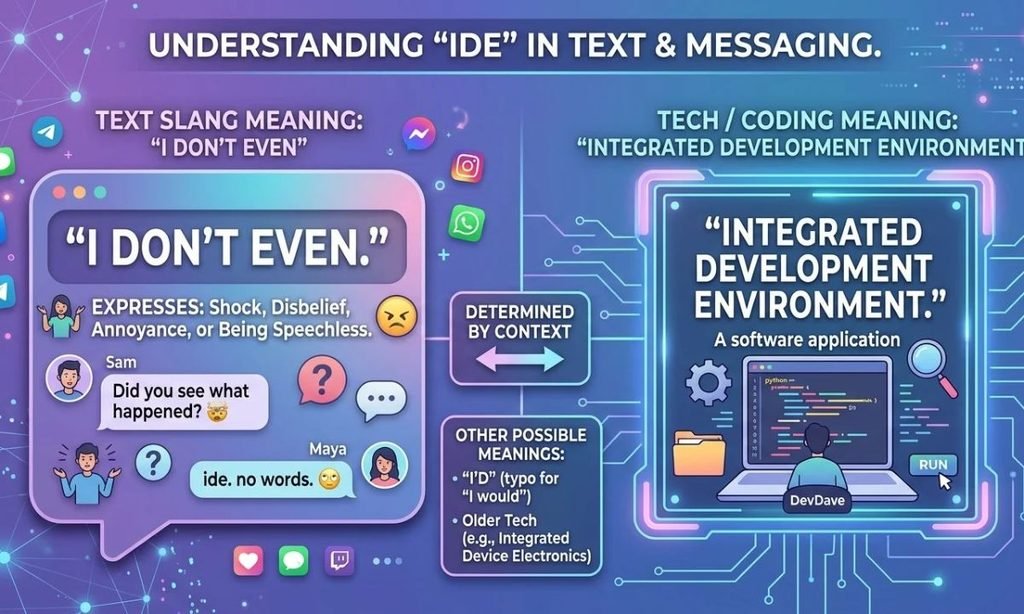
When you see IDE in a text, check three things:
- Who sent it? A close friend or a teenager? Then it is probably slang.
- What came before it? Did something shocking, silly, or annoying just happen?
- Where did you see it? On a coding forum, or in a chat about memes?
Here are the three possible meanings:
| Meaning | Full Form | Where You See It | How Likely in Chat |
| Slang reaction | I Don’t Even | Texts, DMs, comments | Most likely in casual chats |
| Tech term | Integrated Development Environment | Coding, school, work | Most likely in tech talk |
| Typo | Often “I’d,” “ID,” or “ide” for “idea” | Fast typing | Common in quick messages |
Pro tip: If you are not sure, don’t guess. A quick “Wait, do you mean ‘I don’t even’?” costs you five seconds and saves you from an awkward reply.
Origin & Background of IDE in Slang
There is no single proven origin for IDE as slang. It grew out of a bigger internet habit: cutting phrases short.
The phrase “I can’t even” took off in the early 2010s on social media. Teens and young adults used it for anything overwhelming. “I don’t even” followed the same path. People said it with a laugh, a groan, or a screenshot of something wild.
Once a phrase gets popular, people shorten it. That is how IDE likely appeared. A few friends start using it, it spreads in group chats, and it moves to comment sections. Some people never see it at all.
Because it is a small, niche term, you may meet people who have never heard it. That is normal. Slang spreads in circles, not everywhere at once.
Why abbreviations became popular
Abbreviations did not start with smartphones. Telegram writers used short forms to save money. Later, early mobile phones charged by the message and limited each text to 160 characters. People had to be short.
Today the reasons are different:
- Speed: Typing “idk” is faster than “I don’t know.”
- Tone: Short forms sound relaxed and friendly.
- Belonging: If you know the code, you are part of the group.
- Emotion: A short reaction word hits harder than a long sentence.
- Habit: After years of texting, thumbs just type short.
Pro tip from everyday texting: New abbreviations often start as a joke inside one friend group. If your friends use one, ask what it means. Nobody minds.
Real-Life Conversations Using IDE
Here are four made-up but realistic chats. Notice how IDE shows a feeling, not a fact.
1. WhatsApp Chat
Sara: Did you see my brother’s new haircut?
Ali: The one he did himself?
Sara: Yes. He used kitchen scissors.
Ali: IDE 😂😂
Sara: I told him it looks like a bush.
Here, IDE means “I can’t believe it.” It is funny, not mean.
2. Instagram DM Conversation
Maya: She posted 40 photos of the same sunset.
Zoe: All 40?
Maya: All of them. With the same caption.
Zoe: ide
Zoe uses lowercase. That feels even more casual and tired, like a shrug.
3. TikTok Comment Section
Video: A man tries to cook pasta in a coffee machine.
Comment 1: ide 💀
Comment 2: IDE is right. Why would you do this
Comment 3: the confidence though
Comments are short, so IDE fits well. The skull emoji adds to the feeling of “I’m done.”
4. Text Message Example
Dad (typing carefully): Is the IDE ready for the project?
Son: Yes, I installed it this morning.
This is the tech meaning. Dad is talking about coding software, not a feeling. The words around it, “ready for the project” and “installed,” give it away.
Lesson: The same three letters can mean two totally different things. Context is everything.
IDE Meaning in Gen Z
Gen Z loves short, dramatic, and funny reactions. They grew up with group chats, memes, and short videos. Their slang often says a big feeling in very few letters.
For Gen Z, IDE fits a familiar pattern:
- It is dramatic on purpose.
- It is often lowercase, to sound relaxed.
- It is paired with emojis such as 😭, 💀, or 😂.
- It is short enough for comment sections and captions.
Not every Gen Z user knows or uses IDE. Slang changes fast and differs between friend groups, schools, and countries. If you are older and want to sound natural, listen first, then try it. Using slang you don’t feel can sound forced.
IDE Meaning in Urban Dictionary
People often check Urban Dictionary for new slang. It is a user-written site. Anyone can add a definition, so entries can be funny, personal, or even wrong.
For short terms like IDE, expect:
- More than one definition
- Jokes mixed with real meanings
- Different opinions about what the letters stand for
Pro tip: Treat any slang dictionary as a clue, not proof. If three or four sources agree and your friends confirm it, you can trust it. If only one entry says so, be careful.
The most repeated slang reading remains “I Don’t Even.” That matches the way people have used the longer phrase for years.
Emotional & Psychological Meaning
IDE carries a very human feeling: overload. Sometimes life gives us a moment that is too silly, too sad, or too strange to explain. Words feel too small. So we say “I don’t even.”
The phrase can show many moods:
- Shock: “He quit his job by singing. IDE.”
- Amusement: “My cat just fell off the sofa. IDE 😂”
- Frustration: “They canceled again. IDE.”
- Awkwardness: “He called the teacher ‘Mom.’ IDE.”
- Exhaustion: “Monday already? IDE.”
Why people relate
People relate to IDE for a few simple reasons.
First, everyone has been speechless. Using IDE says, “You know the feeling, right?” Second, it lets us react without a long explanation, which is great when you are tired. Third, it adds humor to stress. Laughing at a bad moment makes it lighter.
Psychologists often say that naming a feeling, even in a joking way, can help us handle it. IDE is a tiny, playful way to name “this is a lot.”
A gentle warning: If someone sends IDE after you share something sad or serious, don’t assume they are joking. Ask, “Are you okay?” A kind check-in is always better than a guess.
Usage in Different Contexts
1. Social Media
Social media is where IDE feels most at home. Comments, captions, and replies to stories are short and fast. IDE works with memes, funny videos, and “can you believe this” posts.
Best practice: Pair IDE with an emoji so the tone is clear. A laughing face means “this is hilarious.” A sad face means “this hurts.”
2. Friends & Relationships
Among friends, IDE is playful. You can use it when a friend tells a wild story or does something silly.
In a close relationship, be careful. If your partner shares a problem and you reply “IDE,” it may sound like you don’t care. Say the words fully when feelings are at stake: “I don’t even know what to say, I’m so sorry.”
3. Work or Professional Settings
At work, IDE usually means the tech term, especially on software teams. A manager might ask, “Which IDE are you using for this project?” That is about coding tools.
Using IDE as slang in a work email or a client chat is not a good idea. Many coworkers will think it is a typo or tech talk. Write the whole phrase, or choose a calmer sentence.
- Do: “Which IDE do you prefer, VS Code or PyCharm?”
- Don’t: “The client changed everything again. IDE.”
4. Casual vs. Serious Tone
IDE is casual by nature. It belongs in jokes, memes, and light chats.
| Situation | Is IDE Okay? | Better Choice |
| Funny meme reply | Yes | IDE 😂 |
| Friend’s silly story | Yes | IDE, that’s wild |
| Friend sharing sad news | Not really | “I’m so sorry, I’m here.” |
| Email to a teacher | No | Full sentence |
| Job application | No | Professional language |
| Coding team chat | Yes (tech meaning) | “Which IDE are you using?” |
Common Misunderstandings
Misunderstanding 1: Thinking it’s a typo
Many people see “IDE” and think the sender hit the wrong keys. They may think it should be “I’d,” “ID,” or “idea.” This happens because IDE is not a famous abbreviation.
How to tell: Look at the message. If the sentence makes sense with “I don’t even,” it is probably slang. If it doesn’t, it might be a typo.
Misunderstanding 2: Confusing it with technical terms
If you search “IDE” online, most results will be about Integrated Development Environment. That is a program with a code editor, a tool to run code, and a tool to find mistakes. Examples include VS Code, PyCharm, and Eclipse.
That is a real and common meaning, but it has nothing to do with feelings. Check the topic of the chat. Coding talk means the software meaning. Memes and gossip mean the slang meaning.
Misunderstanding 3: Using it too formally
Because IDE looks like a serious acronym, some people drop it in formal writing. That causes confusion. Never use slang IDE in school, work, or official messages. Your reader may not know what you mean, and you may look careless.
Comparison Table
Here is how IDE compares with its two main identities:
| Feature | IDE (Slang) | IDE (Tech) |
| Full form | I Don’t Even | Integrated Development Environment |
| Purpose | Show shock, humor, or speechlessness | Help write and test code |
| Tone | Casual, funny | Technical, neutral |
| Common places | Chats, DMs, comments | Programming, classes, jobs |
| Typical age group | Teens, young adults | Students, developers |
| Emoji use | Very common | Rare |
| Safe at work? | No | Yes |
| Known worldwide? | Not widely | Yes, among tech people |
Variations and Related Expressions
IDE lives in a big family of short texting phrases. Knowing its cousins helps you read chats with confidence.
1. IDEK
IDEK means “I Don’t Even Know.” It is more common than IDE. Use it when you truly have no idea: “IDEK what happened in that movie.”
2. IDTS
IDTS means “I Don’t Think So.” It is a polite or playful no. Example: “Are you cleaning your room today? IDTS.”
3. SMH
SMH means “Shaking My Head.” It shows disappointment or disbelief. It is a close cousin of IDE, since both react to something silly or sad.
4. ICYMI
ICYMI means “In Case You Missed It.” People use it to share news or posts someone may have skipped. Example: “ICYMI, class is moved to Friday.”
5. TBH
TBH means “To Be Honest.” It comes before an honest opinion: “TBH, I liked the first song better.”
6. FWIW
FWIW means “For What It’s Worth.” It softens advice: “FWIW, I would take the earlier bus.”
7. IDK
IDK means “I Don’t Know.” It is one of the most used abbreviations ever. Don’t mix it up with IDE. One shows a lack of knowledge, the other shows a feeling.
8. IDC
IDC means “I Don’t Care.” It can sound rude. Say it only with people who will not be hurt. Example: “IDC what we eat, anything is fine.”
9. IYKYK
IYKYK means “If You Know, You Know.” It is used for inside jokes. It says, “Some people will understand this, and that’s the fun.”
10. SMFH
SMFH is a stronger, ruder version of SMH. It shows more anger or disgust. Skip it with teachers, parents, or at work.
Quick comparison of these terms
| Abbreviation | Meaning | Feeling Behind It |
| IDE | I Don’t Even | Speechless |
| IDEK | I Don’t Even Know | Confused |
| IDTS | I Don’t Think So | Doubtful |
| SMH | Shaking My Head | Disappointed |
| ICYMI | In Case You Missed It | Helpful |
| TBH | To Be Honest | Open |
| FWIW | For What It’s Worth | Gentle |
| IDK | I Don’t Know | Unsure |
| IDC | I Don’t Care | Uninterested |
| IYKYK | If You Know, You Know | Playful |
| SMFH | Shaking My F-ing Head | Angry |
How to Respond When Someone Uses IDE
Your reply should match the mood. First ask yourself: is this person laughing, upset, or both?
Casual Replies
Use these when the chat is light:
- “Right?? I can’t either.”
- “Same, I’m speechless.”
- “I know, it’s too much.”
- “Wait, what happened?”
Funny Replies
These fit memes, jokes, and silly stories:
- “Don’t even, I’m still laughing.”
- “Imagine being there 😭”
- “That’s a whole movie.”
- “My brain just left the chat.”
Mature or Supportive Replies
Use these when the person seems upset or tired:
- “That sounds like a lot. Want to talk?”
- “I get it. Take your time.”
- “I’m here if you want to explain.”
Pro tip: If the tone is unclear, choose kindness first. You can always switch to jokes later, but you can’t easily take back a careless reply.
Private or Respectful Replies
Sometimes the topic is personal. If someone sends IDE in a group chat about something painful, move the talk to a private message:
- “Do you want to chat one-on-one?”
- “I’ll message you in a minute.”
This respects their feelings and keeps others from piling on.
Regional & Cultural Usage
Slang is never the same everywhere. It changes with language, humor, and the apps people use.
Western Culture
In English-speaking countries like the US, UK, Canada, and Australia, “I can’t even” and “I don’t even” became well known in online culture. Short forms like IDE can appear in teen chats, but they are far less common than IDK or SMH.
Humor in these places often leans on sarcasm and drama. IDE fits that style well.
Asian Culture
In many Asian countries, young people mix English abbreviations with their own languages. Chats may use local words, stickers, and emojis instead. IDE may be understood by English-fluent users, but local reaction words are usually more popular.
Remember too that “ide” is a real word or sound in some languages, so readers may not see an English abbreviation at all.
Middle Eastern Culture
In the Middle East, people often switch between Arabic and English in chats. English slang can be popular with younger users, especially on Instagram, TikTok, and Snapchat. Some write Arabic in English letters, which can mix with abbreviations.
Politeness and respect matter in many communities, so use slang carefully with elders and in formal chats. When in doubt, write in full words.
Global Internet Usage
The internet is global, but slang does not spread evenly. Memes, videos, and games carry words across borders fast. A phrase can be huge in one friend group and unknown in the next.
That means IDE is a niche term. Some users know it well; others never will. The safest approach is to use it only with people who use it first, and to explain it kindly when someone asks.
IDE in text slang most often means “I Don’t Even,” a quick way to say you are speechless, shocked, or amused. In coding chats, it means Integrated Development Environment. Sometimes it is just a typo. The surrounding words, the people, and the platform tell you which one it is.
Final Words
Now you know what HF means in a text. In most chats, it simply means “have fun.” It is a quick and friendly way to wish someone a good time. You can use it with friends, family, and gaming partners. It takes just two letters, so it saves time.
Always check the context before you reply. The same two letters can mean different things in games, school, or work. If you are not sure, ask the person. It is better to ask than to give a wrong answer. Keep your tone kind and light, and you will do fine.
Use HF in your own chats and see how it feels. Share this guide with a friend who also gets confused by short words in text. Small chat terms are easy to learn when you see real examples. Thank you for reading, and come back for more simple guides.
FAQs
What does HF stand for in slang?
HF mostly stands for “have fun.” People use it to wish someone a good time. In gaming chats, it can also mean “have faith” or “hard fail.”
What is HF in chatting?
In a chat, HF means “have fun.” Friends send it before a game, a party, or a trip. It is a quick and kind way to say enjoy yourself.
What does fh stand for in slang?
FH is not a common slang term. It is often a typing mistake for HF. It can also mean “full house” in card games or “family home” in some chats.
What does HF stand for?
HF most often stands for “have fun” in texts. In science and radio, it means “high frequency.” In health chats, it can mean “heart failure.”
What is HF texting?
HF texting means sending “have fun” in short form. It is a friendly sign-off. Use it when someone is going out or starting a game.
What is HF full form?
The full form of HF in text is “have fun.” In other fields, it can mean “high frequency” or “heart failure.” The topic of the chat tells you which one fits.
What is fs in gen z slang?
FS means “for sure.” Gen Z uses it to say yes or to agree with someone. It can also mean “for real” in some chats, so check the context.
What does HF mean in a relationship?
In a relationship chat, HF usually means “have fun.” A partner may send it when you go out with friends. It shows trust and care. Sometimes it can mean “hug first” in a cute, playful way.
What does FWA mean in texting?
FWA is not a very common term. It most often means “friends with attitude” or “forgot what I was saying.” Some people also use it for “free wireless access.” Check the chat to know which one fits.

Hi, I’m Shahid, a passionate content writer and blogger dedicated to creating easy-to-understand, well-researched, and SEO-friendly content. I specialize in explaining the meanings of words, phrases, names, internet slang, symbols, and everyday expressions in a simple and engaging way.