
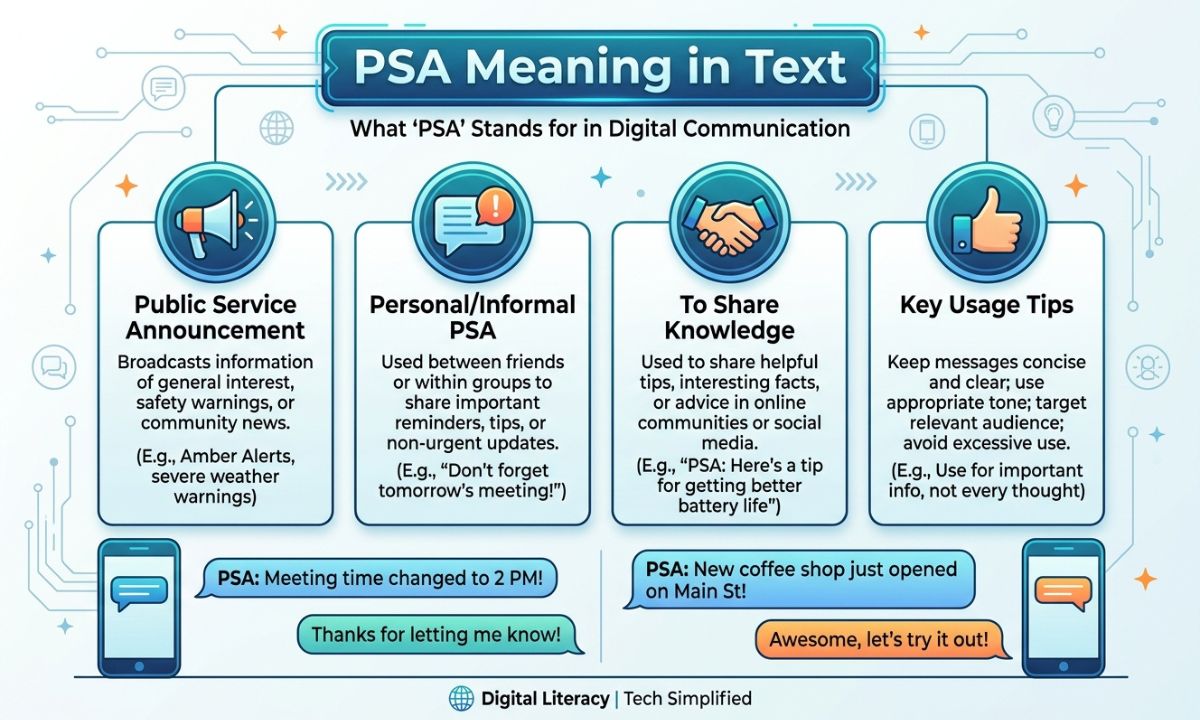
PSA shows up a lot in texts, group chats, and on social media. It can feel confusing if you see it for the first time. Most people use it to mean “Public Service Announcement.” It is a quick way to share important news with friends or followers.
People use PSA when they want to warn, remind, or inform others about something. You might see it before a message about a sale, a schedule change, or a safety tip. It helps the message stand out and grab attention fast. That’s why it’s a popular tag in casual chats and online posts.
The meaning of PSA can shift a little depending on where you see it. On social media, it often has a light or funny tone. In texts, it usually means someone has useful info to share right away. Knowing this slang term helps you understand modern chat language better.
What Does PSA Mean in Text?
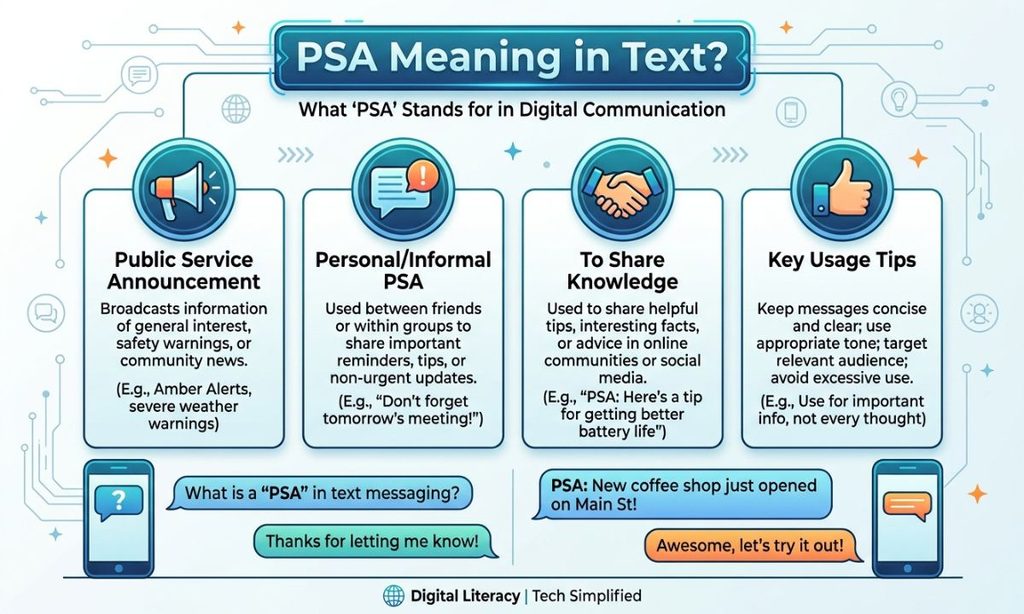
PSA stands for “Public Service Announcement.” People use it in texts, group chats, and on social media to share important information fast. It is a short way to say, “Hey, listen up, this matters.”
You will see PSA before a message that warns you, reminds you, or teaches you something. It works like a flag that tells readers to pay attention—the message after PSA is usually short, direct, and useful.
PSA started as a serious term. Today, it also has a playful side. People use it for jokes, opinions, and everyday reminders too. This mix of serious and funny is what makes PSA so common in modern chat.
PSA Meaning in Slang & Chat
In slang, PSA does not always mean an official announcement. It often just means “I want to tell you something important.” Teens and young adults use it to grab attention before sharing news, advice, or an opinion.
Here is how PSA works in casual chat:
- It signals importance before the main message.
- It can be serious (“PSA: the store closes early today”).
- It can be funny (“PSA: pineapple belongs on pizza, fight me”).
- It often appears in all caps for extra emphasis: PSA.
| PSA Meaning | Explanation | Example in Chat |
|---|---|---|
| Public Service Announcement | A message shared to give people useful information or a warning. | “PSA: The deadline is tomorrow!” |
| Please See Attached | Used in emails or messages when referring to an attached file. | “PSA for the report attached.” |
| Prostate-Specific Antigen | A medical term, usually not slang. | “My doctor asked me about my PSA level.” |
| PSA (Attention/Announcement) | A casual way to say “important announcement” online. | “PSA: Don’t forget to save your work!” |
Pro tip: When you see PSA in a text, always read the next sentence carefully. That is where the real message sits. The word PSA itself is just the attention-grabber.
Background / Origin Of PSA
The term Public Service Announcement comes from radio and television. Stations aired short messages about safety, health, and civic duty. These messages were not ads. They existed to help the public, not to sell a product.
Governments and non-profit groups made PSAs about topics like:
- Road safety
- Disease prevention
- Voting reminders
- Disaster warnings
When texting and social media became popular, people borrowed this term. They needed a quick way to say, “This is not spam, this is something you should know.” So PSA moved from television screens into phone screens.
Real talk from experience: I have watched this shift happen firsthand while writing content for online audiences. Ten years ago, PSA rarely showed up in a text message. Now it shows up in tweets, group chats, and even work emails.
The word traveled from formal broadcasting into everyday slang, and it kept its core meaning: pay attention, this is useful.
This shift did not happen overnight. Early internet forums picked up PSA first, using it mostly for serious warnings about scams or software problems. Then texting culture grabbed the word and gave it more flexibility.
Younger users started applying it to small, everyday moments, not just big warnings. That is how a word built for national safety broadcasts ended up describing a missing TV remote or a group’s pizza order.
Usage Of PSA in Different Contexts
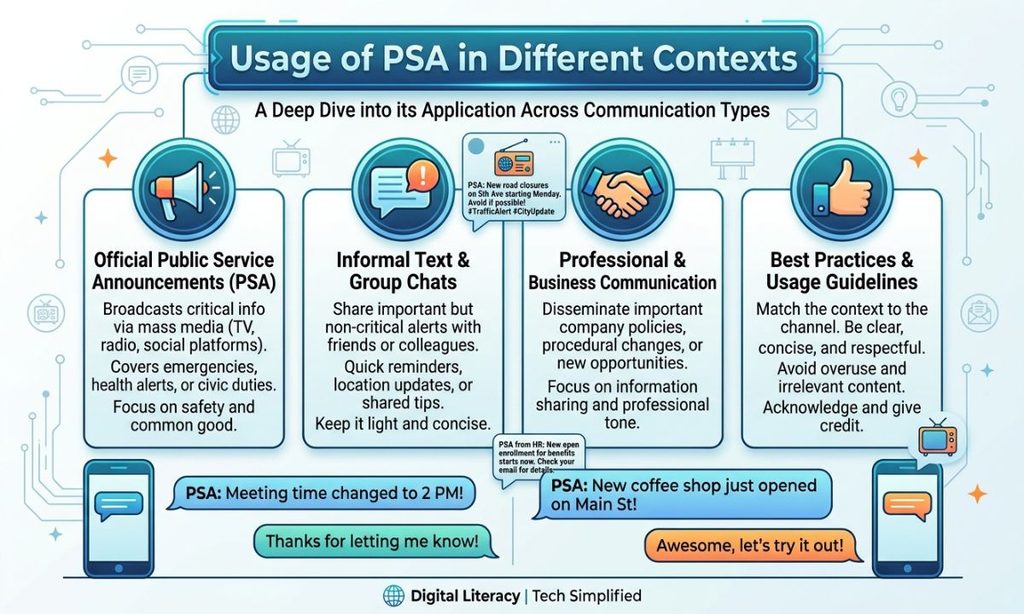
PSA changes its tone depending on where you use it. The core meaning stays the same, but the feel of the message shifts a lot.
General Usage
In general chat, PSA works as an attention signal. People use it to introduce:
- A warning (“PSA: the WiFi will be down tonight”)
- A reminder (“PSA: don’t forget the meeting is moved to 3 PM”)
- An opinion (“PSA: this show is actually really good”)
- A life hack (“PSA: you can microwave rice with a wet paper towel”)
The message right after PSA is usually short and clear. People do not add long explanations. They want the reader to get the point fast.
Formal vs Informal Usage
PSA can be formal or informal, and knowing the difference helps you use it correctly.
| Setting | Tone | Example |
| Formal | Official, serious | “PSA: The office will close on Friday for maintenance.” |
| Informal | Casual, playful | “PSA: Iced coffee in winter is a personality trait.” |
| Workplace | Professional, direct | “PSA: Please submit your reports by Monday noon.” |
| Friend group | Fun, sarcastic | “PSA: Sarah’s birthday is Saturday, don’t forget snacks.” |
In formal settings, PSA still points to something official, like a company update. In informal settings, PSA is more about grabbing attention with a smile. Both uses share the same job: make people notice the message.
PSA Meaning on Social Media Platforms
Social media is where PSA feels most at home. Each platform gives it a slightly different flavor.
- Twitter/X: PSA often starts viral threads. People use it to correct misinformation or share breaking news in a simple format.
- Instagram: PSA shows up in captions and Stories, often about beauty tips, safety reminders, or relationship advice.
- TikTok: Creators say “PSA” out loud in videos before sharing a quick tip, warning, or funny observation.
- Facebook: Older users tend to use PSA more in its original, serious sense, like local safety alerts or missing pet notices.
- Reddit: PSA posts usually warn about scams, software bugs, or give community reminders.
Pro tip from real content work: On platforms like TikTok and Instagram, a PSA-style post tends to get more engagement than a plain statement. The word PSA acts like a hook. It tells the scroller, “Stop scrolling, this one is worth your time.” If you create content, opening with PSA can boost your click-through rate.
Other Meanings Of PSA in Different Fields
PSA is not only about public service announcements. The same three letters stand for very different things in other industries. Context always decides the real meaning.
PSA Meaning in Real Estate
In real estate, PSA usually means Purchase and Sale Agreement. This is a legally binding contract between a buyer and a seller. It locks in details like the price, the closing date, and any conditions both sides must meet before the deal closes.
Key facts about a real estate PSA:
- It becomes active once the seller accepts an offer.
- It lists the purchase price and earnest money deposit.
- It includes contingencies, which are conditions that must be met.
- It guides the deal all the way to the closing day.
If you ever hear “PSA” in a property conversation, it almost never means “public service announcement.” It means a serious legal document.
PSA Meaning in Business
In general business talk, PSA can also mean Professional Services Agreement. This is a contract between a company and a service provider. It explains what work will happen, the timeline, and the payment terms.
Businesses use PSAs to:
- Set clear expectations for a project.
- Protect both sides with legal terms.
- Define deadlines and deliverables.
- Avoid disputes over scope or payment.
PSA Meaning in Technology
In tech and IT, especially in managed services, PSA stands for Professional Services Automation. This is software that IT companies use to manage projects, track time, handle billing, and organize client work in one place.
A PSA tool typically helps with:
- Time tracking for technicians and consultants.
- Ticket management for support requests.
- Invoicing and billing clients accurately.
- Project planning across teams.
PSA Meaning in Oxygen Gas Plant
In the industrial and medical world, PSA stands for Pressure Swing Adsorption. This is a technology used to separate oxygen from air without needing extreme cold temperatures.
Here is how it works in simple words:
- Air passes through a tank filled with a material called zeolite.
- The zeolite traps nitrogen and lets oxygen pass through.
- This process creates medical-grade or industrial-grade oxygen.
- PSA oxygen plants became widely known during health emergencies, when hospitals needed a steady oxygen supply.
This meaning has nothing to do with texting. It shows how important context is when you see the letters PSA.
Examples of PSA Meaning in Text in Sentences
Seeing real examples makes the meaning click faster. Here are common ways PSA appears in everyday texting:
- “PSA: the store is closing 30 minutes early today.”
- “PSA: Check your email; the group project deadline changed.”
- “PSA: it’s supposed to rain all weekend, bring an umbrella.”
- “PSA: This new coffee shop downtown is amazing.”
- “PSA: Don’t leave your phone charging overnight; it’s bad for the battery.”
- “PSA: the concert tickets go on sale at noon.”
- “PSA: reply-all is not your friend, please stop.”
Notice a pattern: PSA sits at the start of the sentence, followed by a colon, then the actual message. This format helps readers spot the important part instantly.
Common Misconceptions
Why You’re Probably Confused
Many people get confused because PSA shows up with totally different meanings across contexts. One minute it is a casual reminder from a friend. The next minute it is a legal document in a real estate deal. This mix of meanings makes people unsure which one applies.
Another reason for confusion is tone. Since PSA can be serious or joking, readers sometimes cannot tell if the message is important or just a joke, especially in text where you cannot hear someone’s voice.
What It Actually Means in Real Life
In real, everyday texting, PSA almost always means: “I have something worth telling you, so pay attention.” That is it. The specific topic can be anything from safety to gossip to a coupon code. The word itself is just a signal flag, not a fixed topic.
How People Use It in Everyday Situations
People reach for PSA in many daily moments:
- Group chats: Sharing schedule changes or reminders.
- Family texts: Warning about weather or traffic.
- Work Slack messages: Announcing small policy updates.
- Social posts: Sharing tips, warnings, or hot takes.
- Friend banter: Making a joke sound “official” for comedic effect.
Pro tip: If you want your message to stand out in a busy group chat, starting with PSA works well. It breaks the pattern of normal chatting and makes people stop to read.
Think about a typical school or work group chat. Messages usually flow back and forth about small talk, jokes, and quick replies. When someone types PSA, it acts like a small stop sign in the middle of that flow.
Readers know the next line is not just chatter; it is something they should actually remember. This is why teachers, team leads, and even parents have started borrowing the term, even if they first saw it from younger family members.
Tone & Context (This Really Matters)
Tone changes everything about how PSA lands. The same word can sound helpful or annoying depending on how you use it.
- Used once in a while, PSA feels helpful and clear.
- Used too often, PSA starts to feel like noise, and people may ignore it.
- Used with humor, PSA can build connection and make people smile.
- Used without context, PSA can confuse the reader about how serious the message really is.
Always think about your audience before typing a PSA. A coworker might expect a professional tone, while a close friend might enjoy a playful one.
A good way to check your tone is to read the message out loud before sending it. If it sounds like something a news anchor would say, it probably fits a formal setting.
If it sounds like something you would say while laughing with a friend, it probably fits a casual setting. This small habit can save you from sending a message that feels out of place.
When You Should NOT Use This Term
PSA is not the right choice in every situation. Avoid it when:
- The message is not actually important, since overusing it weakens its effect.
- You are writing something very formal, like a legal letter or official report, where “Notice” or “Announcement” fits better.
- The topic is sensitive or emotional, such as bad news about a person’s health. PSA can sound too casual for serious personal matters.
- You are talking to someone who may not know the slang, such as an older relative who might take it too literally or get confused.
Natural Alternatives (Grouped by Tone)
If PSA does not fit the moment, try one of these alternatives instead.
Casual alternatives:
- Heads up
- Just so you know
- FYI
- Quick note
Friendly but clear alternatives:
- Reminder
- Just a thought
- One more thing
- Quick update
Formal alternatives:
- Please note
- Kindly be informed
- Important notice
- Announcement
Choosing the right alternative helps your message match the mood of the conversation.
Real-Life Examples
Here are a few real-style scenarios showing PSA in action:
- A college student texts their roommate: “PSA: I used the last of the milk, going to the store later.”
- A social media page posts: “PSA: This popular skincare ingredient can irritate sensitive skin.”
- A manager sends a Slack message: “PSA: the printer on the 3rd floor is out of order.”
- A traveler tweets: “PSA: airport security lines are super long today, come early.”
Each example shares the same structure: PSA, then a short and useful fact.
Platform & Culture Notes
Different online communities treat PSA a bit differently:
- In gaming communities, PSA often warns about server downtime or game bugs.
- In fandom spaces, PSA might correct a rumor about a show, movie, or celebrity.
- In local community groups, PSA usually covers safety, weather, or missing pets.
- In workplace chat tools, PSA keeps a professional tone while still feeling quick and direct.
Pro tip: Before using PSA in a new group or platform, read a few older posts first. Some communities use it strictly for serious warnings, while others use it for humor. Matching the group’s style helps your message land well.
Similar Terms & Alternatives
PSA belongs to a small family of “attention word” abbreviations. Here is how they compare:
| Term | Full Meaning | Typical Tone |
| PSA | Public Service Announcement | Mix of serious and playful |
| FYI | For Your Information | Neutral, informative |
| TLDR | Too Long, Didn’t Read | Summarizing long info |
| NGL | Not Gonna Lie | Honest opinion |
| IMO | In My Opinion | Personal viewpoint |
PSA stands out because it feels like an announcement, while FYI feels more like a quiet note, and IMO feels more like a personal opinion.
How to Respond to PSA Meaning in Text When Someone Uses It
When someone sends you a PSA text, you do not need a complicated reply. Simple responses work best:
- “Thanks for the heads up!”
- “Good to know, appreciate it.”
- “Noted, thanks!”
- For a funny PSA: “Lol duly noted” or a simple laughing emoji.
If the PSA is important, like a schedule change, it also helps to confirm you saw it, so the sender knows their message worked.
In group settings, a quick reply also stops the sender from repeating the message later. A short “got it, thanks” saves everyone time and shows that the PSA did its job. This small courtesy matters more in work chats, where missed updates can cause real confusion.
RMM PSA Meaning: Professional Services Automation
In the IT and managed services world, RMM and PSA often appear together. RMM stands for Remote Monitoring and Management, and PSA here stands for Professional Services Automation.
Here is how they work as a team:
- RMM tools watch over computers, servers, and networks to catch problems early.
- PSA tools manage the business side, like tickets, billing, time tracking, and client records.
- Many IT companies connect RMM and PSA software together so technical alerts turn into organized support tickets automatically.
This meaning of PSA is completely different from the texting meaning, but it shows how the same short word can carry serious business value in the right field.
Difference Between PSA Meaning in Text and Similar Terms
It helps to see PSA and its closest cousins side by side:
| Term | Best Used For | Feels Like |
| PSA (text/slang) | Sharing something worth noticing | An announcement |
| PSA (real estate) | Property deal contracts | A legal document |
| PSA (business) | Service contracts | A formal agreement |
| PSA (tech) | Managing IT services | A software system |
| FYI | Small extra info | A quiet note |
The texting version is the most casual of them all. The others involve contracts, agreements, or software, which makes them far more formal.
Relevance in Online Conversations & Dating Apps
PSA also shows up in dating apps and online conversations, often in a light, self-aware way. People use it to share a quick fact about themselves or set an expectation early.
Examples include:
- “PSA: I take my coffee very seriously.”
- “PSA: I’m not a morning person, don’t expect long texts before 10 AM.”
- “PSA: I will talk about my dog a lot.”
In this setting, PSA works as a fun icebreaker. It signals honesty with a touch of humor, which many people find charming in a bio or an opening message. It shows the sender’s personality while keeping the tone light and easy to read.
Dating app users also use PSA to set gentle boundaries early on, without sounding harsh. A line like “PSA: I don’t check messages much on weekdays” tells a match what to expect, without needing a long explanation. This small trick keeps conversations honest while still feeling friendly and low-pressure.
Final words
PSA is one of those short terms that carries a big job. In texting and social media, it almost always means “pay attention, this matters,” whether the topic is serious, silly, or somewhere in between. The word borrows its energy from old-school radio and TV announcements, but it now lives comfortably inside group chats, tweets, and captions.
Outside of texting, PSA takes on completely different jobs. It can mean a real estate contract, a business agreement, or software that runs an IT company. Even in gas plants, PSA stands for a science-based oxygen process. This range shows why context is everything when you spot these three letters.
The next time you see PSA in a text, look at the words right after it. That is where the real message lives. And if you ever use PSA yourself, remember: it works best when it truly signals something worth stopping for.
“FAQs”
What does “PSA” mean in text slang?
PSA stands for Public Service Announcement. In slang, it means the sender has something important or useful to share right away.
What does PSA stand for in social media?
On social media, PSA still means Public Service Announcement. People use it to flag warnings, tips, or news worth noticing in a post or caption.
What does PSA stand for in Gen Z?
Gen Z uses PSA the same way: Public Service Announcement, but often with a playful or sarcastic tone rather than a strictly serious one.
What does “PSA” stand for in a chat?
In chat, PSA means Public Service Announcement. It signals that the message right after it is worth stopping to read.
What is PSA short for?
PSA is short for Public Service Announcement. Outside texting, the same letters can stand for other terms depending on the field.
What does “PSA” mean on TikTok?
On TikTok, PSA means Public Service Announcement. Creators say it before sharing a quick tip, warning, or funny observation.
What is a PSA message?
A PSA message is a short note that shares important information, a warning, or a reminder in a clear and direct way.
What does “PSA” mean in slang in Urban Dictionary?
Urban Dictionary defines PSA as Public Service Announcement, used loosely online to introduce any statement the sender wants people to notice.

Hi, I’m Shahid, a passionate content writer and blogger dedicated to creating easy-to-understand, well-researched, and SEO-friendly content. I specialize in explaining the meanings of words, phrases, names, internet slang, symbols, and everyday expressions in a simple and engaging way.