
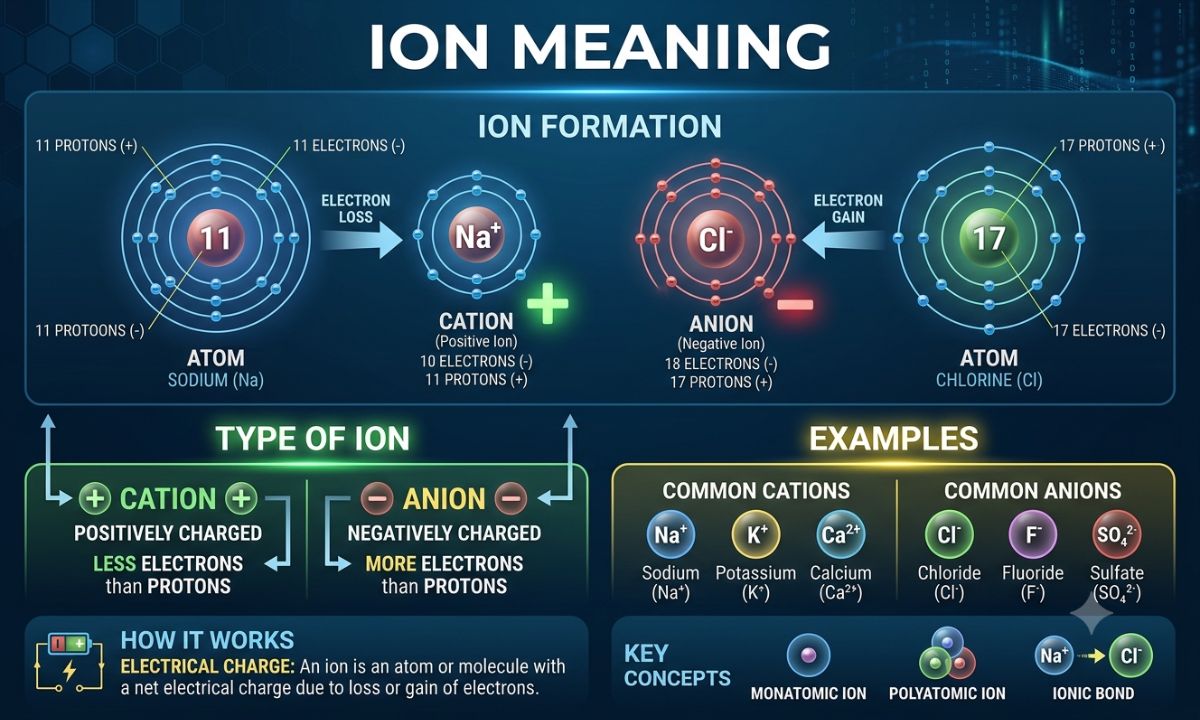
Ion is a popular word you see in texting and on social media. It is not a real word. It is short slang for “I don’t.” People use it to make texting faster and easier. You will see it a lot on TikTok, Twitter/X, and Instagram.
Young people use ion to sound casual and cool. For example, “ion know” means “I don’t know.” “Ion care” means “I don’t care.” This slang saves time when typing. It is very common in DMs, comments, and captions.
Knowing slang like ion helps you understand online conversations better. It also helps you talk like a local in casual chats. This guide will explain the full meaning, examples, and how to use it the right way.
Meaning & Definition Of Ion
Ion is a short slang word. People use it in texting and on social media. It is not a real dictionary word by itself. In most chats, ion is short for “I don’t.”
For example:
- “ion know” = “I don’t know”
- “ion care” = “I don’t care”
- “ion like that” = “I don’t like that”
| Topic | Short Explanation | Example |
|---|---|---|
| Ion (Slang) | A short form of “I don’t” used in texting and social media. | “ion know” = “I don’t know” |
| Why It’s Used | It saves time when typing. | “ion care” = “I don’t care” |
| Ion (Science) | A charged atom or molecule that has gained or lost electrons. | Na⁺, Cl⁻ |
There is also a scientific meaning of the word “ion.” In physics and chemistry, an ion is a tiny particle with an electric charge.
This meaning is very different from the texting slang. We will cover both meanings in this article.
Background Of Ion
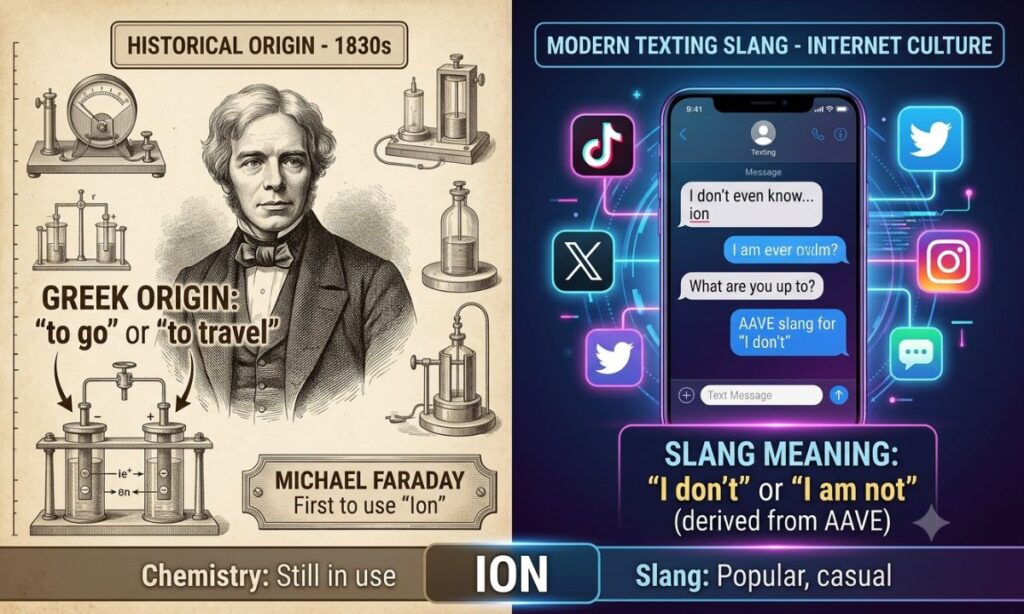
The word “ion” has two totally separate backgrounds. One comes from science. The other comes from internet culture.
In science, the word “ion” is very old. A scientist named Michael Faraday used this word in the 1830s. It comes from a Greek word meaning “to go” or “to travel.” Ions move toward electric charges, so the name made sense.
In texting, the slang “ion” is much newer. It grew from African American Vernacular English (AAVE). This is a style of English with its own words, sounds, and grammar. Many popular slang words in texting and rap songs come from AAVE.
Over time, social media picked up this word. Apps like TikTok, Twitter/X, and Instagram helped it spread fast to millions of young people around the world.
Today, most people who type “ion” are not thinking about chemistry at all. They are using it as a fast, casual short form.
Usage in Different Contexts (Chat, Social Media, Professional Fields)
The word “ion” changes meaning depending on where you see it. Context matters a lot. Here is a simple breakdown:
| Context | Meaning of “Ion” | Example |
| Texting / Chat | Short for “I don’t” | “ion feel like going out” |
| Social Media Captions | Short for “I don’t” | “ion do drama 😌” |
| Physics Class | Charged particle | “The ion moved toward the negative plate” |
| Medical Field | Charged particle in the body | “Sodium ions help your nerves work” |
| Aircraft & Engineering | Ion engines or ion sensors | “The spacecraft uses ion propulsion” |
Pro tip: Always look at the full sentence before you decide what “ion” means. If the sentence sounds casual and personal, it is slang. If it sounds technical, it is science.
In professional writing, like emails, reports, or schoolwork, you should never use “ion” as slang. It looks unprofessional. Save it for texting friends or casual social posts.
Meaning in Chat, WhatsApp, Instagram, TikTok
Different apps use “ion” in slightly different ways, but the core meaning stays the same: “I don’t.”
On WhatsApp: People use “ion” in normal chats with friends. It feels relaxed and friendly. Example: “Ion think I can make it today, sorry.”
On Instagram: “Ion” shows up a lot in captions, comments, and story replies. It gives posts a cool, laid-back tone. Example: “ion post my face that much lol.”
On TikTok: This is where “ion” is most popular. You will see it in video captions, comments, and even spoken out loud in videos. TikTok creators often say “ion” instead of “I don’t” when talking fast. Example: “ion get why people do that.”
On Twitter/X: “Ion” fits well in short posts because Twitter/X has a character limit. Short slang words like “ion” help people say more in fewer letters.
Here is a quick list of common “ion” phrases you will see across these apps:
- ion know – I don’t know
- ion care – I don’t care
- ion think so – I don’t think so
- ion mind – I don’t mind
- ion get it – I don’t get it
- ion trust that – I don’t trust that
Meaning in Physics, Medical, and Aircraft Terminology
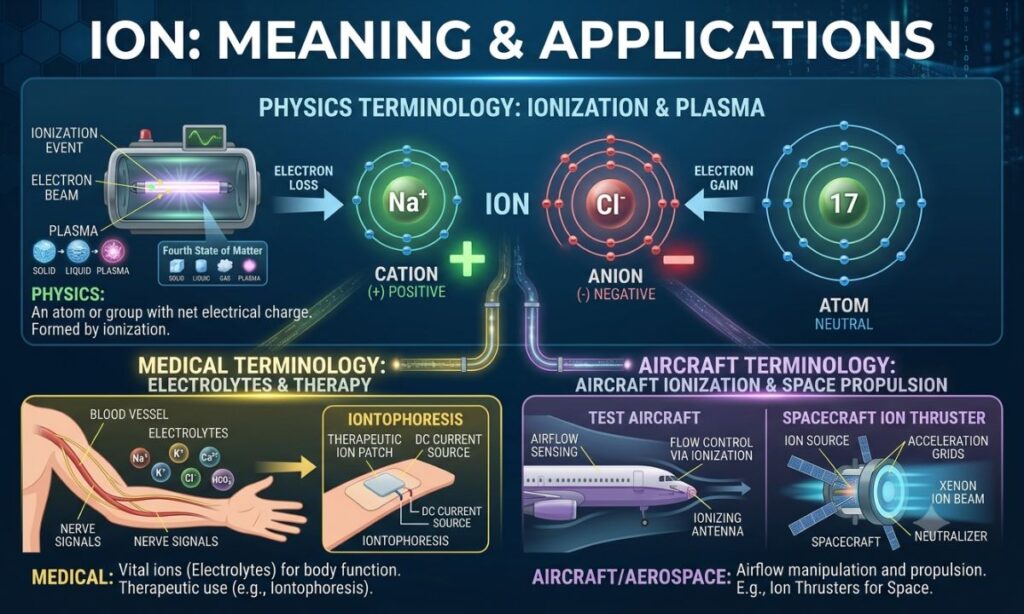
Away from texting, “ion” has a serious and important scientific meaning. Understanding this helps you avoid confusion in school or work settings.
Ion Meaning in Physics
In physics, an ion is an atom or molecule that has gained or lost an electron. This gives it an electric charge.
- If it loses an electron, it becomes a positive ion (cation).
- If it gains an electron, it becomes a negative ion (anion).
Ions are the reason batteries work. They are also why lightning happens in the sky.
Ion Meaning in Medical Field
In medicine and biology, ions play a huge role in how your body works.
- Sodium ions and potassium ions help your nerves send signals.
- Calcium ions help your muscles move and your blood clot.
- Doctors check electrolyte levels, which are really just ion levels in your blood.
Real-life example: If you ever get an IV drip at a hospital, it often contains electrolytes. These electrolytes are ions your body needs to stay balanced and healthy.
Ion Meaning in Aircraft Terminology
In aerospace and aircraft engineering, ions are used in ion propulsion systems. These are special engines that push out charged particles (ions) to create thrust.
- Ion thrusters are used in spacecraft, not regular airplanes.
- They are very fuel-efficient but produce low thrust, so they work best in space, not on Earth.
- NASA has used ion engines on missions like Dawn and Deep Space 1.
Some aircraft also use ion sensors to detect air particles and improve safety systems.
Common Misconceptions
Many people get confused about “ion.” Here are the most common mix-ups, cleared up simply.
Misconception 1: “Ion” is a real English word on its own. This is false. As slang, it is a short form of “I don’t.” It is not found in formal dictionaries as a standalone casual word.
Misconception 2: “Ion” always means the science term. Not true. In 99% of texting and social media use, it means “I don’t,” not the charged particle.
Misconception 3: “Ion” is brand new slang. Actually, it has been around for years in spoken English and AAVE. Social media just made it more visible and popular worldwide.
Misconception 4: You can use “ion” in formal writing. This is a mistake many students make. Never use “ion” in essays, emails, or professional messages. Always write “I don’t” in full.
Misconception 5: “Ion” is disrespectful or rude. Not at all. It is simply casual slang. It is neutral and used by people of all backgrounds in relaxed conversations.
Ion Meaning in Text (Quick Recap for Social Media Content)
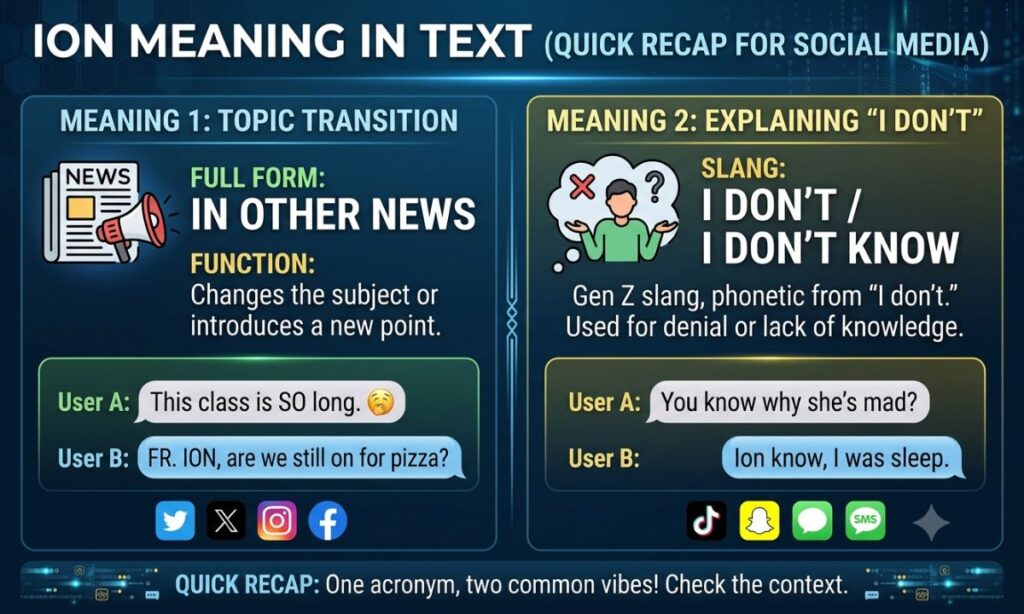
When people search for “ion meaning in text,” they almost always want the slang meaning, not the science one. Content creators and social media managers often explain it like this:
- Ion = “I don’t”
- Used to sound casual and quick
- Common among Gen Z and younger millennials
- Found mostly on TikTok, Instagram, Twitter/X, and Snapchat
If you manage a social media page or blog, this is the exact explanation your readers expect to see. Keep it short, clear, and example-based.
Ion Meaning in Chemistry
Let’s go a little deeper into the chemistry side of “ion,” since this is a common school topic too.
An ion forms when an atom’s number of protons and electrons becomes unequal. Protons carry a positive charge. Electrons carry a negative charge. When these numbers don’t match, the atom becomes charged.
Two main types of ions:
- Cations – Positively charged ions (lost electrons). Example: Sodium (Na⁺)
- Anions – Negatively charged ions (gained electrons). Example: Chloride (Cl⁻)
When cations and anions combine, they form ionic compounds. A very common example is table salt (NaCl), made from sodium ions and chloride ions bonding together.
Simple way to remember it:
- Cation sounds like “cat,” and cats are usually happy and positive. Positive charge.
- Anion starts differently, so it’s the negative one.
Ion Meaning in Text Message
In a text message, “ion” almost always keeps its slang meaning: “I don’t.” But the exact feeling can shift slightly based on tone and punctuation.
| Text Message | Meaning |
| “ion know what to do” | I don’t know what to do (unsure, honest) |
| “ion care fr” | I don’t care, for real (strong emphasis) |
| “ion think that’s fair” | I don’t think that’s fair (disagreement) |
| “ion mind either way” | I don’t mind either way (easygoing) |
Pro tip from real chats: Adding words like “fr” (for real) or “tbh” (to be honest) after “ion” makes the message feel more personal and emotional. This combo is very common among younger texters.
Ion Meaning in Gen Z
Gen Z (people generally born between 1997 and 2012) uses “ion” as part of a bigger slang system. It fits alongside other short forms like:
- idk – I don’t know
- idc – I don’t care
- tbh – to be honest
- fr fr – for real, for real
- ngl – not gonna lie
For Gen Z, “ion” feels more natural and voice-like than typing “I don’t” in full. It matches how they actually speak, not just how they type. This is a big shift from older texting styles, where people tried to write in full, proper sentences.
Real-life observation: Many Gen Z creators use “ion” in video captions even when they are speaking normally in the video. This shows how deeply text slang has mixed with everyday speech.
Similar Terms & Alternatives
If you want to understand “ion” fully, it helps to know similar short forms. Here is a simple comparison list:
- idk = I don’t know
- idc = I don’t care
- ion = I don’t
- ima = I am going to
- finna = about to / going to
- tryna = trying to
- wanna = want to
- gonna = going to
These words all share one thing: they shorten common phrases to make typing and talking faster.
How to Respond to It
If a friend texts you using “ion,” you don’t need to reply with slang too. Just respond naturally, based on what they said.
Example conversation:
- Friend: “ion know if I can come tonight”
- You: “No worries, let me know when you decide!”
Example conversation 2:
- Friend: “ion like that restaurant tbh”
- You: “Fair enough, where do you want to go instead?”
You can also reply using “ion” yourself if you want to match their casual tone. There is no strict rule here. It simply depends on your texting style and comfort level.
Differences from Similar Words
People often confuse “ion” with other short forms. Here is a clear table to avoid mix-ups.
| Word | Full Meaning | Example |
| ion | I don’t | “ion wanna go” |
| ion (science) | Charged particle | “The ion has a positive charge” |
| I’m | I am | “I’m tired” |
| ima | I am going to | “ima call you later” |
| idk | I don’t know | “idk what happened” |
Key difference: “Ion” replaces “I don’t,” while “idk” replaces “I don’t know.” They look similar but are not always interchangeable. “Ion know” and “idk” mean the same thing, but “ion” alone can attach to many other words too, like “ion care,” “ion think,” or “ion mind.”
Ion Meaning in Science
To bring the science side together in one place, here is a clear summary table:
| Field | What “Ion” Means | Example Use |
| Physics | Charged atom or molecule | Ions move in an electric field |
| Chemistry | Atom with unequal protons/electrons | Sodium ion, chloride ion |
| Biology/Medical | Charged particles in the body | Potassium ions in nerve signals |
| Aerospace | Charged particle propulsion | Ion thrusters in spacecraft |
| Environmental Science | Charged particles in air | Negative ions from waterfalls or plants |
Fun fact: Some air purifiers use negative ions to clean the air. This is a real, useful application of ion science in everyday products.
Relevance in Online Conversations & Dating Apps
“Ion” has become a normal part of online conversations, including on dating apps like Tinder, Bumble, and Hinge.
On dating apps, “ion” often shows up in:
- Bios: “ion do fake vibes, keep it real”
- Opening messages: “ion usually swipe right, but your profile caught me”
- Casual chats: “ion mind trying that new place you mentioned”
Why it matters on dating apps: Using casual slang like “ion” can make a profile or message feel more relaxed and authentic. Many people feel it shows real personality instead of a stiff, formal tone. However, it’s smart to match the other person’s style. If they text formally, it may be better to avoid heavy slang at first.
Pro tip: On professional networking apps like LinkedIn, avoid “ion” completely. Keep slang for casual social spaces only, like dating apps, group chats, and social media comments.
Final Words
The word “ion” carries two very different meanings, and now you know both clearly. In everyday texting, chatting, and social media, it simply means “I don’t.” It is fast, casual, and extremely common among Gen Z across TikTok, Instagram, WhatsApp, and Twitter/X.
On the other hand, in science and technical fields, an ion is a charged particle. This meaning matters in chemistry class, medical care, and even spacecraft engineering. Knowing both meanings helps you avoid confusion and use the word correctly in the right setting.
FAQs
What does “ion” mean in a text message?
“Ion” is short for “I don’t.” People use it to type faster in casual chats. Example: “ion know” means “I don’t know.”
Is “ion” rude to use?
No, “ion” is not rude. It is just casual slang. It sounds relaxed, not disrespectful.
Does “ion” ever mean something else?
Yes. In science, an ion is a charged atom or particle. This meaning is used in chemistry, physics, and medicine, not in texting.
Can I use “ion” in professional messages?
No. Avoid “ion” in emails, work chats, or formal writing. Always write “I don’t” in full for professional settings.
Where did “ion” come from?
The slang comes from African American Vernacular English (AAVE). Social media, especially TikTok, helped it spread worldwide.
Is “ion” only used by younger people?
Mostly yes. Gen Z uses it the most, especially on TikTok, Instagram, and Twitter/X. But anyone can use it in casual texting.

Hi, I’m Shahid, a passionate content writer and blogger dedicated to creating easy-to-understand, well-researched, and SEO-friendly content. I specialize in explaining the meanings of words, phrases, names, internet slang, symbols, and everyday expressions in a simple and engaging way.