
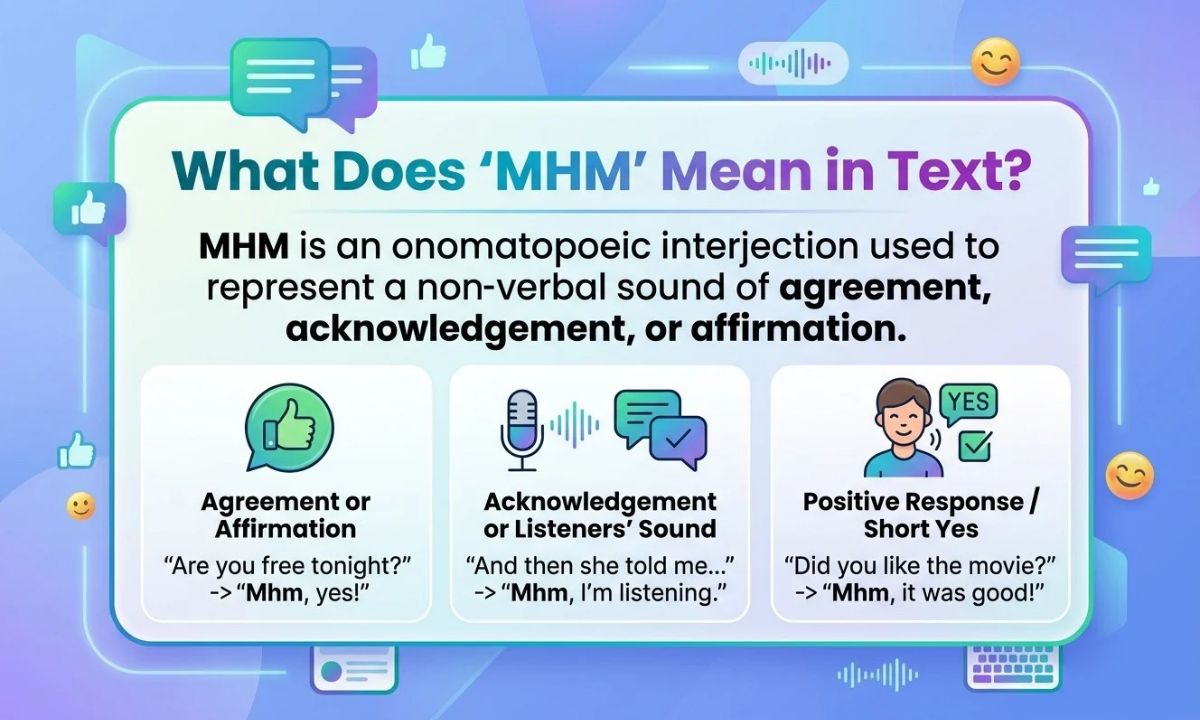
Have you ever gotten a text that just says “mhm” and wondered what it really means? This little word pops up all the time in texting, chats, and social media posts. It looks simple, but it can carry different feelings depending on how it’s used. Some people use it to agree, while others use it to sound calm or even a bit annoyed.
MHM is a short way of saying “yes” or “I agree.” People type it because it’s quick and easy, just like saying it out loud in real life. You will see it in DMs, group chats, and even in comments under posts. It saves time and still gets the message across clearly.
But tone matters a lot with “mhm.” It can sound friendly, bored, or even sarcastic, depending on the context of the conversation. In this article, we will break down its full meaning, how people use it in different situations, and why it has become such a common part of online slang today.
What Does MHM Mean in Text?
MHM is a short text version of the sound “mm-hmm.” People make this sound out loud when they nod their head and agree with someone. When you type “mhm” in a chat, you are writing that sound down instead of saying it.
In simple words, mhm means yes, okay, or I understand. It is one of the most common short replies used in texting today. You will see it in WhatsApp chats, Instagram DMs, group chats, and comments on social media.
Here is a quick real-life example. Imagine you ask a friend, “Are you coming to the party tonight?” and they reply “mhm.” That single word tells you they agree, without them needing to type “Yes, I am coming tonight.”
Pro tip: From my own experience chatting online for years, “mhm” works best with people you already know well. Close friends and family understand your tone. Strangers or new contacts might read it the wrong way, so it is smart to use a full sentence with people you don’t know yet.
Different Meanings of MHM in Text
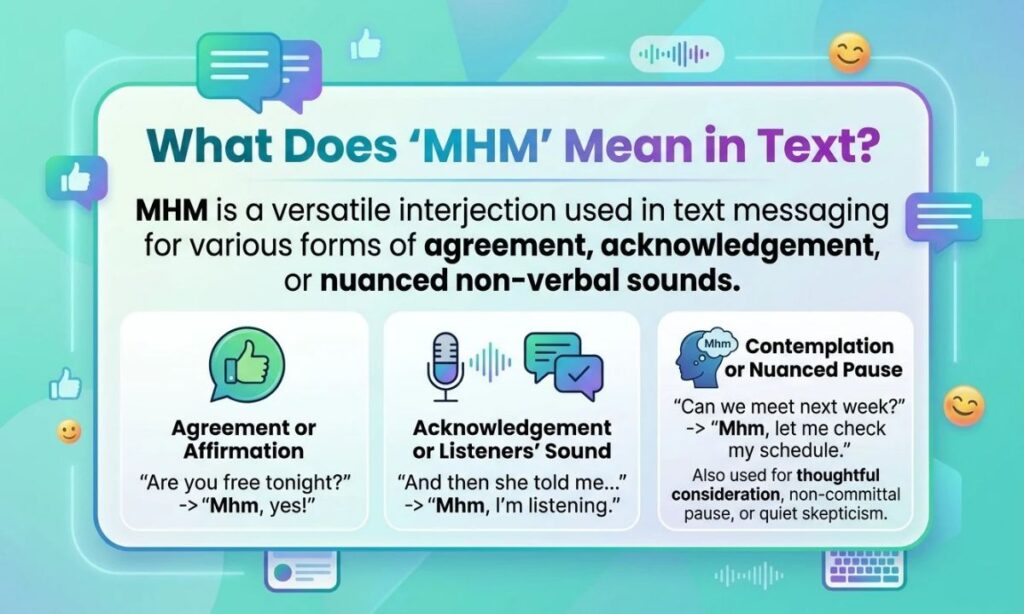
“Mhm” is a small word, but it does not always mean the same thing. The real meaning changes based on the conversation, the relationship, and the mood of the person typing it. Here are the five main meanings you will come across.
1. Agreement or Confirmation
This is the most common use. Someone asks a question, and “mhm” means “yes.”
- “Did you finish your homework?” → “mhm”
- “Is 5 pm okay for you?” → “mhm, works for me”
2. Acknowledgment
Sometimes “mhm” just means “I got your message.” It does not always mean full agreement. It simply shows that the person read and understood what you said.
- “I’ll send the file by tonight.” → “mhm, sounds good”
3. Listening Without Interrupting
In voice chats, calls, or long text stories, people type “mhm” to show they are still there and paying attention. It works like a small nod during a long story.
- “So then I told her the whole plan, and she…” → “mhm… go on”
4. Reluctant Agreement
Sometimes “mhm” is used when a person agrees, but not fully. They might have doubts, but they don’t want to argue. This kind of “mhm” often feels flat or short.
- “You’ll clean your room later, right?” → “mhm” (said without much interest)
5. Disinterest or Passive Response
This is the trickiest meaning. When someone is bored, upset, or does not want to talk, they may reply with just “mhm” instead of a full sentence. This short, dry reply can feel cold or distant.
- “I had a really hard day today.” → “mhm” (with no follow-up question)
Real-life tip: If a friend usually sends long, chatty replies and suddenly starts replying with only “mhm,” that change is often a sign something is wrong. Pay attention to the pattern, not just the single word.
Tone Matters: How MHM Can Change Meaning
Texting has one big problem: it has no voice, no face, and no body language. When you speak, your tone shows your true feelings. In text, that tone disappears, so readers have to guess it from small clues.
This is why the exact same word “mhm” can feel warm in one chat and cold in another. The feeling comes from three things:
- Timing — a fast reply feels different from a reply after ten minutes of silence
- Punctuation — “mhm!” feels happy, “mhm.” feels flat, “mhm…” feels unsure
- Emojis — adding a smiley or heart changes the whole mood
Compare These Variations
| Text Style | Likely Feeling | Example |
| Mhm! 😊 | Happy, warm agreement | “Mhm! Let’s do it!” |
| Mhm. | Neutral or flat | “Mhm. Okay.” |
| mhm… | Unsure, thinking, or sad | “mhm… I guess so” |
| MHM | Strong emphasis, sometimes annoyed | “MHM. Sure.” |
| mhmm | Playful or teasing | “mhmm, I saw that 👀” |
How to Use MHM in Text Messages
“Mhm” is easy to use once you know the right time and place for it. Below is a simple, practical guide.
When to Use MHM
- Casual chats with friends — it keeps the conversation light and quick
- Confirming small plans — like time, place, or simple yes/no questions
- Showing you are listening — during a long story or update
- Replying quickly — when you agree but don’t have time to type more
When to Avoid MHM
- Formal emails or work messages — it can look unprofessional
- Serious or emotional talks — a longer reply shows you truly care
- First-time conversations — new contacts may not read your tone correctly
- Job interviews or customer chats — always use full, clear words here
Pro tip from experience: In my own messaging habits, I never use “mhm” with a client or a new business contact. It feels too casual and can come across as careless, even if that is not what you meant.
Examples of MHM in Real Conversations
Seeing “mhm” in real chat examples makes its meaning much clearer. Below are three common situations.
Friendly Chat
Ali: Hey, are we still on for the movie tonight? Sara: mhm! Can’t wait 😄
Here, “mhm” plus an emoji shows real excitement and agreement.
Listening Mode
Hina: So I told my boss about the new plan, and then she asked me three questions, and I had to explain everything again… Zain: mhm, mhm, then what happened?
Here, “mhm” shows the listener is engaged and wants to hear more.
Slightly Annoyed Response
Bilal: You forgot to call me back again. Ahsan: mhm.
Here, the short, flat “mhm” with a period feels distant. It likely shows mild annoyance instead of real agreement.
MHM vs Other Similar Text Slang
“Mhm” is part of a larger family of short text replies. Knowing how it compares to similar words helps you pick the right one for each situation.
| Slang | Meaning | Feeling |
| Mhm | Yes, I agree, I hear you | Casual, can be warm or flat |
| Hmm | I am thinking or unsure | Curious, doubtful |
| Mmm | I like this, or I am considering it | Pleased or thoughtful |
| Yep / Yeah | Yes | Casual, clearly positive |
| K | Okay | Very short, sometimes cold |
| Ok | Okay, understood | Neutral |
| Sure | Yes, I am willing | Friendly, open |
The biggest difference is that “mhm” copies a sound, not a written word like “yes” or “sure.” That is what makes it feel more personal and voice-like, almost as if the person is really nodding at you through the screen.
Is MHM Rude in Texting?
This is one of the most common questions people ask, and the honest answer is: it depends on the situation.
When It’s NOT Rude
- Between close friends who text this way all the time
- When paired with emojis or extra words
- During fast, casual chats where short replies are normal for both people
- As a quick reply while the person is busy but still wants to respond
When It CAN Be Rude
- When someone asks a serious or emotional question and only gets “mhm” back
- In a formal setting, like work chats or emails
- When it replaces a reply that clearly needed more detail
- When the other person keeps texting and only gets short “mhm” replies again and again
Real example: If someone shares sad news like “My grandmother is in the hospital,” replying only “mhm” can feel careless, even if that was not the intention. A better reply would show real care, such as “mhm, I’m so sorry, are you okay?”
Psychology Behind Using MHM
There is real psychology behind why humans use sounds like “mhm.” Experts call this kind of short response a backchannel. A backchannel is a small sound or word we use to show we are listening, without taking over the conversation.
In face-to-face talking, we nod our heads and say “mhm” without even thinking about it. It is a natural human habit that shows attention and connection. When texting became common, people simply moved this same habit into typed words.
This explains a few interesting things:
- People type “mhm” almost automatically, the same way they say it out loud
- It works as a social glue — a tiny signal that keeps a conversation flowing
- The feeling behind it often matches the person’s real mood at that moment, since it is such a natural, unplanned response
So when someone’s “mhm” suddenly feels shorter, colder, or slower than usual, it is often not random. It usually reflects a real change in how they are feeling.
MHM on Different Platforms
The way people use “mhm” can shift slightly depending on where the chat is happening.
WhatsApp / Messenger
On WhatsApp and Messenger, “mhm” is used mostly in casual, personal chats. Since these apps show read receipts and typing indicators, a short “mhm” after a long pause can feel more noticeable, and sometimes colder, than the same reply sent instantly.
Social Media (Twitter/X, Instagram)
On platforms like Twitter/X and Instagram, “mhm” often appears in comments or reply threads. Here, it is frequently used in a playful or sarcastic way, especially when reacting to a funny post or a joke, rather than as a simple yes.
Workplace Chats (Slack, Teams)
In tools like Slack or Microsoft Teams, “mhm” is best avoided for anything official. It is fine in a relaxed team chat with close coworkers, but for tasks, deadlines, or client matters, a clear word like “Yes” or “Got it” is a much safer choice.
Alternatives to MHM (Better Replies)
If you want to sound clearer, warmer, or more professional, there are plenty of good alternatives to “mhm.”
Casual Alternatives
- Yep
- Yeah
- For sure
- Sounds good
- Got it
More Engaging Responses
- “Yes, that works for me!”
- “I hear you, tell me more.”
- “Got it, thanks for letting me know.”
- “Absolutely, let’s do that.”
- “I understand, that sounds tough.”
Pro tip: Swapping “mhm” for a slightly longer reply, especially in emotional talks, makes the other person feel truly heard. It only takes a few extra words to turn a flat reply into a warm one.
Common Misunderstandings About MHM
Many people believe things about “mhm” that are simply not true. Here are the most common myths.
Myth 1: MHM always means yes
Truth: As shown earlier, “mhm” can also mean acknowledgment, reluctant agreement, or even disinterest. Context always matters more than the word itself.
Myth 2: It’s always polite
Truth: “Mhm” can feel careless or dismissive, especially in serious conversations or when someone is sharing something important with you.
Myth 3: It’s only for texting
Truth: “Mhm” started as a spoken sound long before texting existed. People have been saying it out loud for many decades. Texting simply gave this old sound a new, written form.
Cultural Differences in Using MHM
“Mhm” is common in English-speaking countries, especially the United States, the United Kingdom, and other regions where casual texting culture is strong. It works well because English texting culture generally favors short, quick, informal replies.
In many other cultures and languages, similar sounds exist, but they are written and used differently. Some cultures prefer fuller written replies even in casual chats, since a very short reply might be seen as less warm or less respectful.
Practical takeaway: If you are texting someone from a different cultural background, it is worth watching how they usually reply. If they always send longer, detailed messages, matching that style shows respect and helps avoid any misunderstanding.
When NOT to Use MHM
To wrap up the practical side, here is a clear list of situations where it is best to avoid “mhm” completely:
- Job applications, interviews, or professional emails
- Talking with teachers, doctors, or officials
- Serious, sad, or emotional conversations
- First conversations with someone new
- Customer service or business chats
- Any message where a clear, detailed answer is expected
Quick Summary Table
| Situation | Should You Use MHM? | Better Option (if not) |
| Chat with close friend | Yes | — |
| Confirming simple plans | Yes | — |
| Formal work email | No | “Yes, understood.” |
| Serious emotional talk | No | “I hear you, are you okay?” |
| New contact or stranger | No | “Yes, that works for me.” |
| Listening to a long story | Yes | — |
| Job interview chat | No | “Yes, that sounds great.” |
Final words
“Mhm” may look like a tiny, simple word, but it carries a lot of meaning in modern texting. At its heart, it comes from a natural human sound of agreement and attention, and that is exactly why it feels so personal compared to typed words like “yes” or “okay.”
The real key is learning to read the context around it. A quick “mhm!” with an emoji feels warm and friendly, while a flat “mhm.” after a serious question can signal something completely different. Paying attention to timing, punctuation, and the person’s usual texting style will always tell you more than the word alone.
Once you understand these small signals, you can use “mhm” the smart way: casually with friends, carefully with new people, and never in formal or emotional conversations that truly deserve a full, thoughtful reply.
“FAQs”
1. Does MHM mean yes or no?
MHM means yes. It is a short, casual way to agree or confirm something. But the strength of that “yes” can change with tone — a warm “mhm!” feels like a clear yes, while a flat “mhm.” can feel like a weak, half-hearted yes.
2. Is MHM different from “mm-hmm”?
No, they are the same thing. “Mhm” is just the shorter, typed version of “mm-hmm,” the sound people make out loud when nodding in agreement. Texting simply dropped a letter to make it faster to type.
3. Can MHM be sarcastic?
Yes, it can. When “mhm” is used after something unbelievable or exaggerated, it often means “sure, right” instead of real agreement. Tone, punctuation, and the topic of the chat usually make the sarcasm clear.
4. Is it okay to use MHM in professional chats?
Generally, no. “Mhm” feels too casual for emails, work tasks, interviews, or client messages. Clear words like “Yes” or “Understood” are safer choices in any professional or formal setting.
5. Why do people use MHM instead of yes?
Because it feels more natural and personal. “Mhm” copies a real, spoken sound, so it feels closer to talking than typing. It is also faster to type and matches the relaxed, quick style of casual texting.
6. Is MHM passive-aggressive?
Sometimes, but not always. A short, dry “mhm” with no follow-up can feel cold or annoyed, especially if it replaces a longer reply the person usually gives. Context and the usual texting pattern of that person are the best clues.
7. What’s the best alternative to MHM?
It depends on the situation. For casual chats, “yep” or “sounds good” works well. For serious or professional replies, fuller phrases like “Yes, that works for me” or “Got it, thank you” show more care and clarity.

Hi, I’m Shahid, a passionate content writer and blogger dedicated to creating easy-to-understand, well-researched, and SEO-friendly content. I specialize in explaining the meanings of words, phrases, names, internet slang, symbols, and everyday expressions in a simple and engaging way.