
OPEL means different things in a text. Most people use it to talk about the Opel car brand. Other times, people use it as internet slang. The meaning depends on where you see it and who sent it. This guide breaks down all the ways OPEL shows up in texts today.
If a friend texts about their new Opel Astra, they mean the German car company. Opel started in 1862 and now makes cars, SUVs, and electric models. It is one of Europe’s most trusted car brands. This is the most common way people use the word.
But OPEL also shows up as slang in group chats and memes. Some people use it as a playful insult. It can mean “uncool” or “try-hard” in certain online circles. This use is newer and less common than the car meaning. Knowing both meanings helps you understand the word in any text.
OPEL is a name that most people connect to cars. But this word shows up in many other places too. It appears in knitting patterns, word puzzles, tarot cards, and even casual internet slang. This article explains every meaning of OPEL in simple words. You will learn where the name came from, what it means today, and why it keeps showing up in so many different places.
Quick Facts About Opel
Before we go deep into the details, here is a quick snapshot table. This gives you the fast facts in one place.
| Fact | Detail |
| Full meaning | Opel is a surname, not an acronym |
| Founder | Adam Opel |
| Founded in | 1862 |
| Country | Germany |
| First products | Sewing machines |
| Entered car business | 1899 |
| Current owner | Stellantis |
| Logo symbol | Lightning bolt (called the “Blitz”) |
| Main colors | Yellow, black, and white |
| Sister brand in the UK | Vauxhall |
This table alone answers most quick searches. Now let’s break each point down in easy language.
Opel Word Origin & Linguistic Meaning
Opel is not a made-up word. It is a real German surname. The name likely grew out of old German first names like Adalbert or Albrecht. Over hundreds of years, these names shortened and changed into the surname Opel.
This is an important point to remember: Opel is a family name first, and a brand name second. Adam Opel simply used his own last name for his company. This was common in the 1800s. Many German businesses were named after their founders.
So when someone asks “what does Opel mean,” the honest answer is simple. Opel does not translate into a specific object, action, or feeling. It is a proper noun, just like “Smith” or “Miller” in English. It only carries meaning because of the company that made it famous.
Opel Meaning in German
In everyday German, the word “opel” by itself has no dictionary meaning. It is not a common noun. You will not find it listed as a word for an object or an action in a standard German dictionary.
The confusion often comes from a different German word: “Blitz.” This word means lightning, and it is the name Opel gave to its famous logo and truck line. Many people search for “Opel meaning in German” hoping to find a translation. What they usually find instead is the story of the Blitz symbol.
Here is a simple pro tip from years of writing about car brands: when a brand name sounds foreign, people often assume it must translate to something. Sometimes it does. Sometimes, like with Opel, it is simply a family name that became famous.
Is Opel a German Company?
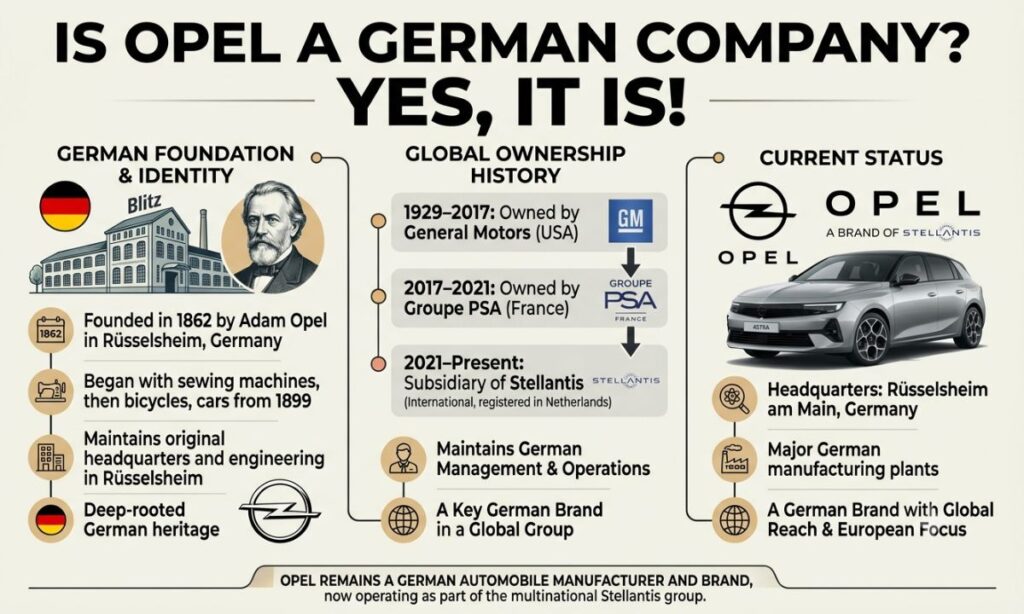
Yes. Opel is 100% a German company in terms of its history and roots. It started in Rüsselsheim, Germany, and this town remains the company’s headquarters today.
However, ownership has changed hands over the years:
- 1929–2017: Owned by General Motors (an American company)
- 2017–present: Owned by Stellantis, a large automotive group formed from the merger of PSA Group and Fiat Chrysler
Even with foreign ownership in the past, Opel’s engineering, design, and factories have stayed rooted in Germany. Most Opel cars are still built in European factories, and the brand is still seen as a proud symbol of German car-making skill.
Opel Car Brand Meaning
When most people type “Opel meaning” into Google, they actually want to know about the car brand. So let’s answer that directly.
Opel is one of Europe’s oldest and most trusted car makers. The brand is known for:
- Affordable pricing compared to luxury German brands like BMW or Mercedes
- Practical, everyday cars built for families and commuters
- Solid engineering with a long history of innovation
- A wide range of models, from small city cars to SUVs and electric vehicles
Popular Opel models people search for include the Opel Astra, Opel Corsa, Opel Insignia, and the electric Opel Mokka-e. If a friend texts you about their new “Opel,” they are almost always talking about one of these car models.
Opel Meaning in the Automotive Industry
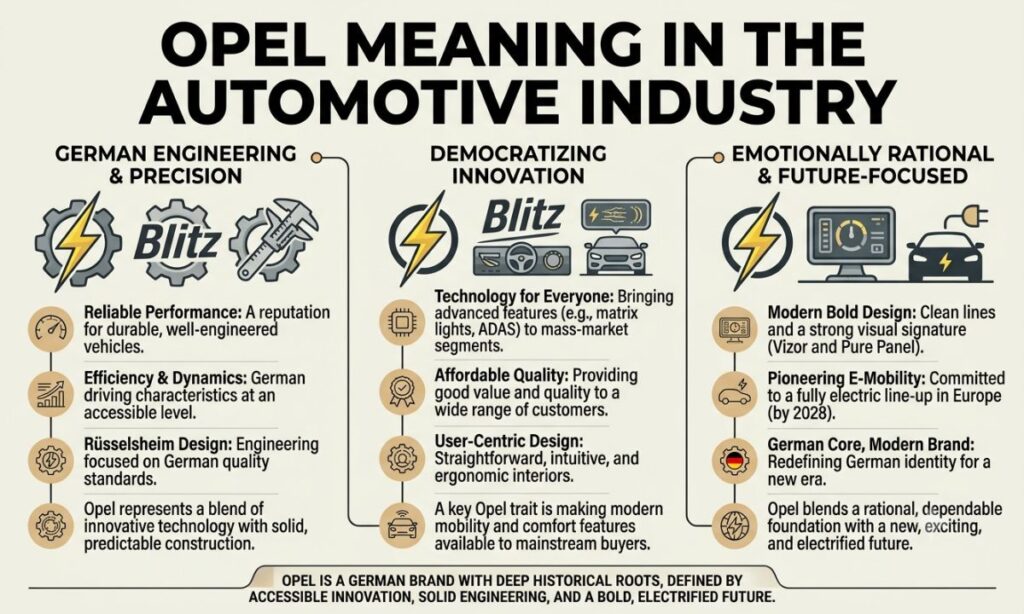
Inside the car industry, Opel carries a specific reputation. It is known as a mass-market brand, which means it makes cars for everyday buyers, not luxury shoppers. This is different from brands that focus only on high-end customers.
Industry experts often place Opel in the same category as brands like Ford, Volkswagen, and Peugeot. These companies compete for the same buyers: people who want a reliable car at a fair price.
Pro tip from real-world car shopping: if you are comparing Opel to premium brands, don’t expect the same price tag or luxury badge status. Opel’s real strength is value. You get solid build quality and modern features without paying luxury-brand prices.
Popular Opel Car Models Explained
If you want to understand what “Opel” means to a real car buyer, it helps to know the lineup. Each model targets a different type of driver.
| Model | Type | Best For |
| Opel Corsa | Small city car | First-time buyers, city driving |
| Opel Astra | Compact hatchback | Daily commuters, small families |
| Opel Insignia | Mid-size sedan | Business travel, longer trips |
| Opel Mokka | Compact SUV | Buyers who want extra height and space |
| Opel Grandland | Larger SUV | Families needing more room |
| Opel Mokka-e / Corsa-e | Electric versions | Drivers switching to electric power |
Each of these models carries the same lightning bolt badge, but they serve very different needs. A buyer researching “Opel meaning” before a purchase usually wants reassurance that the brand is trustworthy — and this wide, practical lineup is a big part of why the brand has stayed popular for so long.
How Opel Builds Its Reputation
Car reviewers and everyday drivers often mention a few common points about Opel vehicles:
- Comfortable ride quality, even on rougher roads
- Fuel-efficient engines, which matter for daily commuting costs
- Simple, easy-to-use interiors without overly complicated technology
- Strong resale value within the European used-car market
These traits explain why Opel has stayed relevant for more than a century, even while facing tough competition from bigger, flashier brands.
Opel History and Brand Story
The story of Opel is genuinely interesting, and knowing it helps explain the brand’s identity today.
Adam Opel was born in 1837 in Rüsselsheim, Germany. He did not start out making cars. His first business made sewing machines, and it became very successful across Europe. Later, the company added bicycles to its product line, which were also a big hit.
It wasn’t until 1899, years after Adam Opel’s death, that his sons pushed the company into car manufacturing. From there, Opel grew into one of the largest car makers in Europe.
Timeline of Opel
| Year | Milestone |
| 1837 | Adam Opel is born |
| 1862 | Adam Opel founds his company, making sewing machines |
| 1886 | Company adds bicycle manufacturing |
| 1899 | Opel begins building automobiles |
| 1929 | General Motors buys a majority stake in Opel |
| 1930s | The “Blitz” truck line becomes a huge success |
| 1963–64 | The lightning bolt logo is officially adopted |
| 2017 | Stellantis (formerly PSA Group) acquires Opel from GM |
| 2020 | Opel unveils its modern, simplified lightning bolt logo |
This timeline shows something important: Opel did not start as a car company at all. Its roots are in sewing machines and bicycles, which is a detail most articles skip. Knowing this helps you understand why the brand values practical, useful engineering over flashy design.
The Bicycle and Sewing Machine Years
It’s easy to forget that Opel spent nearly 40 years making products that had nothing to do with cars. The sewing machines built by Adam Opel’s company were known for being well-made and reliable, and this reputation for quality carried directly into the bicycle business.
By the late 1800s, Opel had become one of the largest bicycle makers in the world. This success gave the company the money and manufacturing knowledge it needed to move into automobiles. Without this early foundation, the car brand we know today may never have existed.
Surviving War and Rebuilding
Opel’s history was not always smooth. During the years around World War II, the company’s factories were taken over and used for wartime production, first under German government control and later under Allied control. Much of the factory infrastructure was damaged.
After the war ended, Opel rebuilt from near ruin. This rebuilding period shaped the brand’s identity as a practical, resilient company. By the 1950s and 1960s, Opel was once again one of Europe’s top-selling car brands, known for dependable family cars.
The Modern Era
In recent years, Opel has focused heavily on electric vehicles and modern safety technology. Under Stellantis ownership, the brand has access to shared technology platforms used across other Stellantis brands, which has helped Opel modernize faster than it could on its own.
Opel vs Other Car Brands
People often want to know how Opel stacks up against other well-known car makers. Here is a simple comparison table.
| Brand | Country | Known For | Price Range |
| Opel | Germany | Practical, affordable everyday cars | Budget to mid-range |
| Volkswagen | Germany | Reliable, well-built family cars | Mid-range |
| BMW | Germany | Performance and luxury | Premium |
| Mercedes-Benz | Germany | Luxury and comfort | Premium |
| Ford | USA | Wide model range, trucks and cars | Budget to mid-range |
| Peugeot | France | Stylish design, fuel efficiency | Budget to mid-range |
Real-world tip: if you are shopping for a car and cross-referencing Opel with these brands, remember that Opel and Peugeot now share the same parent company (Stellantis). This means some models actually share parts and engineering underneath different badges.
Opel Logo Meaning & Symbolism
The Opel logo is one of the most recognized symbols in the car world. It has changed many times, but the core idea has stayed the same for decades.
What Does the Opel Logo Mean?
The modern Opel logo shows a lightning bolt inside a circle. Each part has its own meaning:
- The lightning bolt represents speed, power, and energy
- The circle represents unity, movement, and completeness
Together, these two shapes are meant to show a brand that combines strength with smooth, reliable motion.
Symbol Meaning:
The lightning bolt is officially called the “Blitz,” which is the German word for lightning. This symbol first appeared on Opel’s line of trucks in the 1930s, which were also named “Blitz.” The design proved so popular that Opel later applied it to the entire brand, not just the trucks.
Opel Symbol Meaning in Branding
From a branding point of view, the lightning bolt was a smart choice. It is:
- Simple enough to recognize from far away
- Bold enough to stand out on a car grille
- Meaningful, since it connects to the brand’s own history with the Blitz trucks
Pro tip for design lovers: notice how Opel simplified its logo over time. The 2020 version removed all shading and 3D effects. This matches a bigger trend across the car industry, where brands like Volkswagen, Nissan, and Kia have also flattened their logos for a cleaner, more modern look.
How the Opel Logo Changed Over Time
The logo has gone through more than 25 versions since 1862. Here is a simplified look at the major design shifts.
| Era | Design Style | Key Feature |
| 1862 | Ornamental medallion | Stylized “A” and “O” letters |
| 1886 | Oval shield | Ornamented top and bottom |
| 1930s | Zeppelin and rocket symbols | Represented speed and progress |
| 1963–64 | First lightning bolt (Blitz) | Black and grey design |
| 1987–2000s | Yellow background | Bright, bold brand color |
| 2009 | Silver 3D circle | Sharp, embedded lightning bolt |
| 2020–present | Flat, minimalist bolt | Clean lines, no shading |
Real-world observation: each redesign usually happened alongside a major shift in ownership or company direction. The 2020 redesign, for example, arrived shortly after Stellantis took control, signaling a fresh start for the brand.
Why the Lightning Bolt Still Works Today
Good logos stay simple enough to recognize instantly, even from a distance or at a small size. The Opel lightning bolt succeeds because it can be shrunk down to a tiny icon on a phone screen and still stay clear. This is one reason the brand has kept the bolt as its core symbol for over 60 years, even while changing the surrounding details many times.
What Does OPEL Stand For?
Here is a fact that surprises many people: OPEL is not an acronym. It does not stand for a hidden phrase or a set of initials. Many acronym-listing websites will show random possible meanings, but these are not official or accurate.
OPEL simply comes from the surname of its founder, Adam Opel. Any website claiming OPEL stands for a specific phrase is guessing, not reporting a real, confirmed source. This is one of the most important facts to understand if you are researching the word seriously.
Opel Name Meaning in Different Contexts
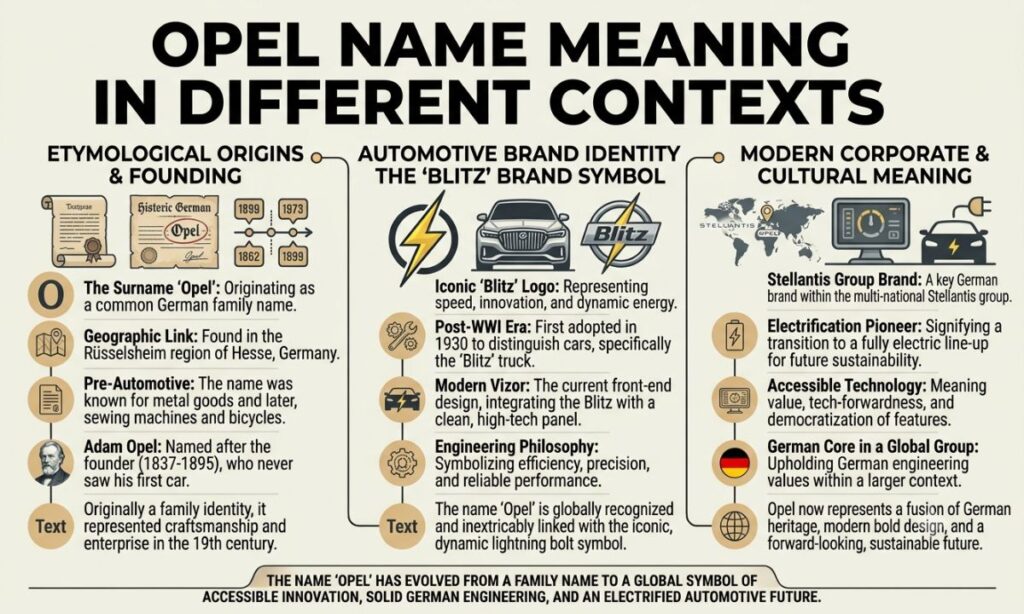
The word “Opel” pops up in more places than just the automotive world. Here is a breakdown of the different contexts where you might see it.
Opel Meaning in Knitting & Textiles
Some people search for “Opel meaning in knitting” after seeing the word in a puzzle or pattern name. Here is the honest answer: there is no official knitting stitch called “Opel.”
The confusion usually comes from two places:
- Word puzzles, like the New York Times Connections game, which grouped “Opel” together with “Purl,” “Choral,” and “Quarts” because they all sound like gemstone names (Opal, Pearl, Coral, Quartz)
- Named knitting patterns, where individual designers sometimes name their patterns “Opel” as a creative title, not as a stitch technique
Opel Stitch Meaning
Just like the point above, there is no standard stitch technique named “Opel” in knitting instruction books. If you saw the word “Opel” in a knitting context, it most likely came from one of the two sources listed above, not from a real stitch method.
Opel Meaning Magic
In tarot card reading, there is a suit called “Pentacles.” Because “Opel” sounds like “Opal,” a gemstone, it sometimes gets linked to tarot and spiritual word games. This connection is really just wordplay based on sound, not an actual meaning tied to magic or spirituality.
Opel Meaning Spiritual
Following the same idea, there is no true spiritual meaning behind the word “Opel.” Any spiritual connection you find online is almost always built on the fact that “Opel” sounds like “Opal,” which is a gemstone often linked to healing and energy in spiritual practices. The word itself, on its own, carries no spiritual weight.
w0l wmi Opel Meaning
This search term looks like a typo or a garbled phrase, possibly from a puzzle game or a misheard word. There is no known, verified meaning tied to this exact phrase. If you saw this term somewhere, it is most likely a typing error or an auto-generated search suggestion, and it does not connect to any confirmed fact about Opel.
Opel Meaning in Slang or English Usage
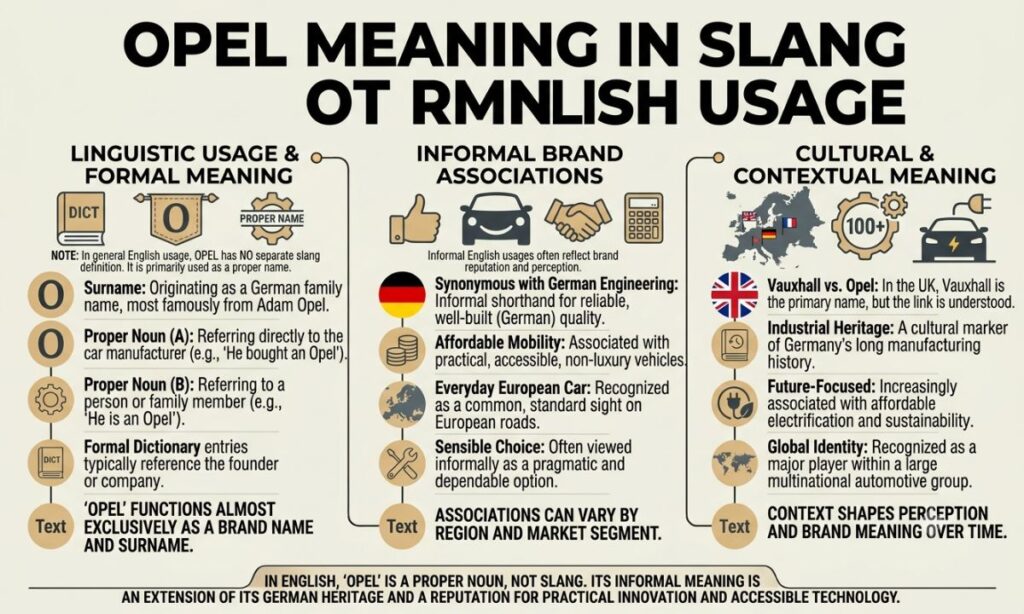
Outside of the car brand, “Opel” has started showing up in some online slang, mostly in meme culture and group chats. In these spaces, some people use “Opel” playfully to describe someone or something as “basic,” “try-hard,” or “uncool.”
This slang use is:
- Not officially recognized in any major dictionary
- Limited mostly to specific online communities, like certain Discord servers or meme pages
- Not something you should use in professional or formal writing
Real-world tip: if you hear “Opel” used this way in a text, don’t assume everyone knows this meaning. It is niche slang, not common English. In most everyday conversations, “Opel” still simply means the car brand.
How to Tell Which Meaning Someone Intends
Context is everything when a single word carries more than one meaning. Here are a few quick clues to figure out which “Opel” someone means:
- If the text mentions driving, buying, or fixing something, it’s almost certainly the car brand.
- If the text appears in a group chat, meme, or Discord server, it might be the slang meaning.
- If the word shows up in a word puzzle or crossword, it likely connects to the Opal homophone.
- If it appears in a knitting forum or pattern name, it’s probably a creative pattern title, not a real technique.
Using context clues like these takes the guesswork out of understanding the word, no matter where you come across it.
Opel Pronunciation & Meaning
Getting the pronunciation right matters, especially if you are talking about the brand in conversation. In German, “Opel” is pronounced roughly as “OH-pel,” with a short, clear “O” sound at the start.
In English-speaking countries, many people say it closer to “OH-pull” or “OP-el.” Neither version is “wrong” in casual conversation, but the original German pronunciation stays closer to “OH-pel.”
Opel Pronunciation Around the World
| Language/Region | Common Pronunciation |
| German (original) | OH-pel |
| British English | OH-pull |
| American English | OP-el |
| French | OH-pehl |
| Spanish | OH-pel |
Pro tip: if you are recording a video or podcast about cars, stick with the German pronunciation. It sounds more accurate and shows respect for the brand’s true origin.
Common Myths About the Opel Name
Because “Opel meaning” is such a popular search topic, a lot of inaccurate information has spread online over the years. Here are a few myths worth clearing up.
- Myth: OPEL is a secret acronym. As covered earlier, this is false. It is a surname, not a set of initials.
- Myth: Opel and Vauxhall are completely different companies. In reality, Vauxhall is simply the UK version of Opel, using different badges but often the same vehicle platforms.
- Myth: Opel has always been a German-owned company. For nearly 90 years, Opel was owned by the American company General Motors, before becoming part of Stellantis.
- Myth: The lightning bolt logo has stayed the same since the 1960s. In truth, the bolt has been redrawn and restyled many times, even though the core idea has stayed consistent.
Clearing up these myths helps readers get an accurate picture instead of repeating outdated or incorrect claims found on other websites.
Opel meaning not car
If you are specifically trying to separate “Opel” from its car brand meaning, here is a clean summary:
- As a word on its own, Opel has no standard dictionary definition in English
- As a surname, it comes from old German first names
- As internet slang, it can mean “uncool” or “basic” in limited online spaces
- As a word puzzle answer, it connects to “Opal” through sound, not meaning
- There is no official knitting, magic, or spiritual meaning behind the word
Why People Search “OPEL Meaning” Online
People land on this topic for many different reasons, and understanding these reasons helps explain why the search term is so common.
Common reasons people search for “Opel meaning” include:
- They saw an Opel car and want to know more about the brand
- They received a text using “Opel” and want to understand the slang
- They played a word puzzle, like NYT Connections, and got stuck on the word
- They are shopping for a car and want background on the brand before buying
- They saw the Opel logo and want to understand the lightning bolt symbol
- They are curious about German surnames and how they became brand names
Knowing the “why” behind a search helps explain why so many different articles exist on this one small word. It also shows why a single page covering every angle — car brand, logo, history, slang, and puzzle context — is more useful than a page that only covers one meaning.
FINAL WORDS
OPEL means different things in a text. Most people use it to talk about the Opel car brand. Other times, people use it as internet slang. The meaning depends on where you see it and who sent it. This guide breaks down all the ways OPEL shows up in texts today.
If a friend texts about their new Opel Astra, they mean the German car company. Opel started in 1862 and now makes cars, SUVs, and electric models. It is one of Europe’s most trusted car brands. This is the most common way people use the word.
But OPEL also shows up as slang in group chats and memes. Some people use it as a playful insult. It can mean “uncool” or “try-hard” in certain online circles. This use is newer and less common than the car meaning. Knowing both meanings helps you understand the word in any text.
Frequently Asked Questions
What does Opel mean?
Opel is not a made-up word. It is the surname of Adam Opel, the man who started the company in 1862. The word only became famous because of the car brand, not because it means something on its own.
Is Opel a German brand?
Yes, Opel is a German brand. It started in Rüsselsheim, Germany, and its headquarters are still there today. Ownership has changed hands over the years, but its roots stay firmly German.
What does the Opel logo represent?
The Opel logo shows a lightning bolt inside a circle. The bolt stands for speed and power, and the circle stands for unity and motion. Together, they represent a brand built on strength and smooth performance.
Does Opel stand for anything?
No, Opel is not an acronym. It does not stand for any hidden phrase or set of initials. It is simply a family name that became a company name.
Who founded Opel?
Adam Opel founded the company in 1862. He first made sewing machines, not cars. His sons later expanded the business into bicycles, and then into automobiles in 1899.
Why is there a lightning bolt in the Opel logo?
The bolt is called the “Blitz,” which means lightning in German. It first appeared on Opel’s popular Blitz truck line in the 1930s. The symbol worked so well that Opel later made it the brand’s main logo.

Hi, I’m Shahid, a passionate content writer and blogger dedicated to creating easy-to-understand, well-researched, and SEO-friendly content. I specialize in explaining the meanings of words, phrases, names, internet slang, symbols, and everyday expressions in a simple and engaging way.