
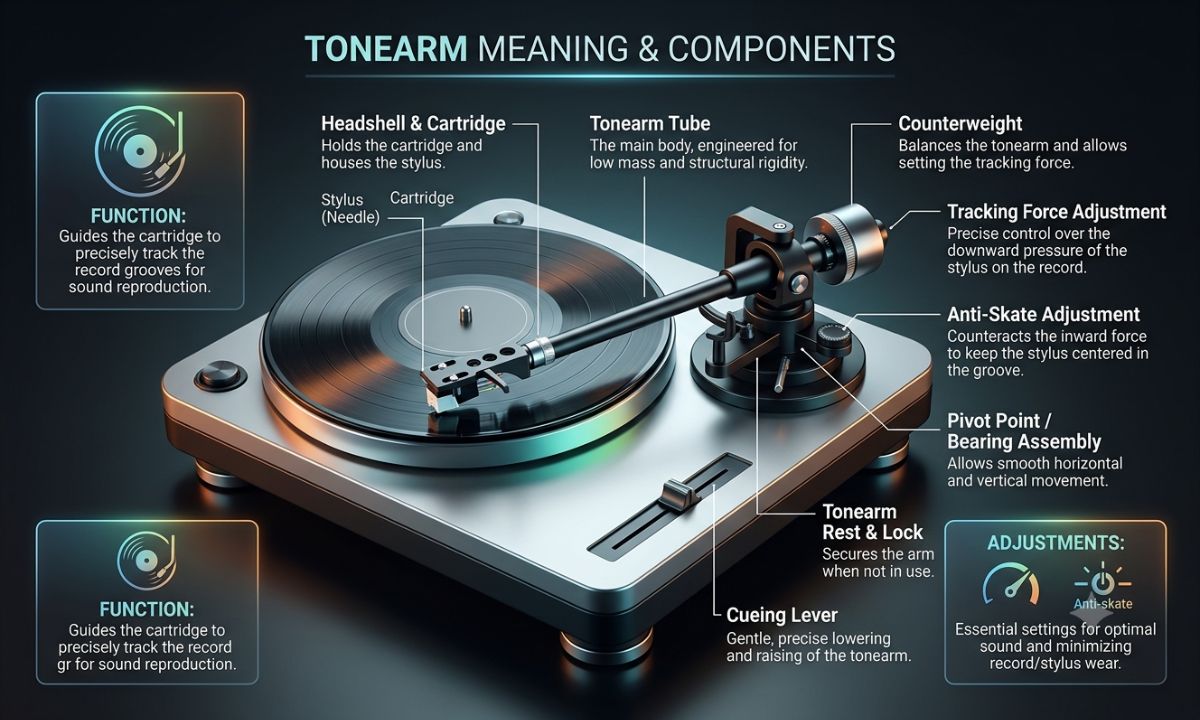
Have you ever seen the long, thin arm on a record player and wondered what it does? That part is called a tonearm. It holds the needle, or stylus, and moves it across the record. Without a tonearm, your turntable simply cannot play music. It is one of the most important parts of any record player.
People use the word “tonearm” in a simple way, and there is no hidden or slang meaning behind it. The name comes from its job: it carries the tone from the record to your speakers through the arm. Some people also call it a pickup arm. In this guide, I will explain its meaning in easy words. I will also cover the different types of tonearms you can find today.
Setting up a tonearm the right way is very important for good sound. A bad setup can cause skipping, poor sound quality, or even damage to your records. Many beginners face small problems with tracking force or alignment. Don’t worry, I will walk you through easy setup steps and show you how to fix common tonearm problems.
What Is a Tonearm?
A tonearm is the long, thin arm on a record player. It holds the stylus (needle) and moves it across the record while it spins. The tonearm’s job is simple but very important: it must let the stylus sit in the record groove with the right amount of pressure, and it must move smoothly from the outside edge to the center.
Think of the tonearm as a bridge. On one end, it connects to the cartridge, which holds the stylus. On the other end, it connects to the turntable base through a pivot or bearing. Without this bridge, the sound from your records would be scratchy, weak, or missing altogether.
Here is a quick snapshot of what a tonearm does:
| Job | Why It Matters |
| Holds the cartridge and stylus | Keeps the needle in the groove |
| Balances tracking force | Protects records from damage |
| Guides the stylus across the record | Keeps sound smooth and even |
| Carries the audio signal | Sends sound to your amplifier |
Every turntable, from a cheap beginner model to an expensive audiophile deck, needs a working tonearm. If the tonearm is bent, loose, or set up wrong, the whole record player suffers. That is why understanding this one part can fix most of your sound problems.
Most people never think about the tonearm until something goes wrong. Maybe the sound starts skipping, or a record starts to sound thin and scratchy. In many cases, the real problem is not the record at all. It is a small tonearm setting that slipped out of place. Once you learn how this part works, these problems become easy to spot and fix.
The tonearm also protects your records. A record groove is very small and delicate. If the tonearm presses down too hard, or moves at the wrong angle, it can wear out the groove faster than normal. A well-adjusted tonearm keeps your records safer, so you can enjoy them for many more years.
Tonearm Meaning in Slang

Many people search online for “tonearm meaning in slang” because the word sounds unusual. Here is the honest answer: tonearm has no slang meaning. It is a plain, technical word used in audio and music equipment.
The name comes from two simple ideas:
- Tone – the sound or musical note coming from the record
- Arm – the long part that moves like a human arm
Put them together, and you get tonearm: the arm that carries the tone. Some older manuals and hobbyists also call it a pickup arm, because it “picks up” the sound from the record groove.
You will not find this word used as slang in everyday conversation, texting, or social media. It stays inside the world of vinyl records, DJ equipment, and audio gear. So if someone uses “tonearm” outside of music talk, they are likely just being playful, not using real slang.
Why the Tonearm Meaning Matters More Than You Think
You might wonder why a simple word deserves this much attention. Here is my honest, real-life take: understanding the tonearm meaning helps you understand your whole record player.
When I first got into vinyl records, I thought the needle was the only part that mattered. I was wrong. The tonearm controls how that needle behaves. A great stylus on a poor tonearm still sounds bad.
Knowing what a tonearm is and does helps you:
- Buy the right turntable for your needs
- Spot problems early, like skipping or fuzzy sound
- Talk confidently with sellers or repair shops
- Set up your player correctly the first time
- Protect your record collection from scratches
Pro tip: Before buying a used turntable, always ask about the tonearm’s condition. A bent or loose tonearm is one of the most common (and expensive) problems to fix.
How a Tonearm Works | Step by Step

Let’s break down the tonearm’s job into simple steps. This is exactly what happens every time you play a record.
- You lower the tonearm onto the spinning record, either by hand or with a lift lever.
- The stylus drops into the groove at the edge of the record.
- The record spins, and the groove pushes the stylus side to side in tiny movements.
- The cartridge turns these movements into an electrical signal.
- The tonearm carries this signal through tiny wires inside it.
- The signal travels to the phono preamp and then to your speakers as sound.
- The tonearm slowly moves inward, following the groove path toward the center of the record.
This whole process needs to happen with almost no friction. That is why tonearms use smooth bearings at the pivot point. Any extra resistance can cause wobble, skipping, or uneven sound.
Real talk: The tonearm does not “know” where the groove goes. It simply follows the groove’s push, like a boat following a river current. This is why smooth bearings and correct balance matter so much.
The Main Parts of a Turntable Tonearm
A tonearm looks simple from the outside, but it has several small parts working together.
| Part | What It Does |
| Headshell | Holds the cartridge at the front of the arm |
| Cartridge | Turns groove movement into an electrical signal |
| Stylus | The tiny needle that touches the record |
| Arm tube | The long body connecting headshell to pivot |
| Pivot/bearing | Lets the arm move smoothly side to side and up/down |
| Counterweight | Balances the arm and sets tracking force |
| Anti-skate dial | Stops the arm from pulling too hard to the center |
| Cueing lever | Lifts and lowers the arm gently |
| Armrest | Holds the tonearm safely when not in use |
Each part has one job, but they all depend on each other. If the counterweight is set wrong, the stylus presses too hard or too soft. If the bearing is stiff, the arm cannot follow the groove smoothly. Think of it like a bicycle: every part needs to work together for a smooth ride.
Tonearm Tracking Force | The Goldilocks Zone
Tracking force is the amount of downward pressure the stylus puts on the record. This number is usually measured in grams, and most cartridges list a recommended range, like 1.5 to 2.0 grams.
I call this the Goldilocks Zone, because the force needs to be “just right”:
- Too light, and the stylus bounces around, causing skipping and distortion.
- Too heavy, and the stylus digs into the groove, wearing out your records faster.
- Just right, and you get a clean, full sound with less record wear.
How to set tracking force (simple steps):
- Check your cartridge’s manual for the recommended gram range.
- Use a tracking force gauge (a small digital or scale tool) for accuracy.
- Adjust the counterweight until the gauge shows the right number.
- Test with a record and listen for skipping or muffled sound.
Pro tip from experience: Never guess tracking force “by eye.” I made this mistake early on, and it damaged one of my favorite records. A cheap digital gauge costs very little and saves your whole collection.
Many people ask why tracking force is not just set to the highest number in the range for “safety.” This thinking is backwards. Extra weight does not protect the record. It actually pushes the stylus deeper into the groove walls, wearing them down faster and making the sound duller over time. Always aim for the exact number your cartridge manufacturer suggests, not the highest or lowest end of the range.
It also helps to re-check tracking force every few months. Small vibrations, moving the turntable, or bumping the counterweight can slowly change the setting without you noticing. A quick check with a gauge takes less than a minute and keeps your setup accurate.
Tonearm Balance Adjustment | Start Here
Before you even set tracking force, you need to balance the tonearm. This step comes first, always.
Steps to balance a tonearm:
- Remove the stylus guard for safety.
- Set the anti-skate dial to zero.
- Slowly turn the counterweight until the tonearm floats level, parallel to the record.
- At this point, tracking force reads zero — this is called “zero balance.”
- Once balanced, turn the counterweight ring (not the whole weight) to add the correct tracking force number.
This might sound tricky the first time, but it becomes easy with practice. Most turntables only need this done once, unless you change cartridges.
Common beginner question: “Why does my tonearm keep drifting to one side after balancing?” This usually means the anti-skate is not set to zero during balancing, or the turntable is not sitting level on its surface.
Tonearm Cartridge and Stylus | The Dynamic Duo
The cartridge and stylus work as a team, but they are not the same thing.
| Feature | Cartridge | Stylus |
| What it is | The full unit that holds the stylus and creates a signal | The tiny needle tip that touches the groove |
| Can it be replaced alone? | Sometimes, depending on type | Yes, on most cartridges |
| Main job | Converts movement into electrical signal | Physically reads the groove |
| Lifespan | Several years with care | 500–1000 hours of play, then replace |
Think of the cartridge as a small generator, and the stylus as its fingertip. The stylus touches the groove and vibrates. The cartridge turns those vibrations into the electrical signal your speakers can use.
Pro tip: Check your stylus regularly under bright light or a magnifier. A worn or chipped stylus can damage your records permanently, even if it still plays sound.
Why Tonearm Alignment Importance Can’t Be Ignored
Tonearm alignment means positioning the cartridge at the correct angle on the headshell. This step gets skipped by many beginners, but it changes your sound quality a lot.
Why alignment matters:
- Poor alignment causes distortion, especially on the inner grooves of a record.
- It increases record wear because the stylus sits at the wrong angle.
- It reduces stereo sound accuracy, making music sound flat or unclear.
Simple alignment method:
- Get an alignment protractor (many are free to print, or come with cartridges).
- Loosen the cartridge screws slightly.
- Line up the stylus with the protractor’s marked points, usually at two spots on the record surface.
- Tighten the screws once the angle matches.
Real-life experience: I once ignored alignment for months because my records “sounded fine.” When I finally aligned my cartridge properly, I noticed clearer vocals and less harshness on loud songs. It made a bigger difference than I expected.
Different Tonearm Types | Which One Do You Own?
Tonearms come in different shapes and designs. Knowing your type helps you understand your turntable better.
By Shape
| Type | Shape | Common Use |
| Straight tonearm | Simple straight line | DJ turntables, some budget models |
| S-shaped tonearm | Curved like an “S” | Classic hi-fi turntables |
| J-shaped tonearm | Curved like a “J” | Vintage and mid-range players |
By Movement Type
- Pivoted tonearm – Moves in an arc, like a clock hand. Most common type.
- Tangential (linear) tonearm – Moves in a straight line across the record, copying how the record was originally cut. Less common, often costs more.
By Material
- Aluminum tonearms – Light and affordable, used in most turntables.
- Carbon fiber tonearms – Stiffer, reduces unwanted vibration, found in higher-end models.
- Wood tonearms – Rare, valued for warm sound by some audiophiles.
Quick way to check your type: Look at your tonearm from above. If it curves, it’s S or J-shaped. If it’s a straight line, it’s a straight tonearm. If it slides in a straight track instead of pivoting, it’s tangential.
None of these types is automatically “the best.” Each one suits a different kind of listener. DJs often prefer straight tonearms because they feel sturdy during scratching and quick cueing.
Home listeners who want smooth, relaxed listening often enjoy S-shaped or J-shaped arms. Tangential tonearms appeal to audiophiles who want the lowest possible tracking error, even though they usually cost more and need more careful setup.
If you are buying your first turntable, do not worry too much about tonearm shape. Focus first on build quality, a solid pivot bearing, and a cartridge that matches your budget.
You can always upgrade to a fancier tonearm design later, once you know what kind of sound you enjoy most.
The Phonograph Tonearm Function | A Brief Reality Check
Old phonographs (the earliest record players) used tonearms too, but their function was much simpler and rougher compared to today.
Here is an honest comparison:
| Feature | Old Phonograph Tonearm | Modern Turntable Tonearm |
| Material | Heavy metal or wood | Lightweight aluminum, carbon fiber |
| Tracking force | Very heavy, often 100+ grams | Light, usually 1–3 grams |
| Sound quality | Rough, limited range | Clear, wide frequency range |
| Record wear | High wear on records | Much lower wear |
| Adjustability | Little to none | Fully adjustable balance and force |
The basic function stayed the same: hold a needle, follow a groove, produce sound. But engineering improvements over the decades made tonearms lighter, smoother, and far kinder to your records. This is a great fact to know if you are comparing vintage phonographs with modern turntables.
Tonearm Setup Guide | A Step-by-Step Walkthrough
Setting up a tonearm correctly is the single best thing you can do for good sound. Follow this order every time:
- Place the turntable on a flat, level surface. Use a small level tool if needed.
- Mount the cartridge onto the headshell, and tighten the screws gently.
- Balance the tonearm to zero, as explained earlier.
- Set the correct tracking force using your cartridge’s recommended range.
- Set anti-skate to match your tracking force number (many turntables use the same number for both).
- Align the cartridge using a protractor.
- Check tonearm height (VTA), making sure the arm sits parallel to the record surface.
- Play a record and listen for skipping, distortion, or uneven sound.
- Make small adjustments if needed, one step at a time.
Pro tip: Only change one setting at a time. If you adjust tracking force, alignment, and height all at once, you won’t know which change fixed or caused a problem.
Common Tonearm Mistakes Beginners Make
Even careful beginners make small mistakes. Here are the most common ones I have seen (and made myself):
- Skipping the balance step and going straight to tracking force.
- Using too much or too little tracking force, guessed instead of measured.
- Forgetting anti-skate, which causes uneven groove wear.
- Touching the stylus with fingers, which leaves oil and dust.
- Not checking cartridge alignment after installing a new one.
- Placing the turntable on an uneven or shaky surface.
- Ignoring dust and dirt on the tonearm pivot, causing stiff movement.
Quick fix checklist:
| Mistake | Simple Fix |
| No balance done | Always zero-balance first |
| Guessed tracking force | Use a digital gauge |
| No anti-skate set | Match it to tracking force number |
| Dirty stylus | Clean gently with a soft brush |
| Uneven turntable | Use a bubble level and adjust feet |
One more mistake worth mentioning is rushing the setup. Many beginners want to hear music right away, so they skip steps or do them too quickly. I understand the excitement, but a rushed setup almost always leads to problems later, like a scratched record or a damaged stylus.
Setting up a tonearm properly usually takes less than fifteen minutes. That small amount of time can save you months of frustration and protect records that you may never be able to replace.
Tonearm Materials and Resonance Control
The material a tonearm is made from affects how it handles resonance, which means unwanted vibration or shaking.
- Aluminum is light and affordable but can pick up small vibrations.
- Carbon fiber is stiffer and better at blocking outside vibration, giving cleaner sound.
- Magnesium is rare, very light, and used in some premium tonearms.
- Wood absorbs vibration differently, giving a warmer, softer tone that some listeners prefer.
Why does resonance matter? If a tonearm vibrates too much, that extra shake mixes with the real music signal. This creates a muddy or unclear sound, especially on bass-heavy tracks.
Simple test: Gently tap your turntable’s plinth (the base) while a record plays softly. If you hear a loud thump through the speakers, your tonearm and turntable may need better vibration control, like a rubber mat or isolation feet.
How Tonearm Length Affects Sound
Tonearm length changes how accurately the stylus tracks the groove across the whole record.
| Tonearm Length | Typical Measurement | Effect on Sound |
| Short | Around 9 inches | More tracking error on inner grooves |
| Medium | Around 9–10 inches | Good balance for most listeners |
| Long | 12 inches or more | Lower tracking error, often smoother sound |
Longer tonearms generally reduce a problem called tracking error, which happens because pivoted arms move in a curve, not a perfectly straight line like the original record-cutting machine did. A longer arm creates a gentler curve, which is closer to a straight line.
Simple way to understand it: Imagine drawing a circle with a short string versus a long string. The longer string makes a flatter, gentler curve. That gentler curve means less error as the stylus moves across the record.
This is why some audiophile turntables use extra-long tonearms, even though they cost more and take up more space.
Why Tonearm Matters in Vinyl Playback | The Final Word
After everything we’ve covered, one truth stands out: the tonearm is the heart of good vinyl sound. You can own the most expensive turntable motor or the best speakers, but if the tonearm is unbalanced, misaligned, or poorly built, your records will never sound their best.
Here’s a simple summary of its role:
- It protects your records from unnecessary wear.
- It carries the sound signal from groove to speaker.
- It controls tracking accuracy, which affects clarity and detail.
- It reflects the overall quality of your turntable setup.
Whether you are a beginner with your first record player or someone upgrading to a better cartridge, paying attention to your tonearm will always improve your listening experience.
Quick Troubleshooting | What’s That Noise?
Use this table to quickly match a problem with its likely cause.
| Noise or Problem | Likely Cause | Quick Fix |
| Skipping | Tracking force too light | Increase force to recommended range |
| Muffled or dull sound | Worn stylus or dirty cartridge | Replace stylus, clean gently |
| Popping or crackling | Dust in the groove or static | Clean record, use anti-static brush |
| Sound leans to one side | Anti-skate set wrong | Match anti-skate to tracking force |
| Arm drifts on its own | Turntable not level | Use a bubble level, adjust feet |
| Distorted inner grooves | Poor alignment or short arm | Re-align cartridge with protractor |
| Buzzing hum | Loose ground wire | Check and tighten ground connection |
Pro tip: Always test one record you know well after any adjustment. Familiar music makes it much easier to notice small changes in sound quality.
Tonearm Meaning USA
In the USA, the word “tonearm” is used the same way as everywhere else in the English-speaking world. It is a standard term found in:
- Turntable and record player manuals
- Audio equipment stores and websites
- Vinyl collector communities and forums
- DJ equipment guides
There is no regional slang version of the word in American English. Whether you are shopping at a big electronics store or a small vinyl shop, “tonearm” always refers to the same part: the arm that holds the stylus and plays your records. American audio brands, hi-fi magazines, and turntable manufacturers all use this exact term, making it a safe and universal word to search for or ask about.
Final Words
That’s everything you need to know about the tonearm and its role in your record player. It is a simple part with a simple job: carry the stylus across the record and send the tone to your speakers. There is no hidden slang meaning behind the word. Once you understand this, the rest of your turntable makes a lot more sense.
We also looked at the different types of tonearms, from straight arms to S-shaped and J-shaped designs. Each type has its own strengths, and the right one depends on your turntable and your budget. Knowing these types helps you make better choices when buying or upgrading gear. It also helps you understand why some turntables sound better than others.
Finally, remember that a good setup makes all the difference. Take your time with tracking force and alignment, and check them often. Most common tonearm problems are easy to fix once you know what to look for. With a little care, your tonearm will give you smooth, clear sound for many years.
FAQs
What does tonearm mean in simple words?
A tonearm is the long arm on a record player that holds the stylus. It moves across the record and carries the sound signal to your speakers.
How do I know if my tonearm is balanced correctly?
Your tonearm is balanced when it floats level and parallel to the record, with the tracking force dial set at zero. If it dips down or tilts up on its own, it still needs adjusting.
What is the ideal tracking force for most cartridges?
Most cartridges work best between 1.5 and 2.0 grams. Always check your specific cartridge manual, since the exact number can vary by model.
Can a bad tonearm damage my vinyl records?
Yes. Wrong tracking force, poor alignment, or a worn stylus can wear down the grooves and cause permanent scratches. A properly set-up tonearm protects your records instead.
Are all tonearms replaceable?
No. Some tonearms are built into the turntable and cannot be swapped out. Higher-end turntables often allow full tonearm replacement or upgrades.

Hi, I’m Shahid, a passionate content writer and blogger dedicated to creating easy-to-understand, well-researched, and SEO-friendly content. I specialize in explaining the meanings of words, phrases, names, internet slang, symbols, and everyday expressions in a simple and engaging way.