
Have you ever heard someone say a method is “tried and true”? This phrase pops up in daily talk, ads, and even recipes. It sounds simple, but many people are not fully sure what it means. In this post, we will break it down in plain words.
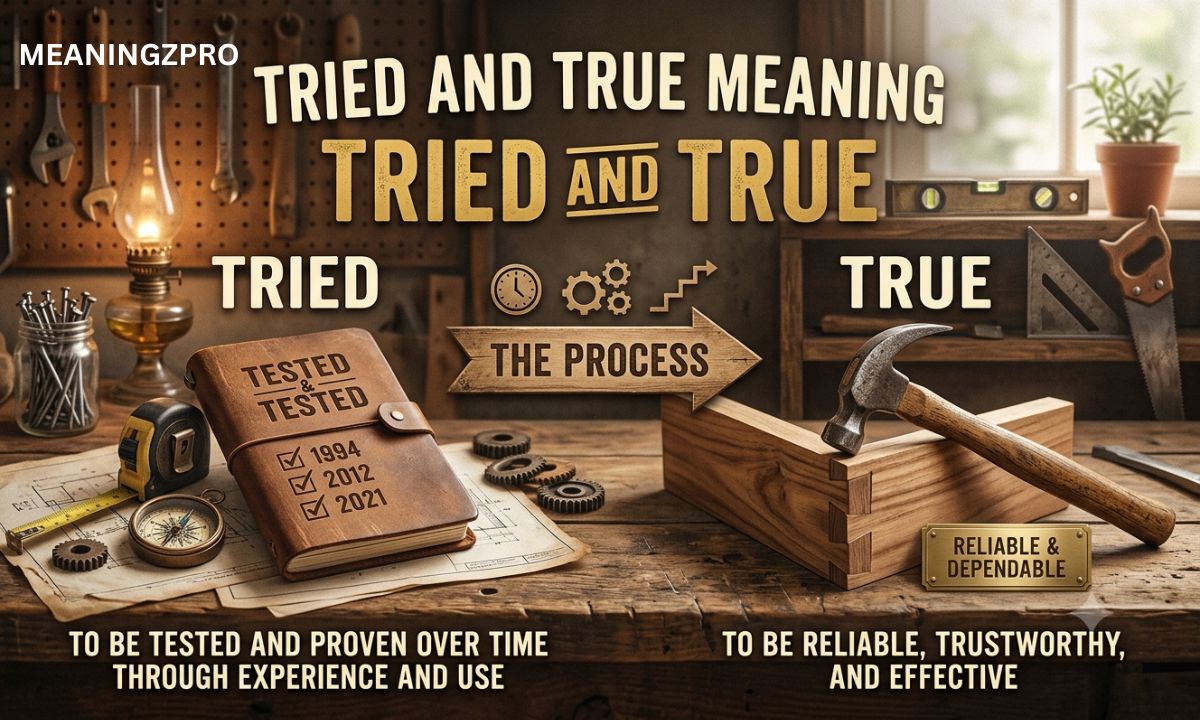
“Tried and true” means something that has been tested many times and always works well. It is not new or risky. People trust it because it has proven itself again and again over time.
This phrase has been used for many years. It comes from old English speech, where “tried” meant tested and “true” meant reliable. Over time, the two words got joined together as one common saying.
You can use “tried and true” in many ways. You might talk about a tried and true recipe, a tried and true method, or even a tried and true friend. In this guide, we will look at its meaning, its roots, and simple examples so you can use it with confidence.
Meaning & Definition

Simple Definition
Tried and true describes something that has been used many times and always works. It is not new. It is not risky. It has passed the test of time, and people trust it.
Think of an old family recipe your grandmother makes every year. It always tastes good. That recipe is tried and true.
Quick Examples
Here are some fast examples so you can see the phrase in action right away:
- Her tried-and-true study method helped her pass every exam.
- We used a tried-and-true recipe for the birthday cake.
- The coach stuck to his tried-and-true game plan.
- This is a tried and true way to save money each month.
Background
The phrase joins two simple words. Tried means tested or checked. True means honest, real, or dependable. Put together, they describe something that has been checked many times and proven reliable.
People use this phrase for methods, tools, recipes, advice, and even people. Anything that has proven itself again and again can be called tried and true.
Here is a simple way to remember it: if something has been used often and it has never let you down, it earns the title tried and true. That single sentence sums up the whole idea.
Real-life experience: Think about a pair of old work boots. They are scuffed and a little worn, but they never hurt your feet, and they never fall apart.
You could buy a shinier new pair, but you keep reaching for the old ones. That is exactly what tried and true feels like in real life — comfort built through repeated success.
Because this phrase describes a pattern of success, one single good result is not enough to earn the label. A method needs to work more than once, ideally many times, before people call it tried and true.
Usage in Different Contexts
The phrase tried and true shows up almost everywhere in daily English. It fits casual talk, business writing, cooking blogs, sports talk, and even school essays.
Here is a quick look at how it changes slightly depending on where you use it:
| Context | Example Sentence |
| Cooking | This is a tried-and-true pasta sauce recipe. |
| Business | We rely on tried-and-true sales strategies. |
| Sports | The team ran their tried and true defense play. |
| Parenting | She used a tried and true bedtime routine. |
| Technology | Many companies still use tried and true software tools. |
Pro tip: When you write for a website or blog, use tried and true to build trust. Readers feel safe when they know a method has worked for others before.
Because the phrase works in so many settings, writers, teachers, and marketers all use it often. It gives instant credibility to whatever it describes.
Let’s look a bit deeper at a few of these contexts:
- In cooking, the phrase almost always describes a recipe that has been passed down or repeated for years. It signals comfort food, not experimental dishes.
- In business, it describes strategies that already have a track record of results, so it reduces the fear of trying something risky.
- In sports, coaches and players use it for plays or drills that have won games before, especially in high-pressure moments.
- In parenting, it usually points to routines, like bedtime or mealtime habits, that keep a household calm and predictable.
- In technology, it can feel a little old-fashioned, since tech usually praises “new” and “innovative.” But some tools, like spreadsheets or basic email, are still called tried and true because they remain useful even after decades.
Notice that in every single context, the phrase carries the same core feeling: safety through repetition. Once you understand that feeling, you can use the phrase correctly in almost any situation you write about.
What Does Tried and True Mean in English With Examples?
In plain English, tried and true means something has been tested over and over and it always gives good results. It is the opposite of something new, untested, or shaky.
When someone says a method is tried and true, they are telling you: “Do not worry. This works. Others have used it before you.”
Examples
- My dad taught me his tried and true way to fix a leaky faucet.
- The teacher used her tried and true lesson plan again this year.
- This is a tried and true trick for getting a baby to sleep.
- Farmers still use tried and true methods to check the weather.
- The old road is a tried and true shortcut through town.
Each example shows a method, plan, or trick that has already proven itself. That is the heart of this phrase.
It helps to compare tried and true with its opposite. Something that is new, untested, or risky is the total opposite of tried and true. Here is a quick side-by-side look:
| Tried and True | Opposite (New or Untested) |
| Grandma’s old bread recipe | A recipe you just found online today |
| A 20-year-old family business | A brand-new startup |
| A well-worn hiking trail | An unmarked path through the woods |
| A classic study method | A method you invented last night |
This comparison shows why the phrase feels so comforting. When something is tried and true, the fear of failure is much lower, because you already know it has worked before.
Pro tip for writers: If you want your sentence to sound extra natural, pair tried and true with a personal detail, like “my grandmother’s” or “our family’s.” This small trick instantly makes your writing feel warmer and more human.
Is Tried and True a Compliment or Phrase Meaning Explained

Yes, tried and true is almost always a compliment. It tells someone that their method, choice, or advice is solid and dependable. It is a positive way to praise something without saying it is exciting or flashy.
However, it is a quiet compliment. It does not mean something is the newest or the fanciest. It means something is steady and reliable. Some people prefer new and exciting things, so calling something tried and true can sometimes sound a little boring, even though it is meant kindly.
Examples
- “Your tried and true advice always helps me.” (a warm compliment)
- “I know it’s not fancy, but it’s tried and true.” (praise with a small hint of plainness)
- “This shop has a tried and true reputation in town.” (strong trust and respect)
Real-life tip: If you want to compliment someone’s reliable habits, skills, or advice, this phrase works well. Just remember it praises steadiness, not newness.
There is one small thing to watch for. If you call a person tried and true, make sure the context is clearly warm and friendly. Calling someone’s ideas tried and true is always safe, but calling a person tried and true without context can sound like you are saying they are old-fashioned.
In most everyday conversations, though, people understand it as a kind and respectful compliment, especially when talking about loyal friends or long-time coworkers.
Here are a few more examples that show the compliment in action:
- “You can always count on Sarah. She’s tried and true.” (praising loyalty)
- “Our accountant has been with us for 15 years. He’s tried and true.” (praising dependability)
- “This old truck is tried and true. It has never broken down on us.” (praising reliability)
In every case, the tone stays positive. That is why tried and true almost always works well as a compliment, as long as you use it to describe steady, dependable qualities.
Tried and True Idiom Meaning With Sentence Examples
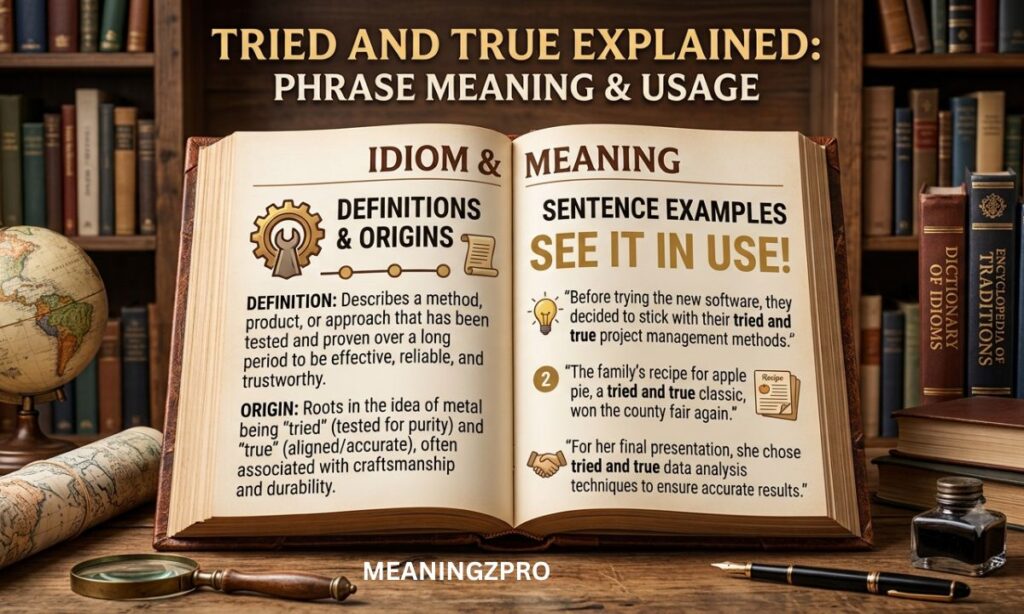
Yes, tried and true is an idiom. An idiom is a group of words whose meaning is more than just the individual words. You cannot fully understand it by only looking at “tried” and “true” separately. Together, they form one clear idea: something proven and trustworthy.
Idioms like this one make English sound natural and native. Learning them helps you speak and write more like a real, everyday English speaker.
Sentence Examples
- The mechanic used his tried and true toolbox to fix the car quickly.
- She trusted the tried and true map instead of her new phone app.
- Grandpa always says, “Stick to what is tried and true.”
- The bakery’s tried and true bread recipe has not changed in 50 years.
- Our tried and true morning routine keeps the whole family on time.
Notice how the phrase almost always comes before a noun, like method, recipe, plan, or advice. This pattern makes it easy to remember and use correctly.
Idioms can be tricky for English learners because the words do not always explain themselves. But once you learn an idiom like tried and true, you can use it confidently in speech, essays, emails, and everyday chats. Here are a few more sentence examples across different situations to help the idiom feel natural:
- The nurse followed a tried and true checklist before every surgery.
- Our neighborhood has a tried and true system for organizing the yearly festival.
- The old fisherman used his tried and true technique to find the best fishing spots.
- Teachers often return to tried and true classroom activities that keep students engaged.
- Even in a fast-changing world, some tried and true values, like honesty and hard work, never go out of style.
Pro tip: Idioms like this one work best when the sentence includes a noun that clearly benefits from being “reliable.” Words like method, system, plan, recipe, advice, technique, and routine pair naturally with tried and true.
Difference Between Tried and Tested vs Tried and True Meaning
Many people mix up tried and tested with tried and true. They are close in meaning, but there is a small difference worth knowing.
Key Difference
- Tried and tested focuses on the process. It means something has gone through testing and checking, often carefully or officially.
- Tried and true focuses on the result. It means something has proven itself as trustworthy and reliable over time, often through everyday use rather than formal testing.
| Phrase | Focus | Feeling |
| Tried and tested | The testing process | Careful, checked, verified |
| Tried and true | Long-term trust | Warm, dependable, comfortable |
Example
- “This medicine is tried and tested in labs before it is sold.” (formal testing)
- “This is my tried and true home remedy for a cold.” (trusted through years of personal use)
Both phrases are correct and useful. Choose tried and tested when talking about official checks. Choose tried and true when talking about long-term personal trust.
Here is another simple way to remember the difference: tried and tested answers the question “Was it checked?” while tried and true answers the question “Can I trust it, even after all this time?”
A few more comparison examples:
- “The new vaccine is tried and tested through clinical trials.” (formal, scientific checking)
- “My aunt’s cough remedy is tried and true. She has used it for 40 years.” (personal, long-term trust)
- “This software update is tried and tested on thousands of devices.” (technical verification)
- “This is our tried and true family game night activity.” (warm, personal habit)
Real-life tip: In professional or scientific writing, lean toward tried and tested. In personal blogs, stories, or casual writing, lean toward tried and true. Knowing this small difference can make your writing sound more precise and natural.
How to Use Tried and True in a Sentence Correctly
Using tried and true correctly is simple once you know the pattern. It almost always acts like an adjective, describing a noun.
Before a Noun
This is the most common way to use the phrase. It sits right before the thing it describes.
- Her tried and true technique never fails.
- This is a tried and true family recipe.
- We follow a tried and true schedule every week.
After a Verb
Sometimes the phrase follows a linking verb, like is or was, to describe the subject of the sentence.
- This method is tried and true.
- Her advice has always been tried and true.
- The old bridge is tried and true, even after many storms.
More Examples
- The company sticks to tried and true marketing tricks.
- His tried and true work ethic impressed everyone.
- We chose the tried and true path instead of the shortcut.
- Their tried and true friendship lasted 30 years.
Pro tip: Do not add extra words like “very” or “so” before this phrase. Native speakers rarely say “very tried and true.” The phrase already feels strong on its own.
Another useful pattern is placing tried and true at the very start or end of a sentence for extra emphasis.
- Tried and true, that is what this method is.
- Nothing beats a tried and true friend when times get hard.
- If you want results, stick with what is tried and true.
Common mistake to avoid: Do not write it as “try and true” or “tried and truth.” The correct spelling is always tried and true, using the past tense of “try” and the adjective “true.” Small spelling slips like this can confuse readers and hurt your writing’s credibility, especially in professional content.
Here is a quick checklist for using the phrase correctly:
- Use it before a noun to describe something reliable.
- Use it after “is,” “was,” or “has been” to describe the subject.
- Avoid adding extra intensifiers like “very” or “extremely.”
- Keep the spelling exactly as tried and true.
- Use it only for things with a real history of success.
Tried and True Meaning in Business and Marketing Context
In business, trust matters a lot. Companies love using the phrase tried and true because it makes customers feel safe. It tells people, “This is not an experiment. This already works.”
Marketers often use this phrase to sell products, services, or strategies that have a strong track record.
Examples in Business
- Our company follows tried-and-true hiring practices.
- The manager uses a tried and true system to train new staff.
- Small businesses often rely on tried and true budgeting habits.
Examples in Marketing
- This is a tried and true advertising strategy that boosts sales.
- Our tried and true formula has helped thousands of happy customers.
- We stick to tried and true email marketing tips that actually work.
Real-life experience: Content writers often use tried and true in headlines and product descriptions. It builds instant trust without needing long explanations. A single bold phrase like this can make a reader feel confident before they even read the details.
Businesses often face a choice between showing off something “new and exciting” or something “tried and true.” Both approaches work, but they attract different kinds of customers.
| Approach | Appeals To | Example Message |
| New and exciting | Early adopters, risk-takers | “Try our brand-new AI tool today!” |
| Tried and true | Cautious buyers, loyal customers | “Trusted by families for over 20 years.” |
Pro tip for marketers: If your product or service has a long history, do not hide it — highlight it. Phrases like “tried and true since 2005” or “a tried and true favorite among our customers” can boost trust and even improve conversion rates, since people naturally feel safer buying something with a proven track record.
Small business owners can also use this phrase in customer reviews, testimonials, and “About Us” pages to build a sense of long-term reliability.
Origin of Tried and True Phrase and Historical Meaning
The phrase tried and true is very old. It comes from a time when the word tried meant something had been tested through experience, not just checked once quickly.
Long ago, people did not have labs, machines, or the internet to test things. Instead, they tested tools, recipes, and advice through years of daily use. If something worked again and again, people called it tried and true.
Old English writing and poetry often used similar phrases to praise loyalty, honesty, and dependable things. Over time, tried and true became a common way to describe anything—people, tools, or ideas—that had proven itself through repeated use.
Even famous old sayings and traditional stories used similar wording to praise loyal friends and reliable tools. This shows the idea of “testing something until you trust it” has been part of the English language and culture for a very long time.
Today, the phrase keeps that same old meaning. It still means something has passed the test of time, even though our world has changed a lot since it was first used.
Interestingly, the word true in Old English did not just mean “not false.” It also carried the meaning of loyal and faithful, similar to how we still say a “true friend” today. So when older generations called something tried and true, they were really saying: this has been tested, and it has stayed loyal to its purpose every single time.
This is part of why the phrase feels warmer than more modern words like “effective” or “efficient.” It carries a small piece of old-fashioned loyalty and trust inside it, even in modern sentences.
Over the centuries, as English spread around the world, the phrase kept its meaning almost perfectly unchanged. That is fairly rare for idioms, many of which shift meaning over time. Tried and true has stayed remarkably stable, which is part of why it still feels so clear and useful today.
Tried and True Synonym Words and Similar Phrases List
If you want to avoid repeating tried and true too many times in your writing, you have plenty of other choices.
Synonyms
- Reliable
- Dependable
- Proven
- Trustworthy
- Established
- Time-tested
- Solid
- Well-tested
Similar Phrases
- Tried and tested
- Stood the test of time
- Old faithful
- Proven method
- Time-honored
- Battle-tested
- Age-old
Pro tip: Mixing synonyms into your writing keeps it fresh and avoids sounding repetitive. This also helps with SEO because search engines like content that uses related words naturally, not the same phrase over and over.
Here is a quick table showing how some synonyms shift the tone slightly, even though the core meaning stays close to tried and true:
| Word or Phrase | Tone | Best Used For |
| Reliable | Neutral, everyday | General writing |
| Dependable | Warm, personal | People, habits, tools |
| Proven | Confident, factual | Business, science |
| Time-tested | Slightly formal | History, traditions |
| Old faithful | Playful, affectionate | Casual conversation |
| Battle-tested | Strong, tough | Sports, challenges |
| Age-old | Historical | Traditions, customs |
Using a mix of these words instead of repeating tried and true in every sentence makes your writing sound more skilled and natural, especially in longer articles, essays, or blog posts.
Tried and True Meaning in Everyday Conversation Examples
You do not need to be a writer or a business owner to use this phrase. People use tried and true all the time in normal talk.
Examples
- “I always use my tried and true shampoo. It never lets me down.”
- “Let’s take the tried and true route instead of the new highway.”
- “My mom’s tried and true trick gets stains out every time.”
- “He gave me some tried and true advice about job interviews.”
- “This app is new, but I still trust my tried and true notebook.”
These sentences show how natural the phrase feels in daily life. It fits chats with friends, family talks, and casual writing like text messages or blog comments.
You will often hear this phrase in conversations about:
- Health remedies: “This is my tried and true cure for a headache.”
- Travel routines: “We always take our tried and true road trip snacks.”
- Cleaning tricks: “Vinegar is my tried and true cleaning helper.”
- Gift ideas: “A book is always a tried and true gift for readers.”
- Money habits: “Saving 10 percent of my paycheck is my tried and true rule.”
Real-life experience: In casual talk, people often shorten longer explanations by simply saying, “It’s tried and true,” instead of explaining the whole history behind why they trust something.
This shows how efficient and useful the phrase really is — one small sentence can carry years of trust and experience.
When to Use the Tried and True Phrase in English Writing
Knowing when to use this phrase is just as important as knowing what it means. It works best when you want to build trust or comfort in your writing.
Common Writing Situations
- Product descriptions: Show customers a product has a strong history of success.
- How-to guides: Reassure readers that a method has worked for many people before.
- Personal essays: Share a habit, tool, or tradition that has lasted through the years.
- Recipe blogs: Highlight a dish that has been loved for generations.
- Advice articles: Add weight to tips that are simple but proven.
Avoid using tried and true when talking about something brand new, experimental, or untested. The phrase only fits things with a real history of success.
Real-life tip: If you are writing a blog post and want a strong, trustworthy headline, try phrases like “5 Tried and True Tips for…” This instantly tells readers the tips are not random guesses—they actually work.
Here is a simple checklist to decide if tried and true fits your writing:
| Ask Yourself | If Yes, Use the Phrase |
| Has this method been used more than once? | ✅ |
| Has it worked well over time? | ✅ |
| Am I trying to build trust with my reader? | ✅ |
| Is this something brand new or experimental? | ❌ Avoid using it |
Writers who understand this checklist rarely misuse the phrase. It keeps their writing accurate and their readers’ trust intact.
Pro tip: In SEO writing, phrases like tried and true also help match how real people search online. Many readers type searches like “tried and true tips” or “tried and true methods” when they want advice they can actually count on.
Using the phrase naturally in your headings and body text can help your content match these searches.
Tried and True Meaning vs Proven Methods Explained Simply
Some people wonder if tried and true is just a fancier way to say proven methods. They are very close, but there is a small, simple difference.
Proven methods usually sound more formal, technical, or scientific. It often shows up in research, business plans, or instructions. Tried and true, on the other hand, feels warmer, more personal, and more emotional. It often connects to family, tradition, or long personal experience.
| Phrase | Tone | Best Used For |
| Proven methods | Formal, technical | Reports, science, instructions |
| Tried and true | Warm, personal | Stories, recipes, personal advice |
Example
- “Doctors recommend proven methods for treating this illness.” (formal, medical tone)
- “My grandmother’s tried-and-true remedy always helped when I was sick.” (warm, personal tone)
Both phrases mean something works well and can be trusted. The choice between them depends on the feeling you want your writing to give.
Here are a few more side-by-side examples to help you choose the right phrase for the right moment:
- “Our research team uses proven methods to test new medicine.” (technical, careful)
- “My uncle’s tried-and-true way of teaching kids to ride a bike always works.” (personal, story-like)
- “The school follows proven methods backed by educational studies.” (formal, evidence-based)
- “Grandpa’s tried-and-true fishing spot never disappoints.” (nostalgic, personal)
Pro tip: If you are writing an academic paper, report, or formal business plan, proven methods will usually sound more appropriate. If you are writing a blog post, personal story, or friendly advice article, tried and true will feel warmer and more relatable to readers.
Understanding this small difference in tone can make a big difference in how professional or how personal your writing feels to your audience.
Final Thoughts
Tried and true is a simple but powerful phrase. It tells the world that something has been tested again and again, and it still works. Whether you talk about a recipe, a method, a habit, or a piece of advice, this phrase adds instant trust to your words.
Now that you understand its meaning, origin, and correct usage, you can use it with confidence in daily talk, business writing, or blog posts. Try adding it the next time you want to praise something dependable without saying it is new or fancy.
Frequently Asked Questions
What does tried and true mean?
It means something has been tested many times and always works well. It is trusted because it has never failed before.
Is tried and true a positive phrase?
Yes, it is a positive phrase. It praises something for being steady, dependable, and worth trusting.
Is tried and true an idiom?
Yes, it is an idiom. Its full meaning goes beyond the two separate words “tried” and “true.”
Can tried and true describe a person?
Yes, it can describe a person. It usually praises someone’s loyalty, reliability, or steady character.
What is the difference between tried and true and tried and tested?
Tried and tested focuses on formal checking or testing. Tried and true focuses on long-term personal trust built over time.
How do you use tried and true in a sentence?
Place it right before a noun, like “method” or “recipe.” You can also use it after “is” or “has been” to describe the subject.
What are synonyms for tried and true?
Common synonyms include reliable, dependable, proven, and time-tested. You can also say “stood the test of time” or “old faithful.”

Hi, I’m Shahid, a passionate content writer and blogger dedicated to creating easy-to-understand, well-researched, and SEO-friendly content. I specialize in explaining the meanings of words, phrases, names, internet slang, symbols, and everyday expressions in a simple and engaging way.