
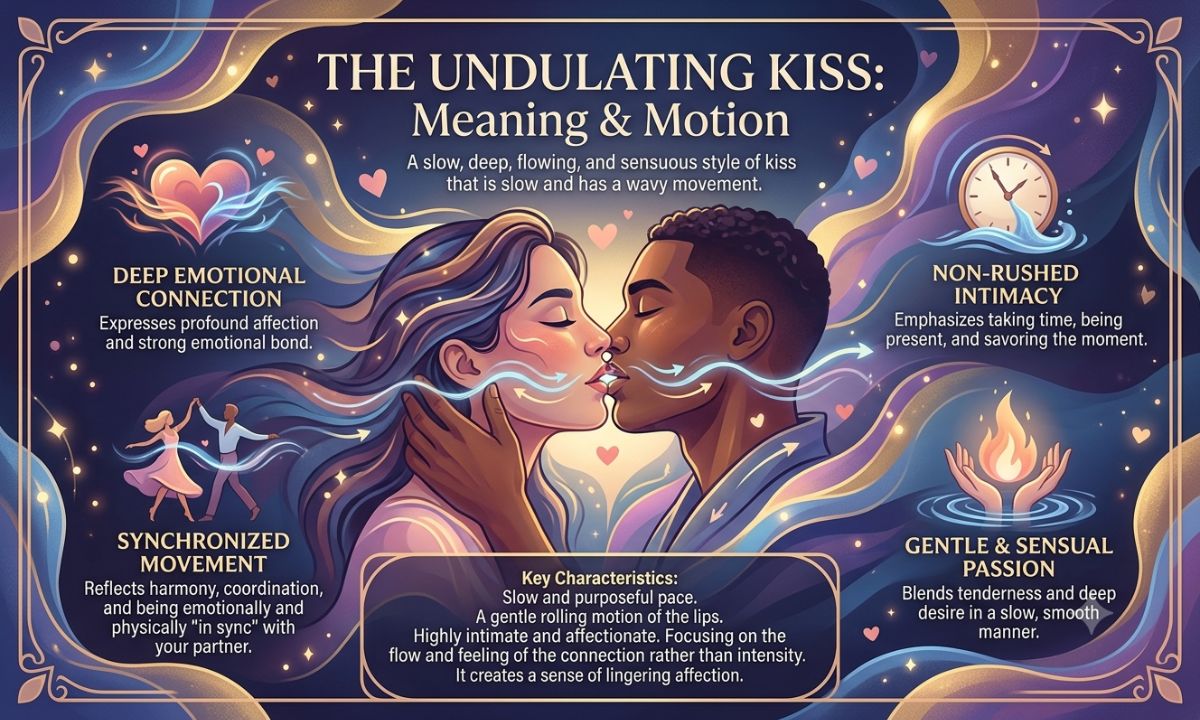
A kiss can say a lot without any words. Sometimes, a kiss feels smooth and wave-like. This is called an undulating kiss. It moves like a gentle rise and fall, almost like a soft rhythm. People often notice this style during a slow, close moment with someone they trust.
This type of kiss usually shows deep comfort and strong connection. It is not rushed or rough. Instead, it flows naturally, almost like a dance between two people. When someone kisses this way, it often means they feel safe and relaxed with their partner.
Many people wonder what this kind of kiss really means. It can point to emotional closeness, trust, and even passion that builds slowly. Understanding this simple sign can help you read your relationship better. It shows how bodies and feelings often move together.
Key Grammatical and Meaning Points
Undulating comes from the verb “undulate,” which means to move up and down in a smooth, wave-like pattern. When you place it before the word kiss, you get a phrase used to describe a kiss that flows gently, almost like water moving in slow, steady waves.
A few quick grammar notes worth knowing:
- Undulating functions as an adjective in this phrase, even though it comes from a verb.
- Kiss is the noun being described.
- The pair “undulating kiss” is a noun phrase, most often found in descriptive or creative writing.
- You can shift the tense: “the kiss undulated,” “the kiss is undulating,” or “an undulating kiss happened.”
This is not internet slang or a trend phrase. It is a piece of descriptive language, the kind writers reach for when they want a reader to slow down and picture soft, rolling movement instead of something quick or forceful.
A few more grammar patterns worth learning
- Present tense: “The kiss undulates softly between them.”
- Past tense: “The kiss undulated slowly in the quiet evening.”
- Continuous form: “They were undulating gently into the kiss.”
- Noun form: “There was a soft undulation to the way they kissed.”
Learning these small shifts helps writers avoid repeating the same sentence pattern over and over. It also helps English learners apply the word correctly across essays, captions, and creative writing without sounding stiff or robotic.
Undulating Kiss Definition
Put simply, an undulating kiss is a kiss with a soft, rising-and-falling rhythm. It does not rush. It moves the way gentle waves move across water, back and forth, slow and steady.
People often use this phrase to describe closeness that feels calm rather than urgent. Both partners move together, almost in step, rather than one person leading and the other following.
Origin & Etymology
“Undulate” traces back to the Latin word unda, meaning “wave.” English writers borrowed this idea centuries ago to describe anything that rolls or ripples — fields of wheat swaying in wind, fabric moving in a breeze, or sound waves traveling through air.
Over time, romance and poetry writers picked up the word to describe physical closeness too. Pairing it with “kiss” gave writers a single, vivid way to describe something that is otherwise hard to put into plain sentences.
Pro tip: Borrowing nature words for emotional writing is a technique used by many published romance authors. A reader who sees “wave” already pictures something calm — attach that image to a kiss, and the feeling transfers automatically.
This kind of borrowing is common throughout English. Words that first describe the natural world — “flow,” “glow,” “ripple,” “drift” — often end up describing human emotion later on. It happens because readers already carry a mental picture of these words from nature, so writers get an emotional shortcut for free.
This is one reason English romantic writing feels so layered. A single word like “undulating” carries the memory of every wave, hillside, or field the reader has ever pictured, and lends all of that imagery to a simple, human moment.
Detailed Usage
In Romantic Relationships
In everyday conversation, almost nobody actually says “we had an undulating kiss.” But the experience behind the phrase is real and common. From real couples’ stories, this slow, wave-like kissing style tends to show up:
- In calm, quiet settings, not rushed goodbyes
- Once both people feel secure with each other
- Right after an emotional or honest conversation
- When neither person feels the need to hurry
Nervous, early-stage kisses often feel quicker simply because both people are excited or a little unsure. As comfort builds, the pace naturally slows. This shift is not something you can force — it tends to happen on its own once trust settles in.
In Literature and Poetry
Writers reach for this phrase because it does double duty: it describes an action and sets a mood at the same time. One sentence — “their kiss undulated like a slow tide” — tells the reader everything: the pace, the emotion, the atmosphere.
Poets frequently pair “undulating” with other soft-sounding words like “tide,” “breeze,” “sway,” or “drift.” Long, flowing words naturally slow a reader’s pace, which mirrors the slow moment being described. This matching of word-sound to word-meaning is a favorite trick in romantic poetry.
In Artistic or Metaphorical Writing
Beyond literal description, “undulating kiss” is often used as a metaphor. Artists and songwriters use it to represent:
- The natural rise and fall of emotion inside a relationship
- Two people moving together, like a slow dance
- A deep, quiet connection shown through movement instead of words
This metaphorical use is why the phrase appears often in song lyrics and film dialogue, even outside strict romantic scenes.
Undulating Kiss Meaning in Different Languages
If you are curious how this phrase translates elsewhere, here is a simple reference table.
| Language | Translation | How to Say It |
| French | baiser ondulant | bay-ZAY on-doo-LAHN |
| Spanish | beso ondulante | BEH-so on-doo-LAHN-teh |
| Italian | bacio ondulante | BAH-cho on-doo-LAHN-teh |
| German | wellender Kuss | VEH-len-der KOOS |
Good to know: Each translation keeps the same wave-based meaning. Romance languages especially lean on this kind of nature imagery in love songs, poems, and letters, so the phrase translates smoothly without losing its emotional weight.
Undulating Kiss Synonyms
Looking for other ways to express the same idea? Try:
- Flowing kiss
- Wave-like kiss
- Rolling kiss
- Slow, swaying kiss
- Rhythmic kiss
- Soft, rippling kiss
Undulating Kiss Antonyms
Knowing the opposite of a word often makes its meaning clearer. Opposite styles include:
- Rushed kiss
- Abrupt kiss
- Rough kiss
- Stiff kiss
- Sudden kiss
Looks Like Words
A few words resemble “undulating” but carry entirely different meanings. Don’t mix them up.
| Word | Meaning |
| Undulate | To move in a wave pattern |
| Undulant | A medical term describing a fever that rises and falls |
| Insulate | To protect against heat, cold, or sound |
| Modulate | To adjust tone, pitch, or volume |
Common Mistakes & Tips
Mistakes
Here are the errors people make most often with this phrase:
- Misspelling it as “undulaiting” or “undulateing”
- Dropping it into casual chat, where it sounds oddly formal
- Confusing “undulating” with the unrelated word “insulating”
- Repeating it too many times in one piece of writing, which weighs the text down
Tips
Follow these simple guidelines instead:
- Reserve the phrase for descriptive, emotional, or creative writing.
- Pair it with gentle imagery — waves, wind, tides, or dance.
- Use it sparingly. One or two mentions per piece is usually enough.
- Read the sentence out loud. If it flows smoothly, you’ve used it correctly.
Cultural & Contextual Insight
Kissing customs differ widely across cultures, and that shapes how this phrase gets used.
- In much of Western romantic fiction and film, a slow, wave-like kiss signals emotional depth and intimacy.
- In cultures where public affection is more reserved, this phrase shows up mostly in private writing, books, or song lyrics rather than everyday public life.
- Water and waves are near-universal symbols of calm across cultures, which is part of why this phrase translates so naturally into other languages.
- Nature imagery — moonlight, tides, wind — is a recurring theme in love poetry worldwide, and “undulating” fits neatly into that long tradition.
It also helps to remember that language around intimacy is shaped heavily by context. A phrase that feels natural in a novel might feel out of place in casual conversation, and that gap can shift from one culture to the next. In some places, poetic, indirect language around romance is preferred over blunt description — which is exactly the kind of gap a phrase like “undulating kiss” fills nicely.
Related Words / Word Families
“Undulate” has a small family of related terms:
- Undulation (noun) — the wave-like movement itself
- Undulatory (adjective) — relating to wave motion
- Undulately (adverb) — done in a wave-like manner
Knowing these forms helps you use the word correctly across different sentence structures.
Reader Interaction / Social Hook
Pause for a moment and think back to a time you felt completely at ease and close with someone. Was there a slow, unhurried quality to that moment? That is essentially what “undulating kiss” tries to capture in language — a feeling many people already know, even without the fancy vocabulary.
Try putting that memory into your own words. You may find you already understood the concept before you ever read its definition.
Related Expressions / Slang Evolution
Modern speech has its own casual ways of describing this same feeling, even without using the word “undulating”:
- “It felt like slow motion”
- “We were completely in sync”
- “It just flowed naturally”
These everyday phrases prove that the feeling behind “undulating kiss” hasn’t changed — only the words people reach for to describe it have evolved with each generation.
The Deeper Meaning Behind Undulating Kisses
At its core, this phrase is about connection over speed. It signals that both people are fully present, with nothing rushed and nothing forced.
This style of closeness often reflects:
- Trust built between two people over time
- Comfort with silence, not needing to fill every moment
- Patience, which many relationship counselors link to stronger long-term bonds
- Emotional safety, the sense that it’s okay to slow down
Interestingly, when people recall their most meaningful romantic memories, they often describe quiet, slow moments rather than dramatic, high-energy ones. Calm moments tend to leave a deeper mark than rushed ones.
There’s a simple reason for this. The brain pays closer attention when it isn’t rushed, and closer attention creates stronger memories.
A hurried moment often blends into every other hurried moment that came before it, while a slow, deliberate one stands apart — the lighting, the silence, the small details all become easier to recall years later.
Step-by-Step Technique Guide: Mastering the Waves
Want to understand or try this style yourself? Here’s a simple walkthrough.
- Pause first. Take one slow breath before you begin — rushing in immediately breaks the rhythm before it starts.
- Begin lightly. Start with soft, gentle contact rather than firm pressure.
- Build a rhythm. Let the movement rise and fall gradually, like a wave rolling in.
- Keep your body relaxed. Tight shoulders or a clenched jaw disrupt the flow.
- Follow your partner’s pace. Move with them rather than setting your own speed.
- Breathe steadily. Holding your breath adds tension; steady breathing keeps things calm.
- Slow down at the end. Ease out of the moment instead of stopping abruptly.
Pro tip: Practicing calm, steady breathing in ordinary daily life — during stressful moments, for example — makes it much easier to stay relaxed during intimate ones too.
Psychological Benefits and Emotional Impact
Reduces Stress and Builds Calmness
Slow, gentle physical contact can lower stress and calm the nervous system for both people involved.
Strengthens Emotional Bonding
A slower pace gives the brain more time to release bonding-related chemicals, which can deepen feelings of closeness over repeated experiences.
Boosts Mood Through Brain Chemistry
Kissing in general triggers feel-good chemicals like dopamine and oxytocin. A slower, wave-like style may stretch out that pleasant feeling rather than compressing it into a quick burst.
Improves Non-Verbal Communication
This style trains both people to pay closer attention to body language, building a skill that carries over into the rest of the relationship.
Creates Lasting Emotional Memories
Slow, deliberate moments tend to stay in memory far longer than fast, routine ones, largely because the brain pays closer attention when it isn’t rushed.
Builds a Sense of Safety
Slowness signals to the nervous system that there’s no danger and no need to hurry, which over time can strengthen a broader feeling of security within the relationship.
Advanced Techniques and Variations
Once the basics feel natural, you can explore small variations:
- Soft-pause technique: Insert brief, gentle pauses between waves of movement.
- Breath-sync technique: Match your breathing rhythm to your partner’s.
- Light-touch technique: Add a gentle touch to the face or hand to deepen the feeling.
- Slow-build technique: Start very light and gradually build closeness over time.
None of these are strict rules — think of them as options to personalize the moment.
Undulating Kisses in Relationship Development
Relationships usually deepen through small, quiet moments rather than big dramatic ones. A shift toward this slower kissing style often signals a relationship has settled into a calmer, more secure stage.
| Relationship Stage | Typical Kissing Style |
| Early dating | Quick, nervous, or eager kisses |
| Building trust | Slower, more intentional kisses |
| Deep connection | Calm, wave-like, undulating kisses |
| Long-term comfort | Familiar, relaxed, rhythmic kisses |
This is a general pattern, not a fixed rule — every couple moves through these stages at their own pace, and some skip straight to a slow, calm style from day one.
Scientific Research on Kissing and Intimacy
Researchers studying human bonding have found that kissing plays a genuine physiological role in closeness. Slower, more deliberate physical contact tends to correlate with lower stress hormone levels and a greater sense of safety between partners.
Studies on touch also show it can lower heart rate and steady breathing, both signs of a calmer nervous system. This lines up with the idea that a slow, wave-like kiss can feel physically soothing, not only emotionally pleasant.
Much of this research focuses on touch and intimacy broadly rather than the specific phrase “undulating kiss.” Still, the underlying pattern holds up consistently: gentle, rhythmic physical closeness is repeatedly linked to calm and connection across relationship studies.
Researchers who study couples also point to the idea of “physiological synchrony” — when two people’s heart rates or breathing patterns start to match during close contact. This shared rhythm is often reported alongside stronger feelings of closeness and understanding, which lines up neatly with the slow, matched movement described by the word “undulating.”
Romantic Storytelling: Undulating Kisses in Literature
Authors often place this kind of kiss at key emotional turning points, such as:
- A reunion after time apart
- A quiet, unspoken confession of feelings
- The closing scene of a slow-building romance
Describing a kiss as “undulating” is a signal to readers: slow down, this moment matters, don’t rush past it.
Film and Media Examples of Undulating Kisses
On screen, directors recreate this slow, wave-like feeling using visual and audio tools rather than dialogue:
- Slow motion or gentle camera movement
- Soft, steady background music
- Close-up shots that linger on small details
- Warm, low lighting to build a calm mood
These choices let audiences feel the rhythm of the moment without a single word being spoken about it.
How to Read Your Partner’s Cues During an Undulating Kiss
Body language tells you a lot in these quiet moments. Watch for:
- Relaxed shoulders, usually a sign of comfort
- Slow, steady breathing, showing calm and trust
- Leaning in, a sign of genuine interest
- Stiffness or pulling away, which may mean it’s time to slow down or stop
Always prioritize these signals over any technique. A simple check-in — “is this okay?” — builds far more trust than perfecting a physical rhythm ever could.
Undulating Kiss Myths vs. Facts
| Myth | Fact |
| It only exists in movies | Many real couples experience this naturally |
| It requires special skill | It mainly requires patience and relaxation |
| It only happens in new relationships | It often grows stronger with time |
| It’s the same as a passionate kiss | It’s typically slower and calmer than passion-driven kissing |
How to Transition from a Simple Kiss to an Undulating Kiss
This shift usually happens naturally as comfort grows, but a few small habits can encourage it:
- Gradually slow your pace mid-kiss instead of keeping one constant speed.
- Ease off pressure and let movement feel lighter.
- Focus on rhythm rather than speed.
- Stay mentally present instead of thinking ahead to what comes next.
The Science Behind Why Undulating Kisses Feel Good
Slow touch activates specific nerve fibers in the skin linked to calming, pleasant sensations. This is part of why unhurried physical contact often feels more satisfying than fast contact.
Combine that with the brain chemicals released during kissing generally, and you get a strong, layered sense of comfort and closeness — more than either factor alone would produce.
Undulating Kisses and Relationship Satisfaction
Couples who regularly make room for slow, meaningful physical closeness often report higher overall relationship satisfaction. This doesn’t mean quick kisses are bad — it simply points to the value of balance.
Pro tip: Setting aside even a short window of quiet, distraction-free time together each day creates natural space for these slower moments to happen on their own.
Busy schedules are often the real obstacle here. Constant phone notifications and daily stress can make even affectionate moments feel rushed. Something as small as ten screen-free minutes together each day can help restore this slower rhythm over time.
It also helps to notice which parts of the day already feel calm — a quiet morning before work, or a settled evening after chores are done — and protect those windows on purpose.
Slower connection rarely happens by accident in a busy schedule; it usually needs a small amount of deliberate space.
Tips for Making Your First Undulating Kiss Memorable
- Pick a calm, private setting free of distractions.
- Don’t rush the lead-up to the moment.
- Give your partner full attention — set the phone aside.
- Let silence feel comfortable rather than awkward.
- Stay relaxed and smile before and after.
Common Misconceptions About Undulating Kisses
A common myth is that this style is reserved for “experienced” couples only. That’s simply not true — new couples can share this kind of moment too, as long as both people feel safe and unhurried.
Another misconception is that it needs to look a certain way to “count.” In truth, it’s far more about the feeling than any visible technique.
How Age and Experience Affect the Undulating Kiss
As people gain more relationship experience, or simply get older, they often naturally slow down — not necessarily because of skill, but because of growing comfort and self-awareness.
Younger or newer couples may lean toward quicker, more excited kissing styles, while long-term partners frequently drift toward calmer, slower ones. Neither style is more “correct” than the other.
Experience also sharpens someone’s ability to read body language. People who’ve been in a few relationships often notice pacing and comfort cues more easily, which naturally supports a slower, more attentive kissing style.
There’s no fixed age when this shift happens, and it isn’t guaranteed to happen at all. What matters more than age is emotional readiness — a willingness to slow down, pay attention, and stay present rather than rushing toward the next moment.
Undulating Kiss Etiquette: When and Where It’s Appropriate
Since this style is slow and personal, it fits best in private, relaxed settings.
- Save it for quiet, private moments rather than public spaces.
- Confirm both people are comfortable and willing.
- Skip it during rushed situations, like a quick goodbye at the door.
- Read your partner’s mood — not every moment calls for a slow kiss.
How to Practice the Undulating Kiss Solo (Yes, You Can!)
You can actually train parts of this skill on your own — not by kissing yourself, but by preparing your body and mind.
- Practice slow, steady breathing daily.
- Work on relaxing your jaw and shoulders during everyday stress.
- Try mindfulness exercises to stay present instead of distracted.
- Pay attention to posture — a relaxed body supports relaxed movement.
Small daily habits like these make it far easier to fall naturally into a slow, connected rhythm when the right moment arrives.
Using an Undulating Kiss to Rekindle Romance
Long-term couples sometimes slip into fast, routine habits without noticing. Deliberately slowing down, even for a single kiss, can help bring back a sense of closeness.
- Set aside quiet time free of screens.
- Give each other full attention during small daily moments.
- Reintroduce slow, gentle touch into everyday routines.
- Talk openly about wanting more calm, connected time together.
Real-life tip: Choose one daily moment — a morning goodbye or an evening greeting — and slow it down on purpose. Small, repeated habits like this often rebuild closeness faster than a single big romantic gesture.
It’s worth remembering that slowing down does not mean losing excitement. Many couples worry that a calmer pace signals fading passion, but the opposite is usually true. Rushed routines quietly wear intimacy down over time, while small, unhurried moments tend to build it back up, one gentle interaction at a time.
Undulating Kiss vs. Other Kissing Styles: Understanding the Differences
| Kissing Style | Pace | Typical Feeling | Best Suited For |
| Undulating kiss | Slow, wave-like | Calm, deep connection | Quiet, private moments |
| Passionate kiss | Fast, intense | Excitement, urgency | High-emotion situations |
| Peck | Very quick | Friendly, casual | Greetings or goodbyes |
| Lingering kiss | Slow, still | Tender, thoughtful | Emotional conversations |
Body Language Signals During an Undulating Kiss
Body language often communicates more than words in these quiet moments. Look for:
- Soft, even breathing
- Relaxed hands, often resting gently on a partner’s face or back
- Softly closed or unfocused eyes
- An unhurried, relaxed posture overall
These are generally strong signs of comfort, trust, and real connection — while stiffness, pulling back, or held breath suggest it may be time to pause or slow down.
Reading these cues well is really a two-way conversation, not a one-sided skill. Checking in with a simple word or gentle question, and adjusting based on the answer, always matters more than any physical technique. Comfort and mutual willingness are what actually make a moment feel connected — the rest is just detail.
Undulating Kiss Techniques for Beginners
New to this style? Keep it simple:
- Don’t overthink it — let it unfold naturally.
- Focus on staying relaxed rather than “getting it right.”
- Slow your breathing before you begin.
- Stay attentive to your partner’s comfort and pace.
- Remember: genuine connection matters far more than technique.
Pro tip: The most common beginner mistake is trying too hard to “perform” the technique. Real closeness comes from relaxing into the moment, not performing for it.
At its heart, an undulating kiss is a simple idea dressed up in poetic language. It’s about slowing down, staying present, and moving in gentle rhythm with someone you trust — nothing more technical than that.
Whether you first came across the phrase in a poem, noticed it in a film, or simply lived it in a quiet moment with someone special, it names something many people already understand instinctively, even without the vocabulary for it. It’s a reminder that some of the most meaningful parts of a relationship are the calm, unhurried ones rather than the dramatic ones.
Final Words
An undulating kiss is more than just a simple touch. It shows trust, comfort, and a real bond between two people. This gentle, wave-like kiss often happens when both partners feel calm and open with each other. It is a quiet way of saying, “I feel safe with you.”
If you notice this kiss in your relationship, take it as a good sign. It means your connection has grown beyond nerves and rush. Slow, flowing kisses often reflect deep emotional closeness. They show that both people are present in the moment, not distracted or unsure.
In the end, every kiss tells a story. An undulating kiss tells a story of patience, care, and real affection. Pay attention to these small signs. They often say more about your relationship than words ever could.
Frequently Asked Questions
Is an Undulating Kiss a Real Kissing Technique?
Undulating kiss is more a descriptive term than a strict technique. It describes a natural, slow, wave-like rhythm rather than a set of exact steps.
What Does “Undulating” Mean?
Undulating means moving in a smooth, wave-like pattern, rising and falling gently. It comes from the Latin word for “wave.”
Is an Undulating Kiss the Same as a French Kiss?
No, they describe different things. A French kiss refers to open-mouth kissing, while “undulating” describes the slow, flowing rhythm of any kiss.
Can Long-Term Couples Experience an Undulating Kiss?
Yes, this style often becomes more common as trust and comfort grow over time. Many long-term couples naturally shift toward this slower, calmer rhythm.
Why Do Writers Use the Phrase?
Writers use it to set a calm, romantic mood without over-explaining a scene. It helps readers feel the slow pace instead of just reading about it.
Is There One Correct Way to Perform an Undulating Kiss?
No, there is no fixed or “correct” way to do it. It depends on comfort, rhythm, and connection between the two people involved.

Hi, I’m Shahid, a passionate content writer and blogger dedicated to creating easy-to-understand, well-researched, and SEO-friendly content. I specialize in explaining the meanings of words, phrases, names, internet slang, symbols, and everyday expressions in a simple and engaging way.