
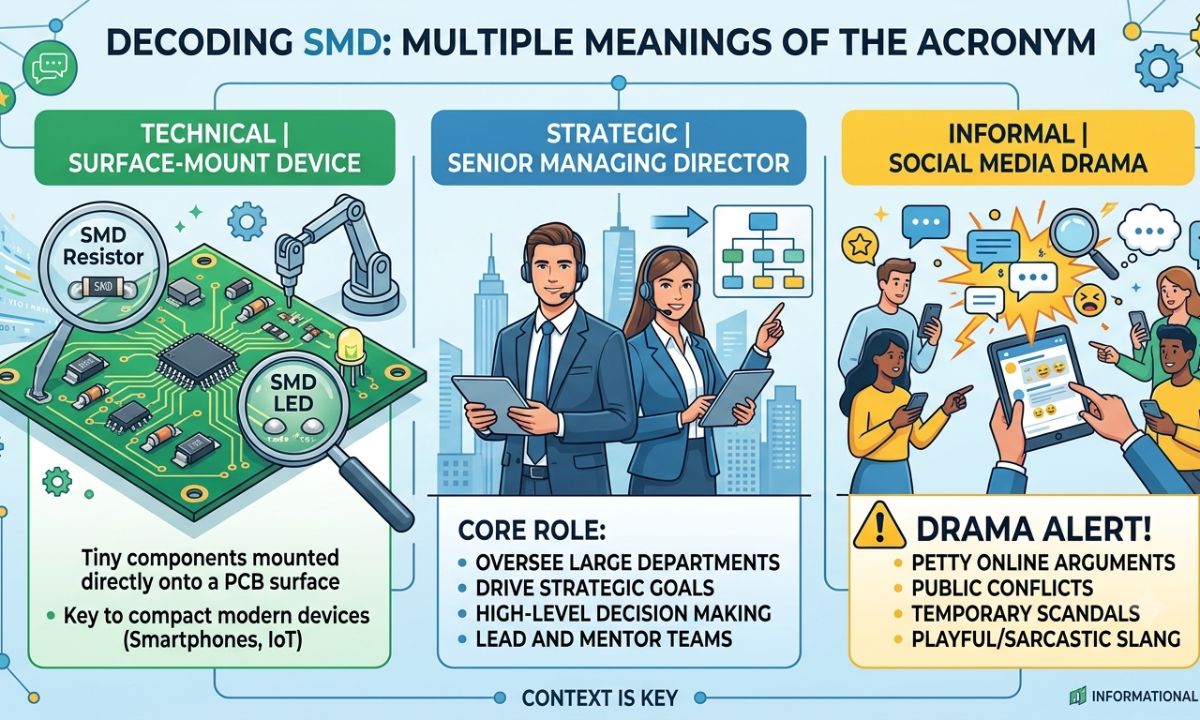
SMD is a short text people use every day. It can mean different things depending on where you see it. In chats and social media, it often has playful or blunt meanings. In medical talk, it means something else entirely.
You may see SMD in a text from a friend, a comment on Instagram, or even a doctor’s note. The same three letters carry different weight in each place. Reading the context helps you understand the real meaning fast.
In casual chat and slang, SMD is often used to express frustration or annoyance. People use it when they are joking around or when they are genuinely upset. The tone of the conversation usually tells you which one it is.
On the medical side, SMD stands for something completely different. Doctors and health sites use it to describe a specific condition. It has nothing to do with texting slang at all.
What is SMD Meaning in the Text?
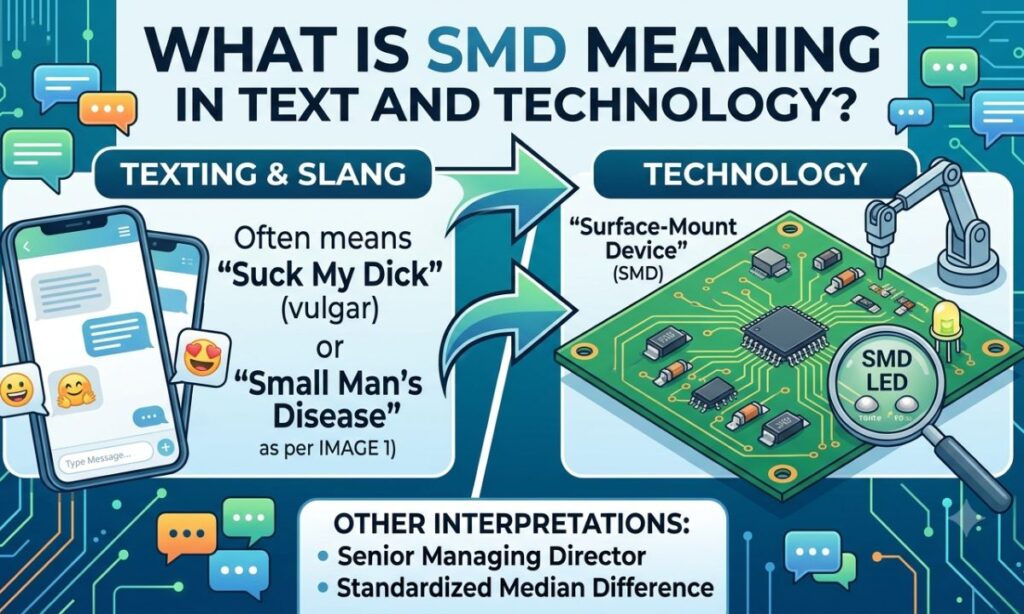
SMD is one of those short text codes that can mean many different things. Most of the time in chats, DMs, and comment sections, SMD stands for “Suck My Dck.”** It is a rude and blunt phrase. People use it to show anger, annoyance, or sometimes even a joke between close friends.
But that is not the only meaning. SMD also shows up in electronics, medical charts, gaming, and even statistics. The letters are the same, but the meaning changes with the topic. This guide explains every version of SMD in simple words, so you never get confused again.
Key Interpretations of SMD in Texting
Here is a quick table so you can see the different meanings at a glance.
| Meaning | Where You See It | Tone |
| Suck My D**ck | Texts, DMs, social media comments | Rude, angry, or joking |
| Surface-Mount Device | Electronics, circuit boards | Neutral, technical |
| Sensory Modulation Disorder | Medical and therapy notes | Neutral, clinical |
| Sega Mega Drive | Gaming forums | Fun, nostalgic |
| Standardized Mean Difference | Research papers, statistics | Neutral, academic |
Pro tip: Always check who sent the text and what you were talking about before you react. The same three letters can mean a video game console or an insult, depending on the group chat.
Example Contexts
Reading the full sentence around SMD tells you almost everything you need to know. Here are a few short examples:
- “SMD, I can’t believe you did that again.” (angry tone)
- “Lol SMD, you’re so annoying 😂” (joking tone between friends)
- “This board uses SMD resistors, not through-hole ones.” (electronics tone)
- “The clinic noted signs of SMD during the sensory evaluation.” (medical tone)
- “I still have my old Sega SMD console in the attic.” (gaming tone)
- “The meta-analysis reported an SMD of 0.5 between the two treatment groups.” (statistics tone)
- “Our team follows an SMD schedule to check the machines every month.” (business tone)
Notice how none of these sentences look alike. That is the biggest clue that SMD is not one single word — it is a shortcut that different groups of people reuse for their own topic. The letters stay the same, but the industry around them changes the meaning completely.
SMD Meaning in Text Slang
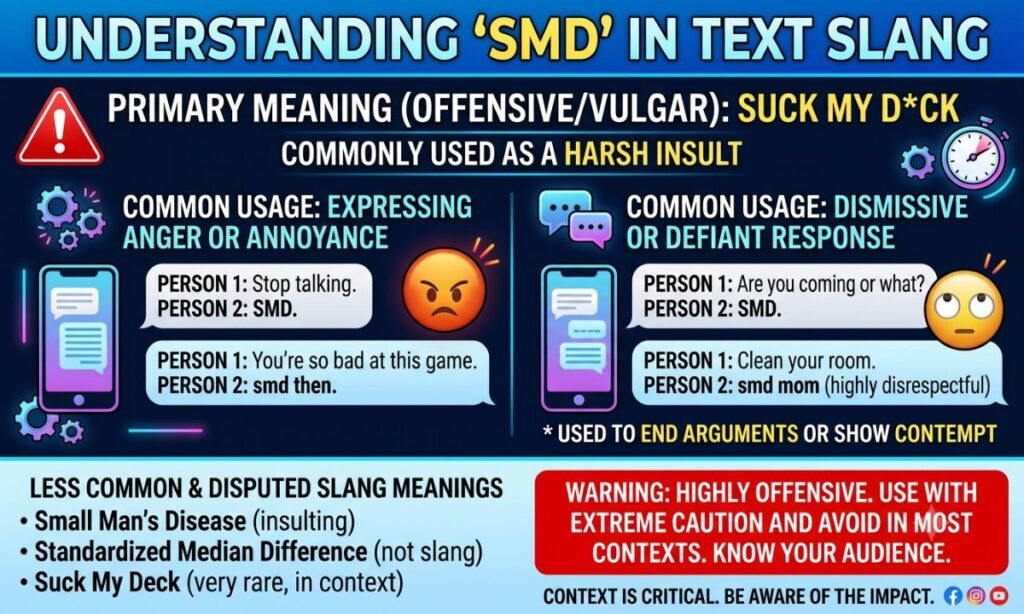
In everyday chat slang, SMD almost always means “Suck My Dck.”** It started as a spoken insult and moved into texting because it is short, sharp, and quick to type.
People use it in a few different ways:
- As an insult — to shut someone down during an argument.
- As a joke — between friends who are just teasing each other.
- As a reaction — to something annoying, unfair, or frustrating.
I have seen this play out in real group chats many times. A friend loses a game and types “SMD” to the whole squad, and everyone just laughs because they know it is not serious. But the same word from a stranger in a comment section usually means real anger. Context is everything with this one.
This slang did not appear overnight. It grew out of the same wave of texting shortcuts that gave us “LOL,” “SMH,” and “IDC.” Back when phones charged by the letter or when typing on small keypads took real effort, people shortened long, harsh phrases into quick letter combos. SMD became one of the sharpest of these shortcuts because it packs a strong reaction into just three characters.
It is also worth knowing that SMD spreads mostly through peer groups, not through official dictionaries. That means its exact “rules” can shift slightly from one friend group, school, or online community to another.
In one Discord server, it might be a normal part of trash talk during a game. In another chat, the same word could start a real fight. This is why paying attention to your specific group’s habits matters more than any general definition.
A few more things to keep in mind about the slang meaning:
- It is considered inappropriate for formal writing, school assignments, or workplace messages.
- Many parents and teachers view it as a red flag when they see it in a child’s messages, since it points to explicit language exposure.
- Some newer texters use it without even knowing the full meaning, simply because they saw it used online and copied the pattern.
- Autocorrect on some phones will not flag or block it, so it appears in texts more easily than people expect.
SMD Meaning in Electronics
In the world of electronics, SMD stands for Surface-Mount Device. This is a completely different, non-offensive meaning used by engineers, hobbyists, and electricians every day.
An SMD component is a tiny electronic part that sits directly on the surface of a circuit board. It does not need long wire legs pushed through holes like older parts did. This makes devices smaller, lighter, and cheaper to build.
Key facts about SMD in electronics:
- SMD parts are used in phones, laptops, TVs, and almost every modern gadget.
- They are placed on boards using machines, which speeds up factory production.
- Common SMD parts include resistors, capacitors, and LED lights.
- SMD technology replaced older “through-hole” parts starting in the 1980s and 1990s.
If you ever open an old radio and a new phone charger side by side, you will notice the difference right away. The old board has big parts with wire legs. The new board is covered in tiny black and silver rectangles — those are SMD parts.
There are several common types of SMD components you might come across if you ever work with circuit boards:
| SMD Component Type | What It Does |
| SMD Resistor | Controls the flow of electric current |
| SMD Capacitor | Stores small amounts of electric charge |
| SMD LED | Produces light, used in screens and bulbs |
| SMD Diode | Allows current to flow in one direction only |
| SMD IC (chip) | Handles processing and logic tasks |
Why engineers prefer SMD parts over older designs:
- They take up much less space on a board.
- They allow machines to place thousands of parts per minute, which speeds up manufacturing.
- They reduce the overall weight of a device, which matters a lot for phones and laptops.
- They tend to perform better at high speeds, which is important for modern processors.
One downside worth mentioning: SMD parts are harder to repair by hand because they are so small. A hobbyist fixing an old through-hole radio can often solder a new part with basic tools.
Fixing a tiny SMD chip on a smartphone board usually needs a magnifying tool, a steady hand, and specialized equipment. This is one reason many repair shops charge more for board-level repairs on modern gadgets.
SMD Meaning in Medical
In healthcare, SMD usually stands for Sensory Modulation Disorder (sometimes also called Sensory Processing Disorder in related discussions). This term describes a condition where the brain has trouble managing information from the senses, like sound, touch, or light.
A person with this condition might feel overwhelmed by noise that does not bother other people. Or they might not notice things that most people would find uncomfortable, like a scratchy tag on clothing.
Key characteristics doctors and therapists look for:
- Strong reactions to sounds, textures, lights, or smells.
- Trouble calming down after being overstimulated.
- Seeking out extra sensory input, like spinning or touching everything.
- Struggling to focus in busy or loud places.
This meaning has nothing to do with the slang version. If you see SMD written in a medical chart, doctor’s note, or therapy report, it is almost certainly about sensory processing, not texting slang.
Sensory Modulation Disorder is often discussed alongside children with autism, ADHD, or developmental delays, though it can also appear on its own. It generally falls into a few patterns:
- Over-responsive: The person reacts strongly to sensory input that most people barely notice, such as tags in clothing, bright lights, or background noise.
- Under-responsive: The person needs a lot more sensory input than usual before they notice or react to it.
- Sensory seeking: The person actively looks for extra stimulation, like touching everything, rocking, or spinning.
How it is usually managed:
- Occupational therapists design activities that help the brain process sensory input more smoothly.
- Parents and teachers often create calmer environments with fewer sudden sounds or bright lights.
- Some children benefit from “sensory diets,” which are planned activities like swinging, deep pressure, or textured play, spread through the day.
If you or someone you know has been told about sensory processing concerns, it is best to speak with a doctor, occupational therapist, or other qualified professional rather than relying only on general articles like this one.
SMD Meaning Text from a Guy
When a guy texts “SMD,” the meaning usually depends on your relationship with him and the mood of the conversation.
- If you are close friends: It is probably a joke or playful trash talk, especially after gaming or teasing.
- If you just argued: It is likely meant as an insult to end the conversation on an angry note.
- If it is flirty banter: Some guys use SMD in a suggestive way, especially in casual or flirty text threads.
Pro tip from real experience: If a guy sends SMD out of nowhere with no context, do not panic right away. Ask yourself what was said right before it. Nine times out of ten, the earlier message explains the tone completely.
A few more signs to watch for when a guy texts SMD:
- Followed by an emoji (😂, 💀, 😏): almost always joking or flirty.
- Sent alone with no punctuation: more likely to be a genuine reaction to something upsetting.
- Sent right after a compliment or inside joke: usually a sign of comfortable, playful teasing.
- Sent after ignoring several of your messages: could signal real frustration, and it may be worth addressing directly instead of guessing.
SMD Meaning in Text from a Girl
The meaning does not really change based on gender, but the reason behind it sometimes does. When a girl texts SMD, it is usually one of these:
- A sharp comeback after being disrespected or annoyed.
- A joking reply in a fun, sarcastic group chat.
- A way to end an argument without writing a long paragraph.
Girls tend to use SMD the same way as guys do — as a short, blunt reaction. The biggest difference is usually the situation that led up to it, not the meaning itself. Always read the full conversation, not just the last message.
If you are unsure how to take it, here is a simple three-step check that works for texts from anyone, regardless of gender:
- Look back at the last two or three messages. What was the topic right before SMD appeared?
- Check for emojis, punctuation, or capital letters. These usually reveal the real emotion behind the text.
- Think about your normal relationship with this person. Do you usually joke around, or is this out of character for them?
Following these three steps will get you the right answer almost every time, without needing to guess or overreact.
When and How to Use SMD?
SMD is a strong word. Even when it is meant as a joke, it can be misread easily over text because there is no tone of voice. Before typing it, think about who is reading it and how well you know them.
Situations Where SMD Might Be Used
- With close friends who use this kind of slang regularly and will not be offended.
- In casual gaming chats where blunt trash talk is normal.
- As a quick reaction to something silly or annoying in a low-stakes conversation.
Situations to Avoid Using SMD
- With coworkers, teachers, or bosses. It can damage your reputation fast.
- With someone you just met. They do not know your sense of humor yet.
- In serious arguments. It usually makes things worse instead of solving anything.
- In public comments or posts. Strangers online cannot read your tone.
- In group chats with mixed audiences, such as family groups or class groups, where not everyone will understand the joke the same way.
- When someone is already upset with you. Adding SMD to a tense conversation almost always makes things escalate faster.
Real-life lesson: A common mistake people make is copying how their friends use SMD and then using it the same way with someone new, like a coworker or a person they just started talking to.
What feels normal in one friend group can come across as shocking or disrespectful to someone outside it. Always test the waters with softer language first before using strong slang like this.
Best Practices for Using SMD
1. If Used Playfully
Keep it light and match the energy. A laughing emoji or a joking reply right after “SMD” shows the other person you are not being serious. Tone markers matter more over text than in person.
2. If Used Aggressively
If you are truly upset, it is usually better to say what is actually bothering you instead of just typing SMD. It feels satisfying for a second, but it rarely fixes the real problem.
3. If You’re Unsure
When you are not sure how someone will take it, do not send it. A short pause before hitting send can save you an awkward conversation later.
Quick Response Guide
If someone sends you SMD, here is a simple way to handle it based on tone:
| Situation | Suggested Response |
| Clearly joking | Laugh it off or joke back |
| Mildly annoyed friend | “Haha okay okay, my bad” |
| Genuinely angry message | Ask calmly what is actually wrong |
| Rude stranger or troll | Ignore it or mute the conversation |
A note on emotional reactions: Getting an SMD text can sting, especially if it comes from someone you care about. It helps to remember that texting removes tone of voice and facial expression completely, so words often land harder than the sender intended.
Before typing an angry reply, it is usually worth taking a short pause, even just thirty seconds, to decide whether the message was meant seriously or not.
Other SMD Meanings
Beyond texting slang, electronics, and medical use, SMD pops up in several other fields. Here is a full breakdown.
Surface-Mounted Device
Already covered above, but worth repeating here since it is one of the most common non-slang meanings. It refers to small parts mounted directly onto circuit boards without wire legs.
Key Points:
- Smaller size than older through-hole parts.
- Used in almost every modern electronic device.
- Made mass production of electronics faster and cheaper.
Smart Motion Detection
Some security camera and smart home brands use SMD to mean Smart Motion Detection. This is a feature that tells the difference between real movement, like a person or car, and false alarms, like moving tree branches.
Features:
- Reduces false alerts on security cameras.
- Uses software to recognize shapes like humans or vehicles.
- Common in doorbell cameras and outdoor security systems.
Sega Mega Drive
Gamers, especially older ones, may use SMD to mean the Sega Mega Drive, a classic gaming console from the late 1980s and 1990s (known as the Sega Genesis in North America).
Key Facts:
- Released by Sega as a rival to the Nintendo Entertainment System.
- Known for games like Sonic the Hedgehog.
- Still loved by retro gaming collectors today.
Social Media D**cheb*g
In some online slang lists, SMD is jokingly expanded to mean Social Media Dcheb*g**, used to describe someone who acts obnoxious or attention-seeking online just to get likes or followers.
Usage Context:
- Used sarcastically to describe influencers or oversharers.
- Mostly seen in comment sections and meme culture.
- Not as common as the main slang meaning.
Sensory Modulation Disorder
Already covered in the medical section above. It describes difficulty processing and responding to sensory information from the environment.
Key Characteristics:
- Over-reaction or under-reaction to sound, light, or touch.
- Often discussed alongside sensory processing differences in children.
- Diagnosed and treated by occupational therapists and specialists.
Strategic Maintenance Development
In some business and industrial settings, SMD can stand for Strategic Maintenance Development, a planning approach used to keep equipment and systems running efficiently over time.
Applications:
- Factory and equipment maintenance planning.
- Reducing downtime in manufacturing plants.
- Long-term asset management strategies.
Standardized Mean Difference
In research and statistics, SMD stands for Standardized Mean Difference. It is a number researchers use to compare results between two groups in a study, even when the groups used different measurement scales.
Key Uses:
- Common in medical and psychological research papers.
- Helps combine results from multiple studies in a meta-analysis.
- Makes it easier to compare study results fairly.
SMD Meaning in Urban Slang
In urban slang and internet culture, SMD is grouped with other short, blunt comebacks like “SMH” (shaking my head) and “IDC” (I don’t care). It is one of the more aggressive ones in this family of text codes.
Unlike softer slang, SMD is meant to hit hard. It works because it is short, easy to type fast during an argument, and instantly understood by most English-speaking texters, especially teens and young adults.
Here is how SMD compares to a few other common text slang terms, so you can see where it fits on the scale of “mild” to “harsh”:
| Slang | Meaning | Tone Level |
| SMH | Shaking my head | Mild disapproval |
| IDC | I don’t care | Mild to moderate |
| GTFO | Get the… out | Moderate to strong |
| SMD | Suck my d**k | Strong, often harsh |
This kind of comparison helps explain why SMD stands out. Words like SMH are safe almost anywhere, even in front of teachers or parents. SMD, on the other hand, sits much closer to the “avoid using it around people you don’t know well” end of the scale.
Being aware of this ranking can help you judge how a message might land before you send it, and how seriously to take it when you receive it.
SMD Meaning Statistics
While there is no single official survey measuring exactly how often each meaning of SMD is used, general search and chat trends show a clear pattern:
- The slang meaning is by far the most searched and most common in everyday texting among teens and young adults.
- The electronics meaning ranks second, mostly searched by students, hobbyists, and people shopping for electronic parts.
- The medical meaning is searched mostly by parents, teachers, and health professionals looking into sensory processing topics.
- Gaming, statistics, and business meanings make up a much smaller share of searches, usually from niche communities.
This pattern shows that the same short code serves very different groups of people, all searching for the same three letters but expecting completely different answers.
A closer look at the research use of SMD: In statistics, the Standardized Mean Difference is especially useful when researchers combine results from several different studies that measured the same idea using different tools.
For example, one study might measure “stress” using a 10-point scale, while another study uses a 100-point scale. The SMD converts both results into a common unit, so scientists can compare them fairly side by side. Generally:
- An SMD around 0.2 is considered a small difference.
- An SMD around 0.5 is considered a medium difference.
- An SMD of 0.8 or higher is considered a large difference.
This makes SMD a small but important tool in fields like medicine, psychology, and education research, even though it looks nothing like the texting slang version on the surface.
Final Words
SMD is a perfect example of how three simple letters can carry many different meanings. In everyday texting, it is usually a blunt or joking way to say “suck my d**k,” and the real meaning always depends on tone and relationship.
Outside of texting, the same letters describe tiny electronic parts, a medical condition, a classic gaming console, and even a term used in research studies. The safest approach is simple: always read the full conversation before reacting, and think twice before sending it yourself, especially with people you do not know well.
Slang like this spreads fast, but understanding it properly helps you avoid awkward mix-ups and respond the right way every time.
FAQs
What does SMD mean in texting?
SMD is a text slang that usually stands for “Suck My D**k.” It’s a blunt phrase people use to show anger, annoyance, or sometimes just playful teasing, depending on who sends it.
Is SMD offensive?
Yes, SMD is considered vulgar and offensive in most settings. It’s fine among close friends who joke around, but it can easily upset someone who doesn’t know you well or reads it as a genuine insult.
Can SMD be used as a joke?
Yes, many friends use SMD as a joke, especially after gaming, teasing, or trash talk. An emoji like 😂 or 💀 right after it usually signals it’s not serious.
What does SMD mean on TikTok?
On TikTok, SMD carries the same slang meaning as in texting. It shows up in comments and captions during jokes, arguments, or reactions to something annoying, so the tone of the video or comment thread tells you how to read it.
What does SMD mean in electronics?
In electronics, SMD stands for Surface-Mount Device. It refers to tiny components, like resistors or LEDs, that sit directly on a circuit board without wire legs, making devices smaller and cheaper to build.
Is SMD appropriate for work?
No, SMD is not appropriate for work. Since it’s rooted in vulgar slang, using it with coworkers, bosses, or clients can come across as unprofessional and disrespectful, even if you meant it as a joke.

Hi, I’m Shahid, a passionate content writer and blogger dedicated to creating easy-to-understand, well-researched, and SEO-friendly content. I specialize in explaining the meanings of words, phrases, names, internet slang, symbols, and everyday expressions in a simple and engaging way.