

You have seen STG in a text or a comment and wondered what it means. You are not alone. Many people see this short word in chats every day. It looks small, but it carries a strong message. Let’s clear it up in simple words.
STG stands for “Swear to God.” People use it to show they are telling the truth. It is a quick way to say, “I am not lying.” You will see it in text messages, Snapchat, Instagram, and TikTok. It is common in casual talk between friends.
In this guide, you will learn the definition of STG and see easy examples you can copy. You will also learn how to use it the right way in your own chats. We will also look at when to avoid it. By the end, you will know exactly how and when to use this texting slang.
What Does STG Mean in Texting?
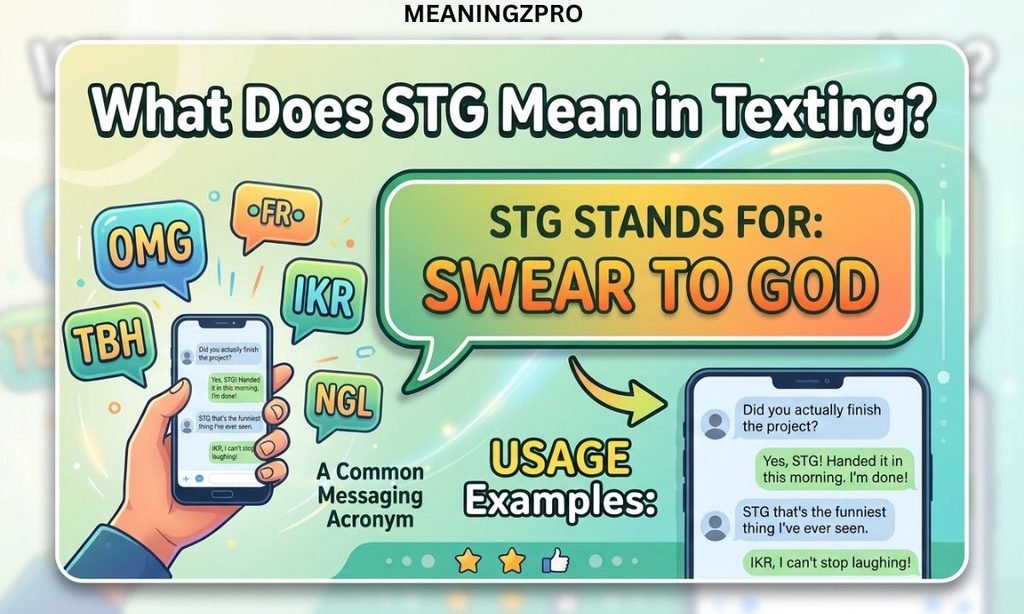
STG means “swear to God.” People type it in text messages and social media chats to show they are serious. It is a fast way to say, “I am telling you the truth,” or “I mean this very strongly.”
Here is a simple example. Your friend texts, “I saw a camel walking on the main road, STG.” Your friend knows the story sounds strange. So the friend adds STG to make you believe it.
STG is informal slang. It belongs in chats with friends, family, and group messages. It does not belong in a job email or a school letter.
Quick answer for fast readers:
- STG = swear to God
- Use = to show honesty, anger, shock, or excitement
- Where = WhatsApp, Snapchat, Instagram, TikTok, Discord, and normal SMS
- Tone = casual, strong, and often emotional
What Does STG Stand for in Texting?
STG stands for three words: Swear To God. The letters come from the first letter of each word. Texters like short forms because they save time and thumb effort.
You may also see small changes in how people write it:
- STG in capital letters
- stg in small letters
- S2G, where the number 2 replaces the word “to”
- Stg. with a full stop at the end
All of these mean the same thing. Capital letters can make the message feel louder, like the sender is raising their voice. Small letters often feel calm and relaxed.
Where Did STG Come From?
People have said “I swear to God” for hundreds of years. It was a way to promise something and prove you were honest. When phones and chat apps became popular, people started cutting long phrases into short codes. “Swear to God” became STG, just like “laugh out loud” became LOL.
The phrase did not become a short code to talk about religion. It became a short code to add power to a sentence. That is why most young texters use it without thinking about the religious side.
What Is the STG Abbreviation Meaning in Simple English?
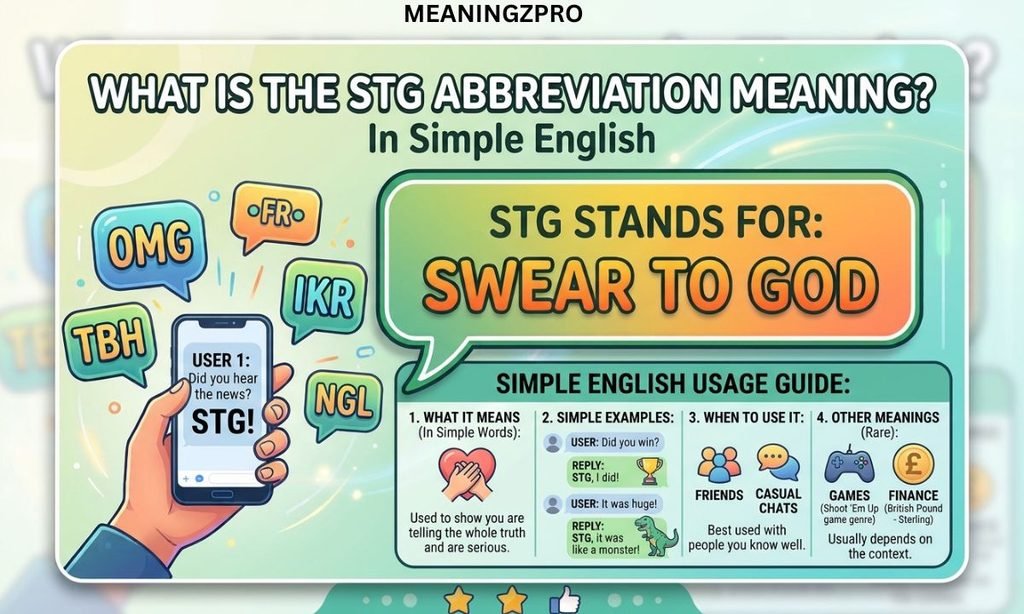
In simple English, STG means “I promise this is true.” It can also mean “I really feel this strongly.”
Think of it like a volume button for your sentence. A normal sentence is at volume 3. A sentence with STG jumps to volume 8.
Look at these two lines:
- “I did not take your charger.”
- “I did not take your charger, STG.”
The second line feels stronger. The sender wants you to trust them.
Pro tip: If you are not sure what a message means, look at the whole sentence. STG alone does not tell the story. The words around it do.
How People Use STG in Text Messages and Social Media

People use STG in many places, and the feeling changes a little in each one. Let’s walk through the most popular apps.
STG in Text Messages and WhatsApp
In normal texts and WhatsApp chats, STG is mostly used between friends and family. People use it to prove a point or to show they are upset.
Real-life style examples:
- “Bro, I reached on time, STG. The traffic was crazy.”
- “STG I told you to bring the keys.”
- “I am so tired, STG. I need a holiday.”
In WhatsApp groups, STG often appears when people argue about a funny story. One person says it happened. Another person says it did not. Then the first person adds STG to win the argument.
Pro tip: In family groups, older relatives may not know this slang. They may also dislike it. If your uncle or aunty is in the group, write the full words or skip it.
STG on Snapchat
Snapchat is fast. People send short messages, quick photos, and funny reactions. STG fits well here because it is only three letters.
On Snapchat, people often use STG with a photo or video:
- A photo of a broken phone with the text “STG it fell from the table”
- A selfie with the text “STG I woke up like this”
- A snap of a long queue with “STG I have been waiting one hour”
Because snaps disappear, people feel free to be dramatic. STG here is often playful and funny, not deadly serious.
STG on Instagram
On Instagram, you will see STG in direct messages, comments, and story replies.
In DMs, it works like a text message. In comments, it often shows excitement or praise. Imagine a friend posts a photo of a delicious cake. Someone comments, “STG this looks better than a bakery cake.” That person is not making a legal promise. They are just showing that they love it.
In story replies, STG shows up when friends react to what you post. It makes the reply feel warm and real.
STG on TikTok
TikTok comments move very fast. People use STG to react to videos, jokes, and stories.
You may see comments like:
- “STG this song is stuck in my head.”
- “I watched this ten times, STG.”
- “STG this happened to me yesterday.”
TikTok creators also use STG in video captions. They say it when they tell a story that sounds hard to believe. It tells the viewer, “Yes, this really happened.”
STG in Gaming Chats and Group Conversations
Gamers type fast. They do not have time for long sentences in the middle of a match. So STG is very handy.
Gaming examples:
- “STG if we lose this round, I am done.”
- “I was not cheating, STG.”
- “STG that player came out of nowhere.”
In voice chat or team chat, STG can show frustration, shock, or a joke. In friendly groups, it makes the chat lively. In a tense match, it can sound angry. So watch the mood of the group before you use it.
Pro tip: In group chats with many people, one strong STG is enough. If everyone types it again and again, the chat starts to feel noisy and hard to read.
STG Meaning in Different Contexts: Honesty, Frustration, and Excitement
STG has one meaning, but it carries different feelings. The feeling depends on the sentence. Let’s look at the three big ones.
STG to Show Honesty
This is the most common use. The sender wants you to believe them.
- “I never saw your message, STG.”
- “I paid the bill yesterday, STG.”
- “I am not lying, STG.”
Here STG works like a promise. The sender wants to clear up a doubt.
STG to Show Frustration
Sometimes STG shows that a person is annoyed or at the end of their patience.
- “STG if this internet goes off again, I will scream.”
- “STG I told you three times already.”
- “STG this bus is always late.”
In these lines, STG is not about the truth. It is about strong feeling. The sender is tired, upset, or fed up.
STG to Show Excitement
STG can also show happy surprise.
- “STG that was the best match ever.”
- “I got the job, STG!”
- “STG this biryani is amazing.”
In happy messages, STG is like saying “wow” or “I can’t believe it.” The emoji and punctuation help you see the mood.
Quick Comparison Table
| Feeling | Example Message | What the Sender Means |
| Honesty | “I did not eat it, STG.” | “Please believe me.” |
| Frustration | “STG this phone hangs every day.” | “I am very annoyed.” |
| Excitement | “STG this view is unreal.” | “I am amazed.” |
| Warning | “STG I will leave without you.” | “I am serious about this.” |
| Joke | “STG my cat understands Urdu.” | “I am being silly.” |
How to Understand STG’s Tone
Text has no voice. You cannot hear a smile or an angry sigh. So you must read clues. Here are five easy clues that help you understand the tone of STG.
- Look at the topic. A message about a funny cat is probably light. A message about a fight is probably heavy.
- Check the emojis. A laughing face means a joke. An angry face means real anger.
- Read the punctuation. Many exclamation marks usually mean excitement. A flat full stop can feel cold.
- Notice the capital letters. “STG” in capitals can feel loud. “stg” in small letters can feel soft.
- Think about the person. Does your friend joke a lot? Or is this person usually calm? Their normal style matters.
A Simple Real-Life Example
Imagine two messages from the same friend:
- “STG I will come on time 😂”
- “STG. I will come on time.”
The first message feels friendly and funny. The second one feels tight and serious. The words are almost the same. The mood is different.
Pro tip: If the tone still feels unclear, ask. A short message like “Are you joking or serious?” saves you from a big misunderstanding.
STG vs. ISTG: What’s the Difference?
These two look almost the same, so people mix them up. The good news is that the difference is tiny.
ISTG Meaning in Text
ISTG means “I swear to God.” It has one extra letter at the front: the letter I.
ISTG is very popular and is often used when someone is frustrated. People like it because it sounds like a full sentence. It starts with “I,” so it feels more personal.
Examples:
- “ISTG if you forget my book again, I will not lend you anything.”
- “ISTG this teacher gives too much homework.”
STG vs. ISTG Examples
Let’s put them side by side.
| Slang | Full Form | Common Feeling | Example |
| STG | Swear to God | Honesty, excitement, anger | “I saw him there, STG.” |
| ISTG | I swear to God | Frustration, warning | “ISTG I will block you.” |
Now let’s see how they work in the same situation.
Situation: Your friend keeps coming late.
- With STG: “STG you are always late.”
- With ISTG: “ISTG you are always late.”
Both lines work. The second one feels a little more personal and a little more annoyed. But most people use them in the same way.
Quick Rule
- Use STG when you want to be quick and casual.
- Use ISTG when you want to sound like you are really losing patience.
Pro tip: You can mix them in different chats. Nobody will count the letters. What matters is the feeling in the sentence.
What About STFG Meaning?
STFG is a stronger and ruder version of STG. It stands for “swear to f***ing God.” The extra word adds anger or shock.
People use it when they are very upset or want to make a very strong point. Because it contains a bad word, it is not good for polite chats.
Here is how the three compare:
| Slang | Strength | Polite Level |
| STG | Medium | Fairly casual |
| ISTG | Medium to strong | Casual |
| STFG | Very strong | Rude, use with care |
Pro tip: Avoid STFG with parents, teachers, bosses, or people you just met. Keep it for very close friends, and only if they are fine with strong words.
STG vs. Other Popular Texting Slang
Texting has many short words that sound like STG. Some also show honesty or strong feeling. Let’s learn the most common ones so you do not mix them up.
ONG Meaning in Text
ONG means “on God.” It is very close to STG. People use it to say, “This is true.” You may see it a lot in rap fans’ chats and among teens.
Example: “That was the best food ever, ONG.”
FR Meaning in Text
FR means “for real.” It is used to agree or to show you mean something. It is lighter than STG. People say “FR?” as a question when they want to know if something is true.
Example: “FR, that movie was boring.”
NGL Meaning in Text
NGL means “not gonna lie.” People use it before they share an honest opinion. It does not promise anything. It just says, “Here comes my honest thought.”
Example: “NGL, I did not like the ending.”
TBH Meaning in Text
TBH means “to be honest.” It works almost like NGL. People use it for honest views, sometimes to be gentle before a hard truth.
Example: “TBH, I think you should call him.”
No Cap Meaning and Cap Meaning in Slang
Cap means a lie. No cap means no lie, or “I am telling the truth.”
- “That test was so hard, no cap.” This means the test was truly hard.
- “He said he ran 20 kilometers. That is cap.” This means you think he is lying.
No cap is very close to STG, but it feels lighter and more playful.
Facts Meaning in Texting
Facts is a short reply that means “That is true” or “I agree.” You can use it when someone says something right.
Example: Your friend says, “Sleep is more important than late-night games.” You reply, “Facts.”
Dead Serious Meaning and Real Talk Meaning
Dead serious means “I am not joking at all.” Real talk means “Let me say something honest and straight.”
- “I am dead serious. I will not come tomorrow.”
- “Real talk, you need to take care of your health.”
Big Comparison Table
| Slang | Meaning | Best Used For | Strength |
| STG | Swear to God | Proving honesty, strong feelings | Medium |
| ISTG | I swear to God | Frustration, warnings | Medium to strong |
| ONG | On God | Truth, strong claims | Medium |
| FR | For real | Agreeing, checking truth | Light |
| NGL | Not gonna lie | Honest opinions | Light |
| TBH | To be honest | Soft honest opinions | Light |
| No cap | No lie | Truth, playful claims | Light |
| Cap | A lie | Calling out a lie | Light |
| Facts | That is true | Agreeing | Light |
| Dead serious | Not joking | Serious points | Strong |
| Real talk | Straight honesty | Honest advice | Medium |
Pro tip: Do not use too many of these in one message. A text like “NGL FR STG no cap that was facts” is confusing. Pick one and keep the message clear.
How to Respond to STG in a Text Message
When someone sends you STG, you do not need a special answer. Just reply based on the situation. Here are ideas for different moods.
Casual Replies to STG
Use these when the chat is relaxed.
- “Okay, I believe you.”
- “Oh wow, really?”
- “Haha, no way!”
- “Got it, thanks for telling me.”
- “That is crazy.”
Funny Replies to STG
Use these only with friends who enjoy jokes.
- “God heard that. Be careful now. 😂”
- “Okay, I will ask the camel too.”
- “Sign it and send it to me, please.”
- “Fine, fine. I will pretend I believe you.”
- “Do you swear on pizza too?”
Mature Replies When Someone Is Serious
When your friend is upset or hurt, a joke can feel unkind. Use calm and caring words.
- “I hear you. Tell me more.”
- “I trust you. What happened?”
- “I am sorry you are going through this.”
- “Thanks for being honest with me.”
- “Let’s talk about it on a call.”
Pro tip: If someone uses STG to defend themselves, do not reply with anger. A calm answer can stop a small fight before it grows.
What If You Don’t Understand STG?
It happens to everyone. New slang appears every year, and nobody knows all of it. Here is what you can do:
- Read the full message again. The other words often explain it.
- Think of “swear to God.” In most chats, that fits.
- Ask the person politely. Type, “What does STG mean?” Most people are happy to explain.
- Check the app and mood. On gaming or social apps, STG almost always means the slang meaning.
Asking is nothing to be shy about. It is better to ask than to guess wrong and reply in a strange way.
Is STG Positive or Negative?
STG is neither good nor bad by itself. It is a booster. It makes the feeling in a sentence stronger.
- Add it to a happy sentence, and the sentence feels happier.
- Add it to an angry sentence, and the sentence feels angrier.
- Add it to a true story, and the story feels more believable.
Here is a short table:
| Sentence | Feeling |
| “STG I love this song.” | Positive |
| “STG I am so tired of this.” | Negative |
| “STG I saw it happen.” | Neutral, shows honesty |
So when you see STG, do not think “bad” or “good” right away. Look at the sentence and decide.
Is STG Considered Rude in Texting?
Usually, no. Most people see it as normal slang. It is not a bad word, and it does not hurt anyone in most chats.
But some situations can make it feel rude:
- You use it with someone older who does not like casual talk.
- You use it in an angry message to push someone.
- You use it with someone who is very religious.
- You use it in a school or work chat.
The words around it also matter. “STG you are lying” feels harsh. “STG this is the best day” feels happy.
Pro tip: If you are unsure how someone feels about the phrase, skip it. A plain sentence like “I promise I am telling the truth” is always safe.
STG and Its Religious Meaning
STG comes from the phrase “swear to God.” That phrase has a religious root. In old days, people called on God as a witness to prove they were honest.
Today, most texters use STG as simple slang. They are not thinking about faith. They only want to say, “I mean it.”
Still, some people feel uncomfortable when God’s name is used in casual talk. For them, using the phrase in a joke can feel disrespectful. This is a fair feeling, and it is good to respect it.
Here is a kind way to handle it:
- If a friend says they dislike it, stop using it with them.
- If you are not sure, use words like “I promise” or “honestly.”
- Think about who is reading your message.
Being kind in chats shows maturity, and people remember that.
Can You Use STG in Professional Communication?
No, it is not a good idea. STG is casual slang. Professional messages need clear and polite words.
Here is why:
- Your boss or client may not know the slang.
- It can sound like you are not serious.
- Using God’s name in a work message may upset someone.
- Formal writing should be simple and respectful.
Compare these two lines:
| Casual (Avoid at Work) | Professional (Better) |
| “I sent the file, STG.” | “I have sent the file. Please check your inbox.” |
| “STG I will finish it today.” | “I will complete it by the end of today.” |
| “STG the client changed the plan.” | “The client has changed the plan.” |
Pro tip: Even in a friendly work chat, keep slang light. If your team uses casual words, copy their style first. Do not be the first one to bring in new slang.
When Is STG Appropriate?
STG works well in the right place. Here is a simple guide.
Good times to use STG:
- Chatting with close friends
- Telling a funny or surprising story
- Reacting to a happy moment
- Joking in a group chat
- Replying to a friend who doubts you
Times to avoid STG:
- Emails to teachers, bosses, or clients
- Messages to strangers
- Serious talks with family elders
- Sad or sensitive conversations
- Any place where people may feel upset by the phrase
A quick test helps: “Would I say this out loud to the person?” If you would say “I swear to God” to them in person, STG is fine in a text.
Other Meanings of STG You May See
In texting and social media, STG means “swear to God” almost every time. But the same letters can appear in other fields. This is rare in chats, yet it helps to know.
- In money talk, STG can be short for sterling, the British pound. You may see it next to a price or in a money record.
- In some work and school papers, STG can be short for words like “stage” or “short-term goal.” The setting makes it clear.
If you see STG in a chat with friends, it is the slang meaning. If you see it in a bank paper, price list, or report, it is probably one of these other meanings.
Common Mistakes When Interpreting STG
Many people read STG the wrong way. Let’s fix the five biggest mistakes.
Assuming STG Always Means Anger
Some people think STG is always an angry word. That is not true. It can show anger, but it can also show joy, surprise, or honesty.
Check the sentence. “STG I won the match!” is clearly happy. Do not read anger into it.
Assuming STG Guarantees the Truth
When someone writes STG, it does not prove they are right. People can use it even when they are exaggerating or joking. It shows that the sender feels sure. It does not show that the facts are correct.
If something important depends on the message, check it yourself. Ask for proof, a photo, or a call.
Confusing STG With ISTG
STG and ISTG mean almost the same. The only difference is the word “I.” Some people think they are two completely different phrases. They are not. Both come from “swear to God,” and both are used in much the same way.
Assuming Every Platform Has a Different Definition
Some people believe STG means one thing on Snapchat and another on TikTok. This is not true. The meaning is the same on WhatsApp, Instagram, Snapchat, TikTok, Discord, and regular texts. What changes is the style and mood of the chat, not the meaning.
On Snapchat it may feel playful. In a gaming chat it may feel heated. But the words still mean “swear to God.”
Using STG in Every Message
Some people add STG to every sentence. This is a mistake for two reasons.
First, it makes you sound less honest. If you “swear” about everything, people stop taking it seriously.
Second, it makes your chat hard to read. Short, clear messages are better than messages full of slang.
Pro tip: Save STG for the moments that matter. A rare STG hits harder than a hundred of them.
Final Words
Now you know what STG means in texting. It stands for “Swear to God.” People use it to show they are serious and honest. It is a short and fast way to stress the truth. That is why it is so common in chats today.
You also saw how to use it with simple examples. It works best in casual talk with friends and family. You can use it on Snapchat, Instagram, TikTok, and in text messages. Keep it light and natural. Do not use it too often, or it may lose its power.
Remember to think about tone and audience before you type it. Some people may find it too strong or not polite. Skip it in work chats and formal emails. Now you can use this texting slang with full confidence. Share this guide with a friend who still asks, “What does STG mean?”
FAQs
Is it I STG or ISTG?
The correct short form is ISTG, which means “I swear to God.” “I STG” is not a standard form, and you can simply use STG if you want it shorter.
What is STF in chat?
STF is usually a rude short form of “shut the f***,” taken from STFU. It is not very common, so check the tone and the chat before you reply.
What does SGT mean in texting?
SGT most often means sergeant, a rank in the army and police. In a casual chat, it can also be a typing mistake for STG (swear to God).
What does STG mean in medical terms?
In patient care notes, STG usually means short-term goal. It is a small target a patient should reach soon, and it has nothing to do with slang.
What does TSF mean in text?
TSF is not a standard slang word with one fixed meaning. It is often a typo (like TFS, “thanks for sharing”), so read the full message or ask the sender.
What is STF in slang?
In slang, STF mostly means “shut the f***,” a strong and rude phrase. Avoid it in polite chats, and do not mix it up with STG.
Is ISTG Gen Z slang?
ISTG is popular with Gen Z, but it is not new, because people have used “I swear to God” in chats for many years. Teens and young adults use it the most, and millennials use it too.
What does S2G mean in text?
S2G means “swear to God,” where the number 2 stands for the word “to.” It means the same as STG, but it looks a bit more old-school.
What is STG fr fr?
STG fr fr means “swear to God, for real, for real.” The double “fr” adds extra emphasis, so the sender wants you to know they are very serious.

Hi, I’m Shahid, a passionate content writer and blogger dedicated to creating easy-to-understand, well-researched, and SEO-friendly content. I specialize in explaining the meanings of words, phrases, names, internet slang, symbols, and everyday expressions in a simple and engaging way.